
ARRT Vascular Interventional Practice Exam
$69.00
- Buy to unlock unlimited access to all Quiz questions.
- After purchase you can print a PDF of the whole quiz at any point. The PDF will contain the questions and the correct answers.
About this Exam
The ARRT Vascular Interventional (VI) certification is a prestigious post-primary credential for Registered Radiologic Technologists (R.T.s). This specialized designation validates advanced knowledge and clinical skills in the demanding field of Interventional Radiology (IR). The certification is designed for technologists who have already demonstrated competency in radiography and wish to specialize in minimally invasive, image-guided procedures. Achieving the R.T.(VI) credential signifies to employers and colleagues that you possess a high level of expertise in vascular anatomy, procedural protocols, patient care, and safety specific to complex interventional techniques. High-quality practice exams are an indispensable part of your preparation, allowing you to identify knowledge gaps and build confidence before the official testing day.
Ready to test your knowledge?
Buy Now to Access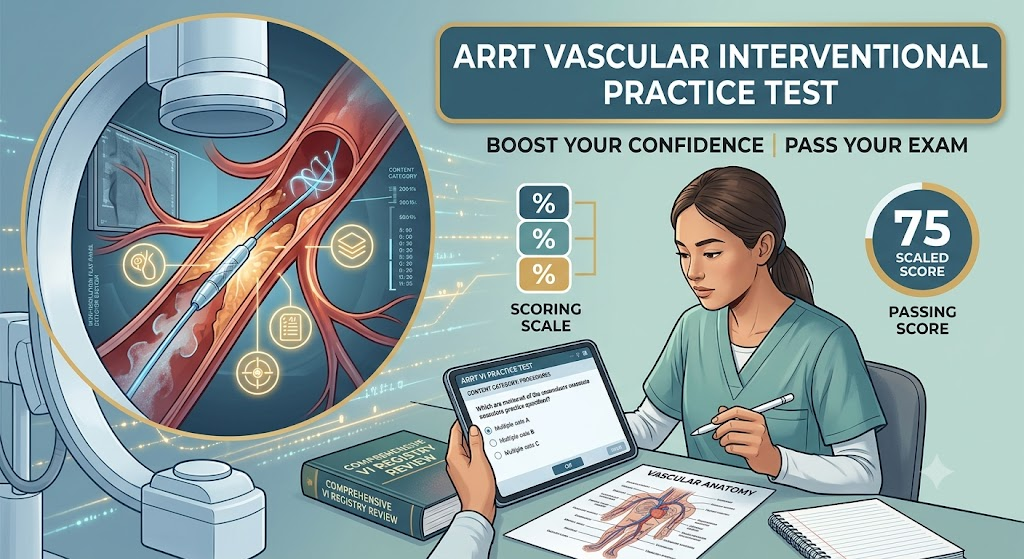
Additional Information
What the Course Entails and Exam Details
Preparing for the ARRT VI exam involves mastering a vast range of theoretical concepts and clinical applications, which you can refine through comprehensive practice material. The exam is structured around specific content areas, as defined by the current ARRT Content Specifications.
Core Topics and Scored Question Breakdown (Approximate):
Patient Care (22 questions): Focuses on patient interactions, management, assessment, pre- and post-procedural care, and monitoring. Topics include understanding lab values, managing medications, contrast media, and proper aseptic technique.
Image Production (26 questions): Covers imaging equipment, image acquisition, and processing, with a heavy emphasis on digital image systems and techniques, including automatic exposure control and flat-panel detectors. It also covers quality control and radiation safety.
Procedures (112 questions): This is the largest and most detailed section. It includes both vascular diagnostic and interventional procedures. Expect questions on vascular anatomy, physiology, and pathology. You will be tested on detailed procedural steps, equipment (e.g., catheters, wires, stents, filters), and interventional techniques for various body systems (e.g., neurological, peripheral, visceral, cardiovascular). It also covers non-vascular interventional procedures like drainage and biopsies.
The "course" you entail isn't a single class, but a combination of study from multiple sources and extensive clinical experience, all of which are essential to confidently answering questions on a practice exam.
What to Expect in the Final Exam
The actual ARRT VI certification exam is a computer-based test (CBT) administered at highly secure testing centers. Being familiar with its format through practice exams is crucial for your performance on the actual day.
Format: The exam consists of standard multiple-choice questions and potentially other innovative formats, such as select all that apply, hot-spot, or drag-and-drop. In total, the exam contains 210 questions: 160 scored questions and 50 unscored pretest questions (which do not affect your final score).
Passing Score: You need a scaled score of 75 or higher to pass. Note that a scaled score is not a direct percentage; it is a score between 1 and 99 that accounts for the difficulty of your specific exam version. The number of correct answers needed will vary.
Time Limit: You are given 3.5 hours to complete the test questions. The entire appointment, including a tutorial and a non-disclosure agreement, will be closer to 4 hours.
Specific Rules: All ARRT exams must be scheduled through Pearson VUE professional test centers. You are allowed three attempts within a three-year period, starting from the time of your first application. Proper identification is required for entry, and strict rules regarding personal items are enforced.
How to Study and Exam Centers
Effective preparation is key to succeeding on the ARRT VI exam, which many consider one of the more challenging post-primary exams. Here are actionable strategies:
Use the ARRT Content Specifications as Your Roadmap: Download and print the current "ARRT Vascular Interventional Content Specifications." Treat this as your primary study guide, checking off every topic as you review it. All exam questions are directly linked to these objectives.
Review Multiple Resources: Don't rely on just one book. Use popular review books specifically designed for the VI exam, relevant chapters from advanced radiography textbooks, official position statements from professional organizations, and guidelines from equipment manufacturers.
Leverage Practice Exams and Question Banks: High-quality ARRT VI practice exams are your best tool for active learning. They simulate the real test environment, time pressure, and question difficulty. Look for practice material with detailed explanations for both correct and incorrect answers. Utilize techniques like spaced repetition (reviewing difficult topics at increasing intervals) and active retrieval (testing yourself frequently).
Focus on Anatomy and Procedures: Spend extra time on detailed anatomy, especially the vascular pathways of the whole body, and the specifics of interventional procedures. Practice mentally visualizing each step and the relevant equipment.
Integrate Clinical Experience: Connect your studying with your daily work in the IR lab. Ask your preceptors and radiologists questions. Participate in as many types of cases as possible to gain practical understanding of the equipment and steps you are studying.
Exam Centers: The final ARRT VI certification exam is administered at Pearson VUE professional test centers worldwide. Pearson VUE maintains thousands of locations, allowing you to choose a center and time that is convenient for you. You must schedule your exam well in advance through your ARRT online account and then select your location and time slot on the Pearson VUE website.
Job Opportunities from the Course
Obtaining your R.T.(VI) credential opens doors to advanced clinical roles and can lead to significant career advancement within interventional radiography. Below is a list of job opportunities and career paths unlocked by this certification:
Vascular Interventional Technologist (R.T.(VI))
Interventional Radiology (IR) Technologist
Special Procedures Technologist
Chief/Lead Interventional Radiology Technologist
Vascular Specialist (in a healthcare system)
Interventional Radiology Clinical Educator
Imaging Department Manager, Interventional Services
The VI certification not only demonstrates clinical excellence but also indicates leadership potential, making it a critical step for technologists aspiring to advance into lead roles, educational positions, or management in specialized imaging departments. We wish you the very best in your preparation for the ARRT Vascular Interventional Practice Exam and your journey to this powerful credential.
Frequently Asked Questions
Reviews
5.0
Based on 0 reviews
Leave a Review
No reviews yet. Be the first to review!