
ARRT Nuclear Medicine Practice Test
$69.00
- Buy to unlock unlimited access to all Quiz questions.
- After purchase you can print a PDF of the whole quiz at any point. The PDF will contain the questions and the correct answers.
About this Exam
The ARRT Nuclear Medicine Technology (R.T.(N)) certification is a prestigious credential offered by the American Registry of Radiologic Technologists. It is designed for medical imaging professionals who specialize in the administration of radiopharmaceuticals for diagnostic and therapeutic purposes. This certification verifies that a technologist has mastered the necessary knowledge, skills, and ethical understanding to safe and effectively perform complex nuclear medicine procedures. For aspiring nuclear medicine technologists, a strong "ARRT Nuclear Medicine Practice Test" is an essential component of their preparation strategy.
Ready to test your knowledge?
Buy Now to Access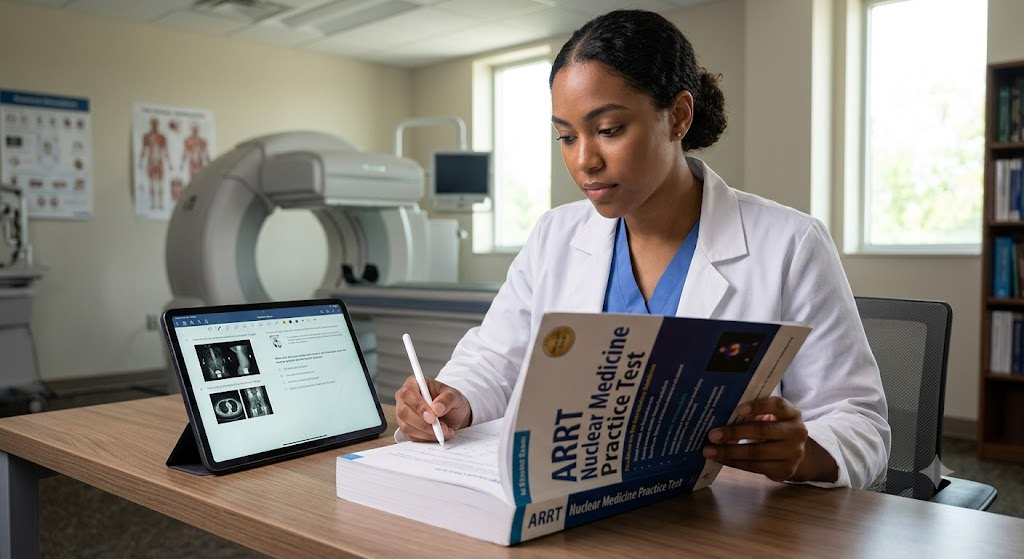
Additional Information
What the Course Entails and Exam Details
This examination is not derived from a single course, but rather serves as a comprehensive assessment of the candidate's formal education in nuclear medicine technology. The study material and the corresponding "ARRT Nuclear Medicine Practice Test" content mirror the major domains of the actual ARRT (NMT) certification exam.
These essential content domains include:
Patient Care: This section covers patient interaction, preparation, physical assistance, and monitoring, as well as ethical and legal requirements in a healthcare setting.
Safety: This critical area focuses on radiation physics, biology, and protection principles for both the patient and the personnel, including proper handling of radiopharmaceuticals.
Image Production: Candidates are tested on the principles of nuclear medicine instrumentation (such as gamma cameras and PET scanners), quality control procedures, image acquisition, and processing techniques.
Procedures: This is the largest portion of the exam, covering specific diagnostic and therapeutic protocols for various body systems, including skeletal, cardiovascular, endocrine, and oncology studies.
What to Expect in the Final Exam
When you sit for the actual ARRT Nuclear Medicine Technology certification exam, you are taking a rigorous, computer-based test that is precisely defined. The examination currently consists of 200 scored multiple-choice questions, along with approximately 30 unscored "pretest" questions that do not count toward your final score.
You will have a maximum of four hours of testing time, with a total appointment length of about 4.5 hours to accommodate introductory tutorials, non-disclosure agreements, and exit surveys.
The ARRT does not use a raw percentage to determine passing. Instead, it employs a scaled scoring system with a range from 1 to 99. To achieve a passing status and earn your credential, you must obtain a scaled score of 75 or higher. You will receive a preliminary pass/fail indication at the test center, but your official, detailed score report will be sent to you later by mail.
How to Study and Exam Centers
Preparation is the key to success. A successful study plan should combine multiple resources, but a robust "ARRT Nuclear Medicine Practice Test" is often cited as one of the most effective tools. It allows you to simulate the exam experience, identify knowledge gaps, and become familiar with the style and difficulty of ARRT questions.
Actionable study strategies:
Utilize Official ARRT Resources: Begin with the content specifications and task inventory directly from the ARRT website.
Engage with Practice Tests: Regularly use a structured, comprehensive "ARRT Nuclear Medicine Practice Test" to build stamina and confidence. Focus on the rationales for both correct and incorrect answers.
Review Textbooks and Course Material: Revisit your original textbooks and notes from your accredited nuclear medicine technology program.
Consider a Review Course: Many professionals find value in enrolling in a formal review course to consolidate their learning.
The actual ARRT Nuclear Medicine Technology exam is administered exclusively through Pearson VUE professional testing centers. These centers are located worldwide, ensuring a secure and standardized environment for all candidates. You must schedule your specific exam date and time through the Pearson VUE system after receiving your authorization to test from the ARRT.
Job Opportunities from the Course
Obtaining your ARRT (R.T.(N)) certification unlocks a clear career path and demonstrates to employers your high level of competence in the field. This credential is often mandatory or highly preferred for positions in hospitals, imaging centers, and specialized medical clinics.
The certification directly prepares and qualifies you for job titles such as:
Nuclear Medicine Technologist
PET/CT Technologist
Cardiac Stress Technologist
Nuclear Cardiology Technologist
Lead Nuclear Medicine Technologist
Frequently Asked Questions
Reviews
5.0
Based on 0 reviews
Leave a Review
No reviews yet. Be the first to review!