
ARRT Fluoroscopy Practice Exam
$69.00
- Buy to unlock unlimited access to all Quiz questions.
- After purchase you can print a PDF of the whole quiz at any point. The PDF will contain the questions and the correct answers.
About this Exam
The ARRT Fluoroscopy Practice Exam is a specialized tool designed to help Radiologic Technologists (RTs) prepare for examinations related to fluoroscopy. In many states, a specific Fluoroscopy Permit is required to operate fluoroscopic equipment beyond basic supervision. The actual exam, often developed by the American Registry of Radiologic Technologists (ARRT) or state licensing boards, assesses a technologist’s readiness to perform these procedures safely and effectively. This practice exam simulates the content and format of the real test, allowing you to gauge your knowledge, identify weak areas, and build confidence before the official assessment. It's essential for RTs pursuing state-specific fluoroscopy credentials and aiming for career growth.
Ready to test your knowledge?
Buy Now to Access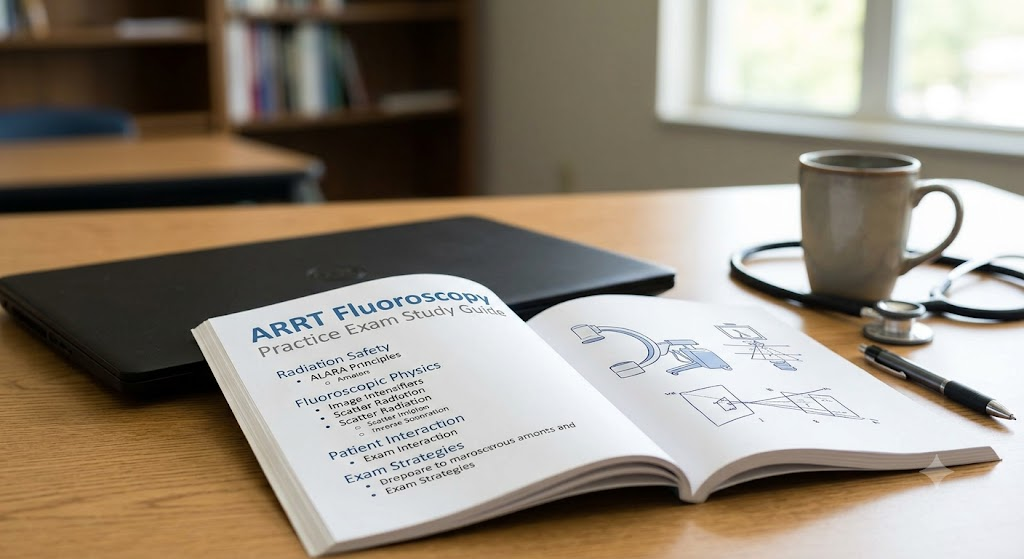
Additional Information
What the Course Entails and Exam Details
This comprehensive course or study guide typically covers all critical knowledge areas relevant to the fluoroscopy examination. The actual exam, which this practice test reflects, includes a broad range of topics fundamental to a competent operator. Key content areas typically include:
Fluoroscopic Equipment: Understanding the operation, components (X-ray tubes, image intensifiers, digital detectors), and advanced features (pulsed fluoroscopy, automatic brightness control).
Radiation Production and Safety: Knowledge of X-ray principles, patient and staff dose minimization, protective devices (lead aprons, shields), monitoring, and regulatory limits.
Image Quality: Principles of spatial resolution, contrast, noise, and geometric factors in fluoroscopic imaging, including digital subtraction and advanced techniques.
Patient Care and Procedures: Proper positioning, contrast media administration, patient preparation, and understanding specific fluoroscopic procedures (GI studies, angiography, interventional cases).
Regulations and Ethics: Current laws, standards of practice, and ethical considerations for the safe and appropriate use of fluoroscopy.
By using the ARRT Fluoroscopy Practice Exam, you are practicing in these key areas.
What to Expect in the Final Exam
The official ARRT-developed state licensing exams for fluoroscopy are typically administered in a secure, computer-based format. While the exact number of questions can vary by state and version, they often feature around 100 to 150 multiple-choice questions. You should expect a mix of recall-based questions on core concepts, as well as application-oriented questions that require using your knowledge to solve clinical scenarios.
The time limit is generally set to allow a reasonable pace, often in the range of 2 to 3 hours. Passing score requirements are determined by each state licensing agency, but a score around 70-75% is common. The environment is highly professional and supervised, similar to the initial ARRT registry exams. The ARRT Fluoroscopy Practice Exam is designed to emulate these conditions and questioning styles, providing a realistic assessment.
How to Study and Exam Centers
Effective preparation is the key to success on the actual exam. Start by carefully reviewing all official state regulations and specific content blueprints provided by your state's licensing board. Utilize comprehensive study materials, such as leading textbooks on radiologic science and fluoroscopy (e.g., those by Bushong or Fauber). Join study groups with fellow RTs or consider enrolling in specialized review courses. The ARRT Fluoroscopy Practice Exam itself should be a central part of your strategy, taken multiple times to track progress and refine your understanding. Treat each practice session like the real exam.
The official exams are usually not taken online at home but at designated physical testing locations. Common exam administrators for state permits include Pearson VUE, Prometric, or specific state-authorized testing centers and schools. Once you have applied and been approved by your state, you will be able to schedule your exam at a convenient center. Ensure you are familiar with the location and required identification before test day. The practice exam, conversely, can be accessed through specific online study platforms or providers.
Job Opportunities from the Course
Obtaining a state Fluoroscopy Permit can lead to specialized roles and professional advancement, including:
Cardiac Catheterization Lab Technologist
Interventional Radiology Technologist
Angiography Technologist
Special Procedures Technologist
Lead Fluoroscopy Technologist
Advanced Practice Radiologic Technologist (typically requires further education)
Surgical Technologist in Hybrid Operating Rooms
Electrophysiology (EP) Lab Technologist
Education and Training roles specializing in Fluoroscopy
Frequently Asked Questions
Reviews
5.0
Based on 0 reviews
Leave a Review
No reviews yet. Be the first to review!