
Arizona State University (ASU) HEP100 Introduction to Health and Wellness Final Practice Exam
$69.00
- Buy to unlock unlimited access to all Quiz questions.
- After purchase you can print a PDF of the whole quiz at any point. The PDF will contain the questions and the correct answers.
About this Exam
Welcome to the ultimate guide for the Arizona State University (ASU) HEP100 Introduction to Health and Wellness Final Practice Exam. This course is a foundational cornerstone for students exploring the dynamic fields of health sciences, kinesiology, and public health. Whether you are a declared major or fulfilling a general studies requirement, HEP100 is designed to equip you with essential, evidence-based knowledge to make informed decisions about your personal well-being and understand the broader spectrum of public health issues. This practice exam is your crucial first step toward mastering the material and achieving academic success.
Ready to test your knowledge?
Buy Now to Access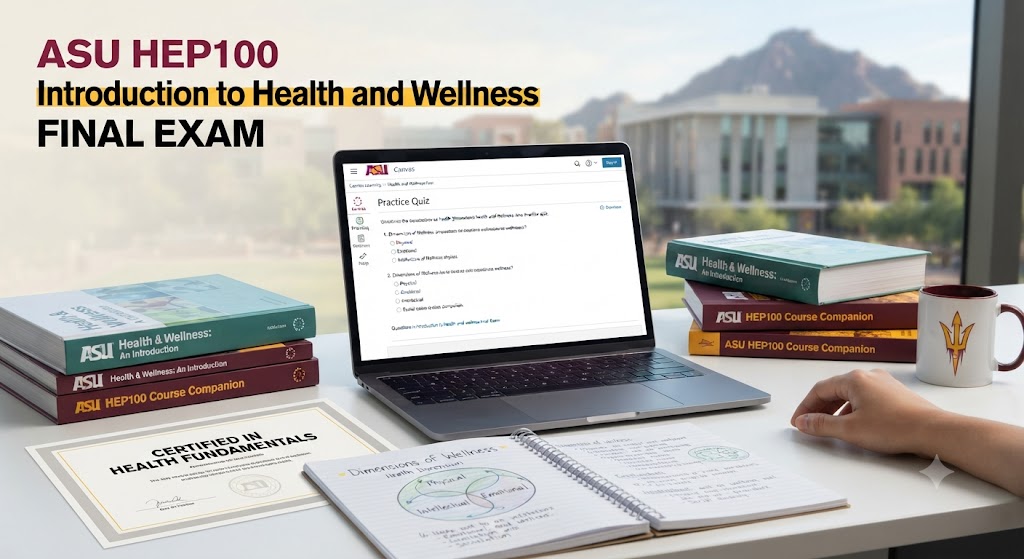
Additional Information
What the Course Entails and Exam Details
The ASU HEP100 curriculum is a comprehensive journey through
the multifaceted world of health and wellness. It moves beyond simple
definitions of physical fitness to embrace a holistic view of health.
The course typically covers the following core pillars:
- Dimensions
of Wellness: Understanding the interconnectedness of physical,
emotional, intellectual, spiritual, social, and occupational well-health.
- Behavior
Change Models: Learning how to implement lasting, positive health
behaviors using established psychological frameworks.
- Nutrition
and Physical Activity: The science of macronutrients, micronutrients,
energy balance, and the principles of designing a safe and effective
exercise program.
- Chronic
Disease Prevention: Identifying risk factors for major lifestyle
diseases, including cardiovascular disease, diabetes, and cancer.
- Stress
Management: Recognizing stressors and developing healthy coping
mechanisms.
- Substance
Use and Abuse: The physiological and psychological impacts of alcohol,
tobacco, and other drugs.
- Sexual
Health: Understanding reproductive health, contraception, and sexually
transmitted infections (STIs).
The final exam is cumulative, meaning it will test your
comprehensive understanding of all these modules. You will be expected to
recall definitions, apply concepts to real-world scenarios, and analyze health
data or case studies.
What to Expect in
the Final Exam
To succeed, you must know the rules of engagement. While
specific details can vary slightly by semester and instructor (always verify
the syllabus), the ASU HEP100 final exam generally adheres to the following
structure:
- Exam
Format: The exam is almost exclusively composed of objective
questions. This includes multiple-choice questions (often scenario-based),
true/false statements, and occasionally matching sections.
- Number
of Questions: The exam typically contains between 100 and 150
questions.
- Time
Limit: Students are usually given a set time limit, commonly 120
minutes (2 hours), which is ample time if you are well-prepared.
- Passing
Score: A passing score is generally defined as 70% or higher, though
this can be adjusted based on the instructor's grading curve.
- Location
and Proctoring: For most ASU Online or large-lecture in-person
sections, the final exam is administered online through the Canvas
learning management system. It is heavily proctored, often using services
like Honorlock, which requires a webcam, microphone, and a secure browser.
You will need a valid photo ID.
How to Study and
Exam Centers
Preparing for a comprehensive exam can be daunting, but a
strategic approach will make the material manageable. Here are actionable study
steps:
- Review
All Module Quizzes: This is your best resource. Go back and retake
every quiz from the semester. If you get a question wrong, understand why
it is wrong and why the correct answer is right. Instructors often
draw heavily from the quiz question bank.
- Analyze
the Learning Objectives: Before diving into your notes for a chapter,
read the learning objectives provided in the syllabus or at the start of
each module. If you can confidently explain each objective, you know the
material.
- Create
Concept Maps: Health and wellness are interconnected. Create visual
maps linking topics. For example, connect "Stress" to
"Cardiovascular Disease Risk," "Cortisol Production,"
and "Coping Mechanisms like Exercise."
- Utilize
the Practice Exam: Treat this practice exam as the real thing. Take it
in a quiet room, without notes, and under timed conditions. Afterward,
review every question, especially the ones you guessed on.
- Focus
on Terminology: Create flashcards for key terms. You cannot answer
scenario-based questions correctly if you do not understand the
foundational vocabulary.
Exam Centers: As noted, the exam is typically taken
online using a proctoring service like Honorlock. You do not need to travel to
a physical testing center unless you have specific accommodations arranged
through ASU’s Student Accessibility and Inclusive Learning Services (SAILS).
Ensure your computer meets all technical requirements well before exam day.
Job Opportunities
from the Course
While HEP100 is an introductory course, it lays the vital
groundwork for numerous rewarding careers. This course demonstrates your
foundational knowledge in health promotion and disease prevention.
This certification/course unlocks pathways to careers such
as:
- Health
Educator/Community Health Worker: Teaching individuals and communities
about healthy behaviors.
- Wellness
Coach: Guiding clients in setting and achieving personal health goals.
- Corporate
Wellness Coordinator: Designing programs to improve the health of
employees.
- Fitness
Specialist/Personal Trainer: Creating and leading exercise programs
(requires further specialized certification).
- Public
Health Assistant: Supporting public health initiatives and research.
- Non-profit
Health Program Administrator: Managing programs for health-focused
organizations.
Furthermore, HEP100 is a prerequisite for advanced degrees
in Nursing, Nutrition, Kinesiology, and Health Policy, which lead to careers as
Registered Dietitians, Nurse Practitioners, and Physical Therapists.
Frequently Asked Questions
Reviews
5.0
Based on 0 reviews
Leave a Review
No reviews yet. Be the first to review!