
Arizona State University (ASU) HCR240 Human Pathophysiology Test 1 Practice
$69.00
- Buy to unlock unlimited access to all Quiz questions.
- After purchase you can print a PDF of the whole quiz at any point. The PDF will contain the questions and the correct answers.
About this Exam
What the Course Entails and Exam Details
ASU’s HCR240 course is structured to provide a comprehensive
overview of the pathophysiology of common diseases affecting the human body
across the lifespan. The curriculum typically begins with fundamental concepts
that apply to multiple systems before diving into specific disease processes.
Test 1 generally covers the first several modules or
chapters of the course. You can expect the material to focus heavily on these
core areas:
- Cellular
Injury and Adaptation: Understanding how cells respond to stress, injury,
and aging (e.g., atrophy, hypertrophy, hyperplasia, metaplasia, dysplasia,
and necrosis vs. apoptosis).
- Inflammation
and Tissue Repair: The complex sequence of events in acute and chronic
inflammation, the role of chemical mediators, and the process of wound
healing.
- Genetics
and Disease: Basic principles of inheritance, chromosomal disorders,
and the role of genetics in disease susceptibility.
- Fluid,
Electrolyte, and Acid-Base Imbalances: A crucial section covering the
movement of fluids, the role of electrolytes (sodium, potassium, calcium),
and mechanisms regulating pH balance in the body.
- The
Immune System: An introduction to the innate and adaptive immune
responses, hypersensitivity reactions, and autoimmunity.
- Infection:
Basic concepts of microbiology, mechanisms of microbial pathogenesis, and
the body’s defense mechanisms.
Test 1 is designed to test your ability to recall key
definitions and, more importantly, to apply these concepts to clinical
scenarios. For example, instead of just defining inflammation, you may be asked
to identify the clinical manifestations of acute inflammation in a patient
scenario.
What to Expect in the Final Exam
While this guide focuses on Test 1, it is important to
understand the context of the final examination, as Test 1 establishes the
foundation upon which the rest of the course is built.
For ASU HCR240, exams are typically administered either in
person within a testing center or remotely using online proctoring services
(like Honorlock or Respondus Monitor), depending on the specific section of the
course you are enrolled in (e.g., ASU Online vs. on-campus immersion).
- Exam
Format: Test 1 is usually composed of a combination of question types
designed to assess both knowledge and application. This typically
includes:
- Multiple
Choice (the most common format)
- Multiple
Select (select all that apply)
- True/False
- Matching
- Short
Answer or fill-in-the-blanks (less common, but possible for key terms)
- Number
of Questions: Test 1 often contains between 50 and 100 questions,
depending on the instructor and the length of the testing window.
- Time
Limit: You will generally be given a strict time limit, often ranging
from 60 to 90 minutes. This means you need to be prepared to answer
questions efficiently.
- Passing
Score: While a passing score for an individual test may vary, a
"C" grade (70% or higher) is typically required to pass the
overall course and progress in your health-related major.
Specific rules for the exam often include the requirement
for a quiet, well-lit environment, a mandatory room scan, and the prohibition
of unauthorized materials, notes, or communication with others.
How to Study and Exam Centers
To succeed on ASU HCR240 Test 1, a passive review of the
textbook will not be sufficient. You need an active, engaged study strategy.
Actionable Study Strategies:
Master the Vocabulary:
Pathophysiology is like learning a new language. Create flashcards for every
key term in the assigned chapters. Do not just memorize the definition;
understand the concept. Use the "Feynman Technique": Try to explain
the term or process (e.g., "osmosis" or "the complement
system") simply, as if teaching it to someone else. If you get stuck, you
haven't mastered it yet.
Utilize Concept Maps: This
is one of the most effective study tools for pathophysiology. Create a diagram
showing the cause-and-effect relationships of a disease process. For example,
start with "Hypoxia" and branch out to show its effect on ATP
production, the failure of the Na+/K+ pump, cellular swelling, and eventually
cell death.
Apply Concepts to Clinical
Scenarios: As you read about inflammation or fluid imbalances, constantly
ask yourself, "What would this look like in a patient?" If a patient
has hypokalemia, what symptoms (e.g., muscle weakness, arrhythmias) would I
expect to see? This connects theory to practice.
Form Study Groups:
Explaining concepts to peers and debating answers to practice questions is an
excellent way to solidify your understanding and identify gaps in your
knowledge.
Review Course Materials:
Thoroughly review your lecture notes, any provided study guides, and the
textbook chapters. Instructors often signal the importance of specific topics
during lectures.
Where and How to Take the Exam:
- ASU
Online Students: Your exams are typically taken online using a
proctoring service like Honorlock. You will access the test directly
through the Canvas course shell. Ensure you have the required technology
(webcam, microphone, secure browser) set up and tested well before the
exam date.
- Immersion
(On-Campus) Students: Your exam will likely be held in a designated
physical testing center on the ASU campus (e.g., the University Testing
Services). You must arrive on time with your ASU student ID and any
permitted materials. Check your course syllabus for the exact location and
time.
Job Opportunities
from the Course
HCR240 is a foundational course, meaning it is a
prerequisite for more advanced clinical training. Successfully completing this
course (and the program it belongs to) opens the door to a wide variety of
rewarding healthcare careers.
This course provides the essential knowledge base for
professionals who assess, monitor, and care for patients. Career paths include:
- Registered
Nurse (RN): Requires an ADN or BSN, heavily reliant on pathophysiology
for patient assessment and care planning.
- Nurse
Practitioner (NP): An advanced practice role requiring deep diagnostic
and treatment knowledge based on pathophysiology.
- Physician
Assistant (PA): Similar to NPs, PAs require a comprehensive
understanding of disease processes to diagnose and manage patient care.
- Physical
Therapist (PT) / Occupational Therapist (OT): Pathophysiology is
essential for understanding how disease and injury affect movement,
function, and a patient's ability to participate in therapy.
- Clinical
Research Coordinator: Manages clinical trials and research studies,
requiring an understanding of the disease processes being studied.
- Health
Care Administrator / Manager: While not a direct clinical role,
understanding the health challenges of the population served is vital for
effective management.
- Medical
Device Sales Representative: Requires a strong clinical understanding
to effectively communicate the value and function of medical products to
healthcare providers.
- Exercise
Physiologist / Kinesiologist: Uses pathophysiology to design safe and
effective exercise programs for individuals with chronic diseases (e.g.,
diabetes, heart disease).
Ready to test your knowledge?
Buy Now to Access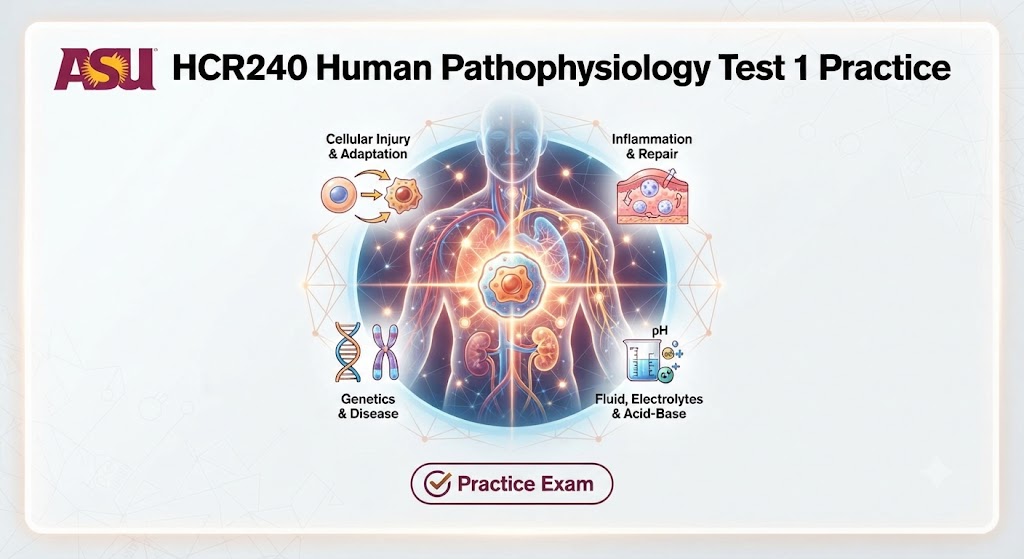
Frequently Asked Questions
Reviews
5.0
Based on 0 reviews
Leave a Review
No reviews yet. Be the first to review!