
Arizona State University (ASU) COM312 Communication, Conflict, and Negotiation Exam 1 Practice Exam
$69.00
- Buy to unlock unlimited access to all Quiz questions.
- After purchase you can print a PDF of the whole quiz at any point. The PDF will contain the questions and the correct answers.
About this Exam
Welcome to the comprehensive study guide for the Arizona State University (ASU) COM312 Communication, Conflict, and Negotiation Exam 1. This critical first exam covers the foundational theories and initial skillsets of one of ASU’s most impactful communication courses. COM312 is designed for undergraduate students across various majors who seek to understand the complex dynamics of human interaction in professional, personal, and social settings. This course moves beyond simple definitions of conflict; it dives deep into the strategic communication choices that shape negotiation outcomes and conflict resolution. Whether you are pursuing a career in business, law, human resources, or leadership, mastering this material is essential for effective professional practice.
Ready to test your knowledge?
Buy Now to Access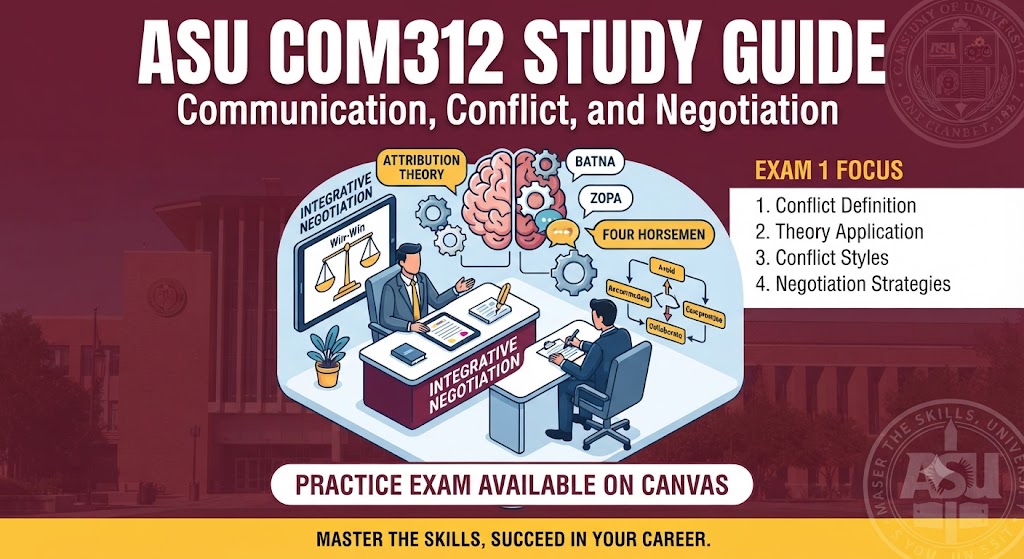
Additional Information
What the Course Entails and Exam Details
COM312 builds a robust theoretical framework before
transitioning into practical application. Exam 1 typically covers the first
three to four weeks of the course, establishing the core vocabulary and models
of analysis.
Key topics include:
- Defining
Conflict: Understanding conflict as an expressed struggle between
interdependent parties who perceive incompatible goals, scarce resources,
and interference from others.
- Theories
of Conflict: Exploring major perspectives such as Social Exchange
Theory, Attribution Theory, and the role of perception in escalating or
de-escalating disputes.
- Conflict
Styles: Mastering the five primary conflict styles—Avoidance,
Accommodation, Competition, Compromise, and Collaboration (often using the
Thomas-Kilmann Conflict Mode Instrument framework).
- The
Nature of Negotiation: Distinguishing between Distributive (win-lose)
and Integrative (win-win) negotiation strategies, and understanding key
concepts like ZOPA (Zone of Possible Agreement) and BATNA (Best
Alternative to a Negotiated Agreement).
- Communication
Patterns: Identifying destructive communication cycles, such as the
"Four Horsemen" (criticism, contempt, defensiveness,
stonewalling), and learning constructive alternatives.
What to Expect in the Final Exam
While this article focuses on Exam 1, it is helpful to
understand how this assessment fits into the overall course structure. Exam 1
is typically a mid-term milestone, usually administered around Week 5 or 6 of
the semester.
The format for Exam 1 is generally structured as follows:
- Question
Types: Expect a combination of multiple-choice questions, true/false,
and short-answer or scenario-based essays. The multiple-choice questions
will test your recall of definitions and theories, while the
scenario-based questions will require you to apply those concepts to
hypothetical conflict situations.
- Time
Limit: You will likely have a standard class period (50 to 75 minutes)
to complete the exam, though this may vary if taken online via ASU's
Canvas platform.
- Content
Emphasis: The exam will heavily test your ability to differentiate
between conflict styles and identify whether a given scenario represents
distributive or integrative negotiation tactics. Be prepared to analyze
short dialogues and categorize the communication behaviors you observe.
How to Study and Exam Centers
Success on the COM312 Exam 1 requires active studying rather
than passive review. Because the exam emphasizes the application of
concepts, mere memorization of definitions will not be sufficient.
Actionable study strategies include:
- Create
Scenario Flashcards: Instead of just defining
"Accommodation," create a flashcard with a short scenario (e.g.,
"A team member agrees to a deadline they know is unrealistic to keep
the peace.") and ask yourself to identify the conflict style.
- Analyze
Real-World Conflicts: Practice applying the "Four Horsemen"
or conflict styles to conflicts you observe in the news, in movies, or
even in your own life. This cements the vocabulary in your mind.
- Review
Lecture Notes and Textbook: Exam questions are drawn directly from the
required readings (often the Interpersonal Conflict textbook by
Wilmot and Hocker) and lecture slides. Ensure you have a strong grasp of
the specific terminology used by your instructor.
- Form
Study Groups: The best way to test your understanding is to explain
these concepts to others. Discussing the nuances of a complex negotiation
scenario with classmates will reveal gaps in your knowledge.
Exam Administration Details:
For on-campus ASU students, Exam 1 is typically taken in a
physical classroom or an assigned testing facility. For ASU Online students,
the exam is usually administered via the Canvas learning management system,
often requiring the use of a proctoring service like Honorlock. Ensure you have
a reliable internet connection, a working webcam, and a quiet environment for
testing. Always confirm the specific testing format and window with your course
syllabus or instructor announcements.
Job Opportunities
from the Course
The communication, conflict management, and negotiation
skills acquired in COM312 are universally applicable and highly sought after by
employers across all industries. This course provides foundational competencies
that are critical for roles requiring high emotional intelligence, strategic
thinking, and leadership capability.
The skills developed in this course are directly relevant to
the following career paths and job titles:
- Human
Resources Specialist & Employee Relations: Mediating workplace
disputes, facilitating communication between management and staff, and
fostering a positive organizational culture.
- Sales
Manager & Account Executive: Utilizing negotiation strategies to
close deals, manage client relationships, and resolve customer conflicts
effectively.
- Project
Manager: Coordinating diverse teams, navigating inevitable project
conflicts, and negotiating resource allocation.
- Mediator
& Arbitrator: Specializing specifically in alternative dispute
resolution (ADR) to help parties settle conflicts outside of the
courtroom.
- Public
Relations (PR) Specialist: Managing organizational communication
during crises and negotiating public narratives.
- Corporate
Trainer & Organizational Development Consultant: Teaching
communication skills, conflict competence, and negotiation tactics to
employees and leadership teams.
- Attorney
& Legal Support Staff: While requiring further education, the
ability to analyze conflict and understand negotiation dynamics is the
bedrock of a legal career.
- Management
Consultant: Analyzing business operations and interpersonal dynamics
within an organization to recommend improvements and resolve
inefficiencies caused by poor communication.
Frequently Asked Questions
Reviews
5.0
Based on 0 reviews
Leave a Review
No reviews yet. Be the first to review!