
Arizona State University (ASU) CEE181 Technological, Social, and Sustainable Systems Final Practice Exam
$69.00
- Buy to unlock unlimited access to all Quiz questions.
- After purchase you can print a PDF of the whole quiz at any point. The PDF will contain the questions and the correct answers.
About this Exam
The ASU CEE181 Technological, Social, and Sustainable Systems course provides a vital introduction to the complex relationship between human society and the engineered world. It is typically designed for undergraduate students, particularly those exploring majors within the Ira A. Fulton Schools of Engineering, such as Civil, Environmental, and Sustainable Engineering.
The primary goal of CEE181 is to equip future engineers and planners with the ability to analyze infrastructure projects not just for technical feasibility, but also for their social impacts and long-term sustainability. The final exam is the culmination of this learning, testing your ability to synthesize concepts ranging from basic engineering economics and life-cycle assessment to environmental justice and ethical considerations in design.
Ready to test your knowledge?
Buy Now to Access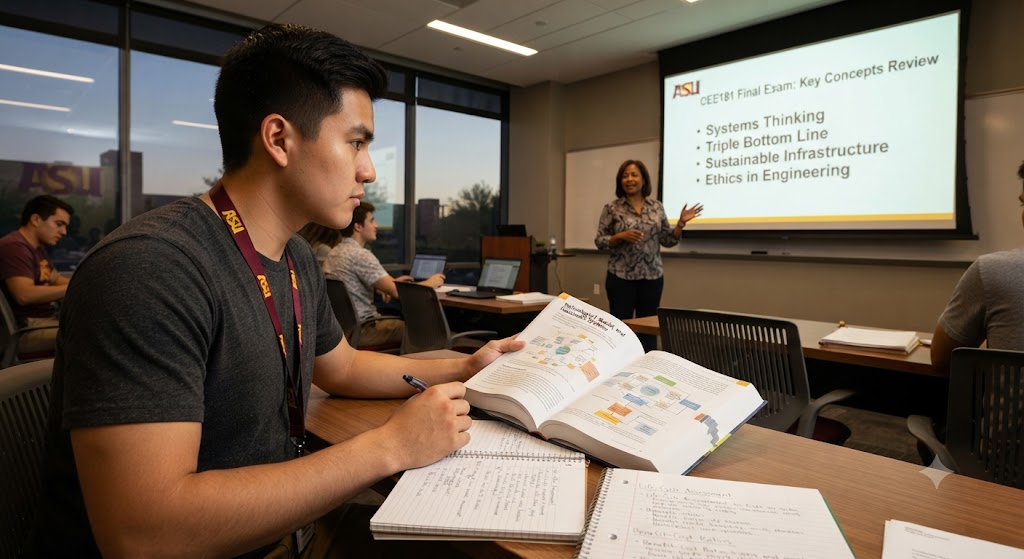
Additional Information
What the Course
Entails and Exam Details
To succeed on the final exam, you must have a firm grasp of
the core pillars presented throughout the semester. The syllabus is structured
to build a holistic understanding of modern engineering challenges.
Core Course Topics:
- Systems
Thinking: Understanding infrastructure as interconnected systems
rather than isolated components.
- Sustainability
Principles: The triple bottom line (People, Planet, Profit), resource
management, and ecological footprints.
- Technological
Innovation: The history and future of engineering marvels, disruptive
technologies, and the role of innovation in solving societal problems.
- Social
Context of Engineering: Ethics in engineering, community engagement,
environmental justice, and the social impacts of large-scale projects.
- Basic
Engineering Economics: Life-cycle cost analysis (LCCA), benefit-cost
ratios, and time value of money concepts applied to sustainable projects.
- Infrastructure
Systems: An overview of transportation, water, energy, and waste
management systems and their sustainability challenges.
The final exam will test your recall of definitions, your
ability to apply economic formulas, and, most importantly, your capacity to
analyze case studies using the frameworks learned in class.
What to Expect in
the Final Exam
The ASU CEE181 Final Exam is designed to be rigorous yet
fair, evaluating both your foundational knowledge and your ability to apply
that knowledge to real-world scenarios. While specific formats may vary
slightly by semester and instructor, students should generally prepare for the
following:
- Exam
Format: The exam is typically a combination of multiple-choice
questions, true/false, short-answer questions, and one or more essay or
long-form case study analysis questions. The non-multiple-choice sections
are critical for demonstrating your depth of understanding.
- Question
Types: Expect scenario-based questions where you must identify the
sustainable or socially responsible choice among several technically
viable options. You will likely be asked to perform basic calculations
related to life-cycle costs.
- Time
Limits: The exam is usually administered during the designated final
exam period for the university, typically allowing 2 hours and 50 minutes.
- Passing
Score: A passing score is generally a 60% or higher, though this can
vary depending on the instructor's grading curve. You should aim for a
significantly higher score to ensure a strong final grade in the course.
- Materials:
The exam is typically closed-book, though some instructors may allow a
single "cheat sheet" or provide a formula sheet. Always confirm
the specific rules with your instructor well before the exam date.
How to Study and
Exam Centers
Effective preparation for CEE181 requires more than just
memorizing definitions; it requires active engagement with the material.
Actionable Study Strategies:
Review Course Modules and
Lectures: Go through your lecture notes, recorded lectures, and any
supplementary reading materials provided on the course management system
(Canvas). Focus on understanding the "why" behind the engineering
solutions.
Master the Vocabulary:
Create flashcards for key terms related to sustainability (e.g., life-cycle
assessment, carbon footprint, cradle-to-cradle), social
systems (e.g., environmental justice, stakeholder engagement),
and economics (e.g., discount rate, present worth).
Practice Case Studies: The
essay portion of the exam often involves analyzing a complex infrastructure
project. Practice applying the "triple bottom line" framework to
projects discussed in class or recent news events.
Utilize Practice Exams: If
your instructor provides a practice exam or previous final exams, take them
under timed conditions. This is the single best way to gauge your readiness and
familiarize yourself with the question style.
Form Study Groups: Discussing
the ethical and social implications of engineering with peers can deepen your
understanding and reveal perspectives you may have missed.
Where and How to Take the Exam:
As a standard ASU course, the CEE181 Final Exam is
administered directly by the university.
- Location:
The exam will take place in the physical classroom assigned by the
university registrar for the final exam period. You must attend in person.
- Online/Hybrid
Sections: If you are enrolled in an online section (ASU Online), the
exam may be proctored remotely using a service like Honorlock or Respondus
Monitor. You will need a reliable computer, webcam, and internet
connection, and a quiet environment.
- Preparation:
Ensure you know the exact date, time, and location (or online proctoring
requirements) of your exam. Arrive early (or log in early) and have your
ASU student ID ready.
Job Opportunities from the Course
The concepts learned in CEE181 are foundational for numerous
high-impact career paths. This course is often the first step for students
interested in addressing global challenges through engineering.
Career Paths Unlocked by This Knowledge:
- Civil
Engineer: Planning, designing, and supervising the construction and
maintenance of building structures and infrastructure projects, with a
focus on sustainability.
- Environmental
Engineer: Developing solutions to environmental problems, such as
water and air pollution control, recycling, waste disposal, and public
health issues.
- Sustainability
Consultant: Advising companies and municipalities on how to reduce
their environmental impact, improve resource efficiency, and enhance
social responsibility.
- Urban
Planner: Developing land use plans and programs that create
communities, accommodate population growth, and revitalize physical
facilities in towns, cities, counties, and metropolitan areas.
- Renewable
Energy Engineer: Designing and developing systems that harness
renewable energy sources like solar, wind, and geothermal power.
- Infrastructure
Policy Analyst: Researching and analyzing policies related to the
development and maintenance of public infrastructure, focusing on
long-term social and economic impacts.
- Corporate
Social Responsibility (CSR) Manager: Leading initiatives that ensure a
company operates in an ethical and sustainable way, considering its impact
on the environment and society.
By mastering the material in ASU CEE181 and performing well
on the final exam, you are not just earning a grade; you are building the
crucial first layer of knowledge for a rewarding career dedicated to building a
better, more sustainable future.
Frequently Asked Questions
Reviews
5.0
Based on 0 reviews
Leave a Review
No reviews yet. Be the first to review!