
Arizona State University (ASU) BMI201 Introduction to Clinical Informatics Final Practice Exam
$69.00
- Buy to unlock unlimited access to all Quiz questions.
- After purchase you can print a PDF of the whole quiz at any point. The PDF will contain the questions and the correct answers.
About this Exam
Welcome to the ultimate guide for the Arizona State University (ASU) BMI201 Introduction to Clinical Informatics Final Practice Exam. This course serves as the foundational gateway for students entering the dynamic intersection of healthcare, technology, and data management.
Clinical informatics is rapidly transforming the healthcare landscape, and BMI201 is designed to equip you with the essential knowledge required to navigate this specialized field. Whether you are a pre-health major, a nursing student, or pursuing a degree in Health Information Management, this course provides critical insights into how technology supports clinical decision-making, improves patient outcomes, and enhances operational efficiency.
This practice exam guide is specifically structured to help you assess your readiness, understand the exam format, and identify key areas where further review is needed. By leveraging this resource, you are taking a proactive step toward mastering the material and achieving academic success in BMI201.
Ready to test your knowledge?
Buy Now to Access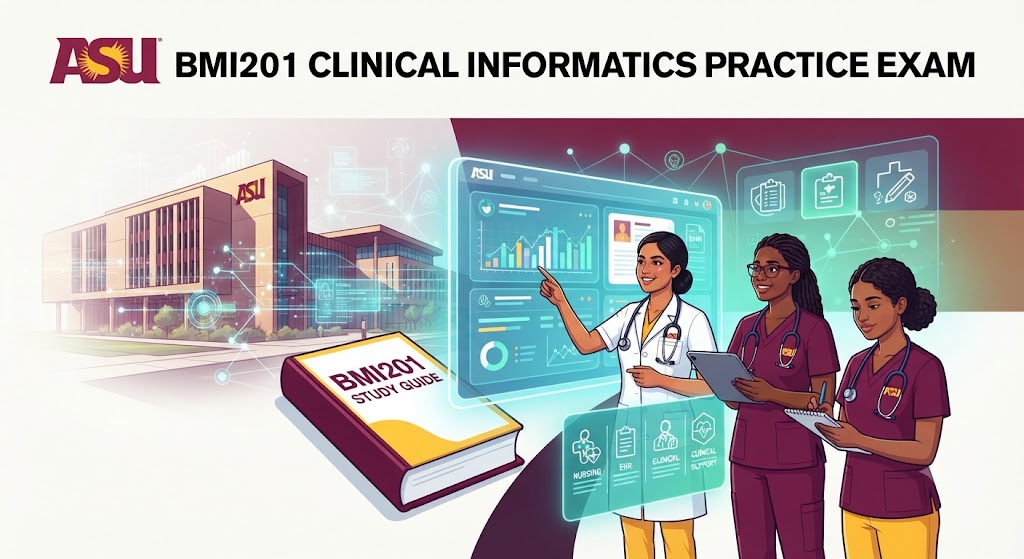
Additional Information
What the Course Entails and Exam Details
The ASU BMI201 curriculum covers a broad spectrum of topics
essential to understanding the role of informatics in modern healthcare. The
final exam is comprehensive, designed to test your cumulative knowledge of
these core subject areas.
To succeed, you must have a solid grasp of the following key
topics:
- The
U.S. Healthcare System: Understanding the structure, challenges, and
regulatory environment in which clinical informatics operates.
- Electronic
Health Records (EHRs): The core components, functions, and
implementation challenges of EHR systems.
- Clinical
Decision Support Systems (CDSS): How technology aids clinicians in
making diagnostic and treatment decisions.
- Health
Information Exchange (HIE): The standards, methods, and importance of
securely sharing patient data across different healthcare organizations.
- Interoperability
and Standards: The technical frameworks (such as HL7 and FHIR) that
allow different health IT systems to communicate.
- Privacy,
Security, and Confidentiality: The critical importance of HIPAA, data
security best practices, and ethical considerations in handling patient
health information (PHI).
- Telehealth
and Mobile Health (mHealth): The growing role of remote patient
monitoring and virtual care technologies.
- Quality
Improvement and Data Analytics: Using data to measure and improve
healthcare outcomes and processes.
The final exam will test your ability to recall definitions,
apply concepts to case scenarios, and analyze the implications of informatics
in real-world healthcare settings.
What to Expect in the Final Exam
The ASU BMI201 Final Exam is a rigorous assessment of your
understanding of clinical informatics. While the specific format may vary
slightly by semester or instructor, it generally adheres to the following
structure:
- Exam
Format: The exam typically consists of a combination of
multiple-choice questions, true/false questions, and matching questions.
Some sections may include short scenario-based questions that require you
to apply your knowledge to a hypothetical clinical situation.
- Question
Types: Expect questions that range from simple recall of terminology
to more complex analysis of how different informatics components interact
within a healthcare system.
- Time
Limit: Students are usually given a strict time limit to complete the
exam, often ranging from 90 to 120 minutes. It is crucial to manage your
time effectively during the test.
- Passing
Score: The passing score is determined by the course syllabus,
typically requiring a 70% or higher to demonstrate competency.
- Proctoring:
The exam is generally administered online through ASU’s learning
management system (Canvas) and may require the use of a proctoring service
(such as Respondus LockDown Browser and Monitor) to ensure academic
integrity.
Ensure you review the specific instructions provided by your
instructor regarding the availability window for the exam and any allowed
materials (e.g., whether it is an open-note or closed-book exam).
How to Study and
Exam Centers
Preparing for the BMI201 final requires more than just
last-minute cramming. A strategic, multi-faceted approach is necessary to
master the volume of information.
Actionable Study Strategies:
- Review
Course Materials: Systematically go through all lecture slides,
reading assignments, and module notes. Pay close attention to key terms,
definitions, and diagrams.
- Utilize
the Practice Exam: Take the official practice exam multiple times.
Treat it not just as a quiz, but as a diagnostic tool. Analyze which
questions you got wrong and, more importantly, why they were wrong.
Review the corresponding material in the textbook or lectures for those
topics.
- Create
Concept Maps: Visualize the relationships between different
informatics topics (e.g., how HIE supports Interoperability, which in turn
enables effective CDSS).
- Form
Study Groups: Discussing complex concepts with peers can reinforce
your understanding and expose you to different perspectives.
- Focus
on Application: Don't just memorize definitions; understand how these
systems function in a real hospital or clinic. Ask yourself, "How
would an EHR impact a nurse's workflow in the emergency department?"
Where and How to Take the Exam:
As an ASU course, the BMI201 Final Exam is administered
online. You do not need to travel to a physical testing center. You will take
the exam remotely using your personal computer, provided it meets the technical
requirements specified by ASU and the proctoring service.
Ensure you have:
- A
reliable high-speed internet connection.
- A
working webcam and microphone (required for proctoring).
- The
latest version of the required web browser or proctoring software (e.g.,
Respondus LockDown Browser).
- A
quiet, private location where you will not be interrupted during the exam.
Before the day of the final, run a system check with the
proctoring service to avoid technical difficulties.
Job Opportunities
from the Course
Completing Introduction to Clinical Informatics is the first
step toward a lucrative and impactful career at the intersection of healthcare
and technology. This course provides the foundational knowledge necessary for
entry-level roles and lays the groundwork for advanced certifications (such as
the CAHIMS certification) and graduate studies.
The specific job titles and career paths this course unlocks
include:
- Clinical
Informatics Specialist: Supporting the implementation and optimization
of EHR systems and training clinical staff.
- Health
Information Technician: Managing and organizing patient data, ensuring
its quality, accuracy, security, and accessibility.
- EHR
Application Analyst: Configuring, maintaining, and troubleshooting
electronic health record systems within a healthcare organization.
- Clinical
Data Analyst: Analyzing healthcare data to identify trends, support
quality improvement initiatives, and inform decision-making.
- Health
Information Management (HIM) Coordinator: Overseeing the operations of
the HIM department and ensuring compliance with regulatory requirements.
- Patient
Access Specialist: Managing the front-end of the patient revenue
cycle, utilizing health IT systems for scheduling, registration, and
insurance verification.
- IT
Support Specialist for Healthcare: Providing technical support
specifically for clinical software and hardware.
By mastering the content in BMI201, you are positioning
yourself as a valuable asset in a healthcare system that is increasingly
reliant on technology to deliver high-quality patient care. Good luck with your
studies and your final exam!
Frequently Asked Questions
Reviews
5.0
Based on 0 reviews
Leave a Review
No reviews yet. Be the first to review!