
Arizona State University (ASU) BME100 Introduction to Biomedical Engineering Midterm Practice Exam
$69.00
- Buy to unlock unlimited access to all Quiz questions.
- After purchase you can print a PDF of the whole quiz at any point. The PDF will contain the questions and the correct answers.
About this Exam
The [ASU BME100 Introduction to Biomedical Engineering Practice Exam] is designed as the essential first step for students enrolled in Arizona State University’s Ira A. Fulton Schools of Engineering, specifically within the Biomedical Engineering BSE program. This foundational course, BME 100, acts as a gateway, offering a compelling overview of the vast and dynamic field of biomedical engineering. It introduces students to the core concepts, the diverse specialization areas, and the pivotal role that biomedical engineers play in solving complex medical and health challenges through innovative engineering solutions. The midterm practice exam is a crucial tool for students to assess their early understanding, identify knowledge gaps, and build the confidence necessary to excel in the actual proctored midterm examination.
Ready to test your knowledge?
Buy Now to Access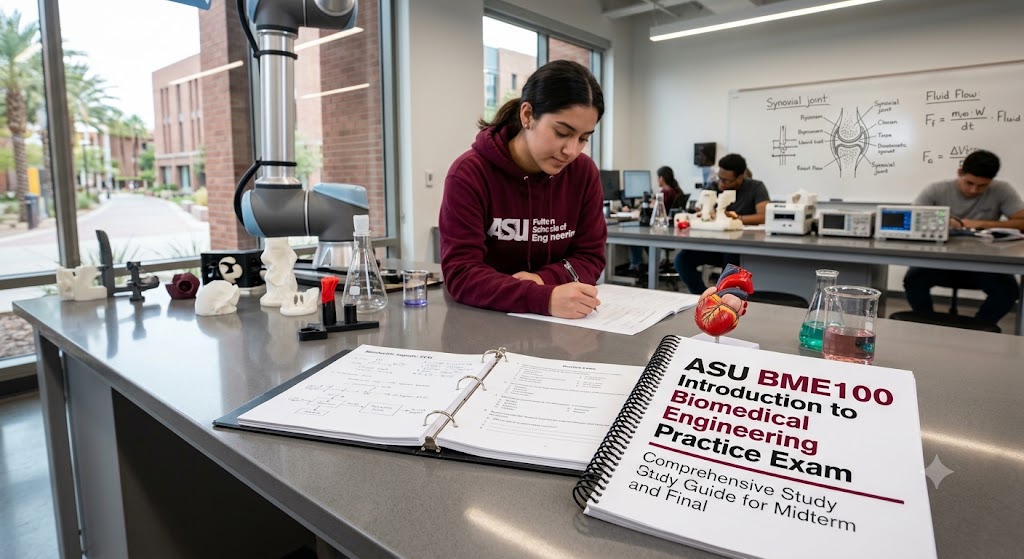
Additional Information
What the Course Entails and Exam Details
ASU's BME 100 is a broad-reaching introduction, blending
mathematical and scientific principles with engineering design to understand
and improve human health. The course, and consequently the midterm exam, covers
a wide range of topics, ensuring a comprehensive foundational knowledge base.
Students can expect to be tested on their understanding of the various
sub-fields of biomedical engineering.
Key areas include:
- Introduction
to Bioelectrical Engineering and the origin of bioelectric signals,
such as the ECG, EEG, and EMG, and how they are measured.
- Foundations
of Biomaterials Science, examining the properties of materials used
in medical devices and implants and their interaction with the human body.
- Core
principles of Biomechanics, applying mechanics to study the
structure, function, and motion of biological systems, including joint
forces and fluid dynamics in the cardiovascular system.
- Overviews
of other specializations like Biomedical Imaging (X-ray, MRI, CT), Cell
and Tissue Engineering, and Neural Engineering.
- The
course also emphasizes professionalism, bioethics, and communication
within the engineering context, teaching students how to read, analyze,
and present scientific literature.
The [ASU BME100 Introduction to Biomedical Engineering
Practice Exam] typically features a series of questions that mirror the actual
exam’s structure, providing a realistic preview of the complexity and variety
of problems students will face.
What to Expect in the Final Exam
For the official ASU BME 100 midterm, students should
prepare for a comprehensive test, likely proctored and conducted within a
strict time limit, typically 60 to 90 minutes. The exam is structured to
evaluate both theoretical knowledge and the ability to apply that knowledge to
practical scenarios.
The format typically includes a mix of:
- Multiple-Choice
Questions: designed to test recall of terminology, key concepts, and
foundational principles from lectures and readings.
- Short-Answer
and Problem-Solving Questions: requiring students to apply equations,
describe biological processes, or outline engineering design
methodologies. These may involve calculating forces, analyzing data
snippets, or identifying ethical considerations in a case study.
While specific passing scores are determined by the course
instructor and the grade breakdown, students are generally expected to
demonstrate proficiency across all tested modules to succeed. Proper
preparation, including a solid understanding of all homework, lab concepts, and
lecture materials, is key.
How to Study and Exam Centers
Preparation is paramount for success on the ASU BME 100
midterm. The best approach involves a mix of conceptual review and active
practice.
Here are actionable study strategies:
- Utilize
Official Resources: Your first stop should be the material provided by
your instructor. Review all lecture slides, assigned textbook
chapters, and lab notebooks. Pay close attention to any
provided study guides or specific learning objectives.
- Engage
with Practice Exams: The [ASU BME100 Introduction to Biomedical
Engineering Practice Exam] is an invaluable tool. Take it under timed,
simulated exam conditions without notes. Afterward, carefully review all
answers, especially the ones you got wrong. Don't just learn the correct
answer; understand why it's correct.
- Form
Study Groups: Collaborating with peers is highly effective. Discuss
difficult concepts, quiz each other on terminology, and work through problsets
together. Teaching a concept to someone else is one of the best ways to
solidify your own understanding.
- Active
Learning Techniques: Instead of just re-reading notes, use flashcards
for definitions, draw out physiological systems, and recreate formulas
from memory.
- Exam
Centers: Since BME 100 is an introductory course within the
university, the midterm exam is typically administered in-person,
during a scheduled class period, in your assigned lecture hall at Arizona
State University. Online students might use a university-sanctioned
proctoring service like Honorlock or take it at an authorized testing
center, but for the majority of on-campus students, it’s a standard
in-class examination.
- Job Opportunities from the Course
A strong performance in BME 100 sets the foundation for the
rest of your biomedical engineering degree. Completing this program unlocks a
multitude of high-growth career paths in industry, research, and healthcare. Biomedical
engineering is a versatile field with diverse applications.
Here are specific job opportunities and career paths
unlocked by a Biomedical Engineering BSE from ASU:
- Biomedical
Engineer: Working in research and development to design and create new
medical devices, software, and artificial organs.
- Manufacturing
Engineer: Overseeing the production of medical technology, ensuring
efficiency and quality.
- Quality
Engineer (Medical Devices): Developing and implementing quality
control protocols to meet strict regulatory standards for medical
products.
- Biomaterials
Developer: Researching, testing, and synthesizing materials for
implants, scaffolds, and drug delivery systems.
- Clinical
Engineer: Managing medical equipment within a hospital setting,
ensuring proper functioning and integration.
- Biomedical
Scientist/Researcher: Conducting fundamental research in academia,
government, or private institutions.
- Regulatory
Affairs Specialist: Ensuring company compliance with FDA and
international regulations for medical products.
- Nanosystems
Engineer: Designing and building microscopic tools and materials for
targeted drug delivery and advanced diagnostics.
<!--[if mso & !supportInlineShapes & supportFields]> SHAPE \* MERGEFORMAT <![endif]--><!--[if gte vml 1]>
This foundational course is your introduction to a career
dedicated to technological innovation for human wellness. Leverage the [ASU
BME100 Introduction to Biomedical Engineering Practice Exam] to start your
journey strong.
Frequently Asked Questions
Reviews
5.0
Based on 0 reviews
Leave a Review
No reviews yet. Be the first to review!