
Arizona State University (ASU) BIO360 Animal Physiology Exam 1 Practice
$69.00
- Buy to unlock unlimited access to all Quiz questions.
- After purchase you can print a PDF of the whole quiz at any point. The PDF will contain the questions and the correct answers.
About this Exam
Are you an Arizona State University student diving deep into the fascinating world of animal form and function? This study guide is designed specifically for students taking BIO360 Animal Physiology. As you gear up for your first major exam, mastering the complex mechanisms of life is essential. This guide, and the associated practice exam materials, are crafted to help you consolidate your understanding of early course concepts. We focus on ensuring you are well-prepared for your upcoming assessment, boosting your confidence and knowledge retention. Let's explore how you can effectively prepare with ASU BIO360 Animal Physiology Exam 1 Practice resources.
Ready to test your knowledge?
Buy Now to Access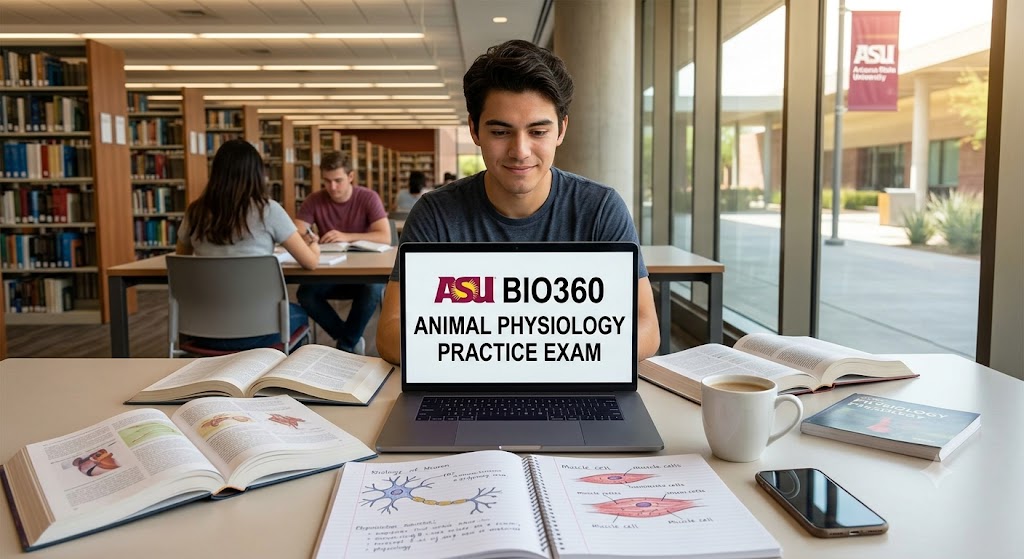
Additional Information
What the Course
Entails and Exam Details
ASU's BIO360 course delves into the intricate mechanisms
that govern how animals work at multiple levels, from molecules to whole
organisms. The initial phase of the course, covered by Exam 1, typically
focuses on foundational physiological principles. Students explore cellular
physiology, including membrane transport, signaling, and excitability. Key
areas such as the central and peripheral nervous systems, including neuron
structure and function, neurotransmission, and sensory processing, are covered
in detail. Additionally, muscle physiology, examining contraction mechanisms
across different muscle types, and perhaps early cardiovascular or endocrine
concepts, are core components of this section. This extensive syllabus requires
a strong conceptual grasp and the ability to apply knowledge to diverse animal
systems.
What to Expect in the Final Exam
While this practice guide focuses on preparing you for Exam
1, understanding the format and expectations for the actual ASU BIO360
assessment is crucial. The first main exam typically evaluates your
understanding through a mix of question formats. You can generally expect
multiple-choice questions that test factual knowledge, conceptual
understanding, and problem-solving skills. Some true/false, fill-in-the-blank,
or short-answer questions requiring concise explanations may also be included
to assess deeper comprehension. Regarding passing scores and specific limits,
these details are determined by the course instructor and will be outlined in
your syllabus. Time limits are standard for university exams, usually ranging
from 50 to 90 minutes, depending on the number and complexity of questions.
Specific rules, such as permitted materials (like standard calculators or
formula sheets), will be clearly communicated by your instructor beforehand.
How to Study and
Exam Centers
Preparing effectively for ASU BIO360 Exam 1 requires a
dedicated study strategy. Utilize this practice guide extensively, making sure
you can confidently answer similar questions and understand the underlying
physiological principles. Revisit your lecture notes, textbook chapters, and
any supplemental materials. Actively engage with the content by drawing out
pathways, creating flashcards for key terms and concepts, and discussing
difficult topics with peers or teaching assistants. Practicing with a variety
of question types will significantly enhance your preparedness and reduce
anxiety. Regarding exam logistics, this specific assessment is typically
administered internally at Arizona State University. You will take the exam in
a designated classroom on one of the ASU campuses, with specific details
provided by your course instructor well in advance. Online proctoring solutions
may be utilized for certain course sections; check your specific syllabus for
confirmation.
Job Opportunities from the Course
Completing ASU BIO360 Animal Physiology and excelling in
your coursework contributes significantly towards your broader degree in
biology, biomedical sciences, or related fields, which opens doors to numerous
rewarding career paths. Here are some specific job opportunities that leverage
knowledge gained in such programs:
- Veterinary
Surgeon or Veterinarian (further study required)
- Research
Scientist (Physiology or Biomedical Sciences)
- Zoological
or Wildlife Biologist
- Pharmaceutical
Research Associate
- Physiologist
or Health Physiologist (specialized roles)
- High
School Biology Teacher (with education credentials)
- Biomedical
Engineer (interdisciplinary field)
- Clinical
Research Coordinator
- Conservation
Scientist
- Medical
Professional (Physician, Physician Assistant, etc. - requires further
education)
Frequently Asked Questions
Reviews
5.0
Based on 0 reviews
Leave a Review
No reviews yet. Be the first to review!