
Arizona State University (ASU) BIO331 Animal Behavior Exam 1 Practice
$69.00
- Buy to unlock unlimited access to all Quiz questions.
- After purchase you can print a PDF of the whole quiz at any point. The PDF will contain the questions and the correct answers.
About this Exam
Arizona State University's BIO331 course on Animal Behavior is a pivotal step for students delving into the fascinating complexities of how and why animals behave as they do. This practice exam guide is specifically designed for students currently enrolled in ASU's BIO331 Animal Behavior course who are preparing for their first major examination of the semester. It serves as an invaluable self-assessment tool, mirroring the content and style of the actual Exam 1, helping you identify knowledge gaps and boost your confidence before test day. Master the foundational principles of ethology and behavioral ecology with this practice exam, a key resource for aspiring biologists, zoologists, and comparative psychologists.
Ready to test your knowledge?
Buy Now to Access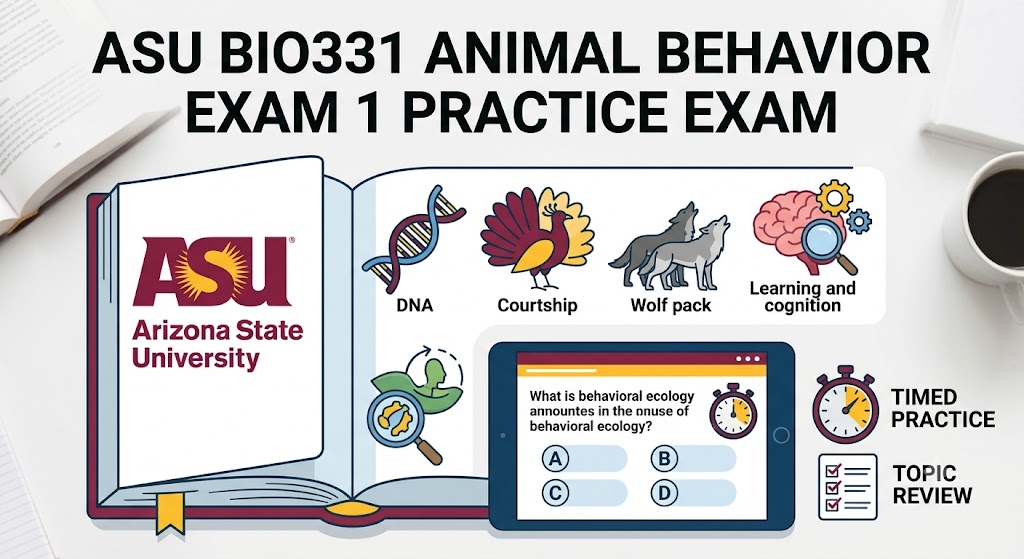
Additional Information
What the Course Entails and Exam Details
The ASU BIO331 course provides a deep dive into the diverse
and intriguing field of animal behavior. This practice exam specifically covers
the crucial concepts introduced in the first few weeks of the semester, often
corresponding to the initial modules or chapters of the syllabus. You can
expect questions focusing on the history and approaches to studying animal
behavior, including classical ethology, comparative psychology, and modern
behavioral ecology. Students will be tested on their understanding of proximate
and ultimate levels of analysis—the 'how' and 'why' of behavior. Key areas also
include the genetic and developmental bases of behavior, hormonal control
systems, and early-life experiences that shape an animal's behavioral
repertoire. Additionally, foundational concepts like learning, memory, and
simple cognitive processes are central to this first exam, preparing you to
tackle more complex topics later in the course.
What to Expect in the Final Exam
The official ASU BIO331 Exam 1 is typically a timed,
closed-book assessment administered via the Canvas learning management system.
The format consists entirely of multiple-choice questions, challenging your
recall of critical terms, theories, and experimental examples discussed in
lectures and readings. While individual professors may adjust specific
parameters, a standard Exam 1 often features approximately 50 to 75 questions
to be completed within a strict 60 to 90-minute time frame. Passing score
requirements vary according to the overall course grading scale but generally
align with standard university percentages. Students are typically required to
use the Respondus LockDown Browser or equivalent proctoring software when
taking the exam remotely, ensuring integrity by restricting access to outside
resources. It is crucial to check your specific syllabus on Canvas for
confirmation of the exact number of questions, time limit, and accepted
proctoring methods for your particular section of BIO331.
How to Study and Exam Centers
To excel on ASU BIO331 Exam 1, a strategic approach is
essential. Start by thoroughly reviewing all lecture slides, your personal
notes, and assigned textbook readings from the first few modules of the course.
Create a focused study schedule and practice actively by re-writing difficult
concepts or explaining them aloud. Use flashcards for key vocabulary terms and
experimental definitions. Crucially, engage with this very practice exam
multiple times, treating each attempt as a timed mock test to build stamina and
identify remaining weaknesses. Form or join a study group to discuss complex
topics and quiz each other on potential exam scenarios. The actual ASU BIO331
Exam 1 is taken exclusively online through Arizona State University's internal
Canvas learning platform. No physical testing centers or external vendors like
Pearson VUE are involved. Students must have a reliable computer, a webcam for
proctoring, and a stable internet connection to complete the exam from their
preferred study location during the assigned test window specified by their
professor.
Job Opportunities from the Course
Mastering the principles of Animal Behavior (BIO331) lays a
robust scientific foundation that unlocks diverse and rewarding career paths in
numerous fields dedicated to wildlife conservation, veterinary medicine, and
human-animal research. Success in this foundational course is a critical
prerequisite for students targeting careers such as Wildlife Biologist,
studying animal populations and habitats; Zoologist, researching exotic species
in captivity or in the wild; or Veterinarian/Veterinary Specialist, applying
behavior knowledge to animal health. It also serves as a vital stepping stone
for roles like Zookeeper or Aquarist, managing the daily care and behavioral
enrichment of animals; Animal Behaviorist/Consultant, solving pet behavioral
problems or enhancing welfare; and Comparative Psychologist, investigating the
evolutionary origins of mind and behavior in both animals and humans. Graduates
may also pursue opportunities as Conservation Scientist, Wildlife Rehabilitator,
or Laboratory Animal Care Technician in academic and research settings.
Frequently Asked Questions
Reviews
5.0
Based on 0 reviews
Leave a Review
No reviews yet. Be the first to review!