
Arizona State University (ASU) BIO202 Human Anatomy and Physiology II Exam 1 Practice Exam
$69.00
- Buy to unlock unlimited access to all Quiz questions.
- After purchase you can print a PDF of the whole quiz at any point. The PDF will contain the questions and the correct answers.
About this Exam
Welcome to your comprehensive study guide for the ASU BIO202 Human Anatomy and Physiology II Exam 1! ASU's BIO202 course is a vital cornerstone for students pursuing diverse healthcare and life science degrees. This specific exam is the first of several crucial assessments, designed to evaluate your deep understanding of key physiological systems and their roles in maintaining human life. This practice exam is expertly crafted for serious ASU pre-health students, including those aiming for nursing, physical therapy, medical school, and related disciplines, providing the necessary tools to gauge your knowledge and identify areas for targeted study. Mastery of these early concepts is essential for success in the entire course and your future career.
Ready to test your knowledge?
Buy Now to Access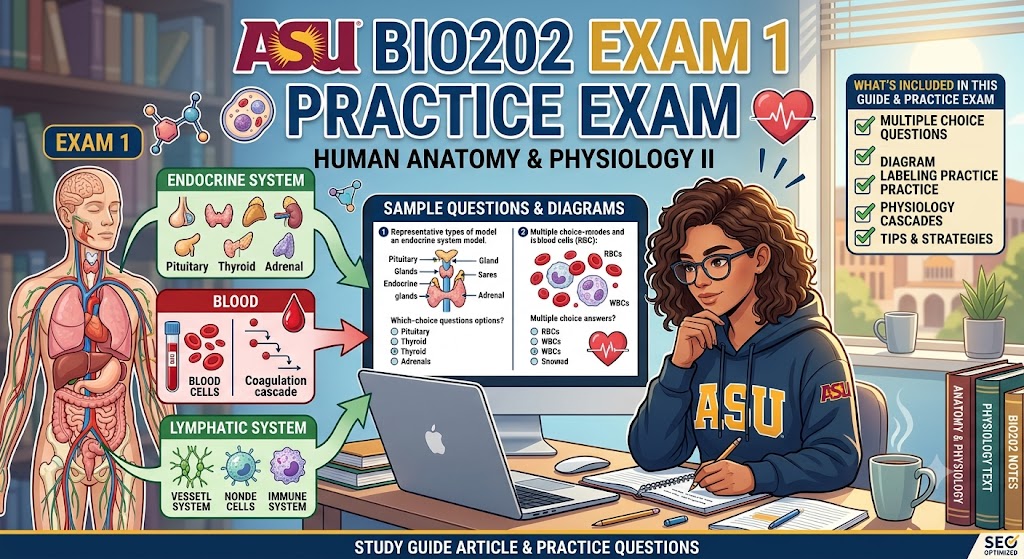
Additional Information
What the Course Entails and Exam Details
ASU BIO202 Human Anatomy and Physiology II delves deeper
into the complex, integrated functions of the human body, following the
foundational knowledge built in BIO201. Your first exam (Exam 1) typically
focuses heavily on foundational fluid dynamics and two essential control
systems. It broadly covers the structures, physiological processes, and
critical interactions of the Endocrine System, the complex component of Blood,
and the vital, circulating elements and basic functions within the Lymphatic
and Immune Systems, including potentially initial cardiovascular elements
like the structure and function of Blood Vessels. You can expect
questions that test your ability to recall anatomical structures from
microscopic and gross models, explain physiological cascades (such as hormone
regulation or blood coagulation), and understand how these systems contribute
to the fundamental concept of homeostasis in the human body. This practice exam
is designed to reflect these core competencies and ensure your preparation is
aligned with the typical ASU course syllabus.
What to Expect in
the Final Exam
While the exact structure and combination can vary between
instructors, typical ASU BIO202 Exam 1 is a substantial, timed assessment. It
primarily consists of highly specific multiple-choice questions that
require careful analytical thinking. Beyond simple recall, you may also
encounter fill-in-the-blank statements, requirements to label
intricate diagrams, or even one or more short-answer or brief essay
questions focusing on physiological mechanisms. A passing grade for this
challenging course is typically set according to standard ASU policies (often
requiring a cumulative 70% average or better for nursing school prerequisites,
though individual exam weights can differ; check your specific course
syllabus). Strict rules generally apply: expect a time limit of
approximately 60 to 90 minutes, or longer for more complex assessments, potentially
administered through the Canvas learning management system with a secure
browser and online proctoring for online students, or as proctored,
paper-based, or computerized exams for those in physical sections. You should
assume no external aids like notes, textbooks, or unauthorized electronic
devices will be allowed during the official exam.
How to Study and
Exam Centers
Effective preparation for this critical exam demands an
active and structured approach. You must move beyond passive reading. First,
create comprehensive study guides from both lecture notes and textbook
readings. Actively draw and repeatedly label key diagrams of endocrine glands,
blood components, the coagulation cascade, and lymphatic circulation until you
can reproduce them accurately. Build a large deck of physical or digital
flashcards to master terminology, specific hormone functions and their targets,
cell types, and physiological pathways. Group study is exceptionally effective
for anatomy and physiology; take turns explaining complex processes and
challenging each other with high-quality practice questions. Don't simply
review the correct answer on practice questions – understand exactly why
the other options are incorrect and how to apply your knowledge to
similar scenarios. This very practice exam you are using is your single
best tool for diagnostic self-assessment! Ensure you are taking actual ASU
exams according to your course's specific requirements – whether in a specified
ASU testing center on campus, an approved, physically proctored location, or
via a secure online proctoring service (like Respondus LockDown Browser or
Honorlock) as facilitated by your instructor and accessible through the Canvas
portal. This practice exam is typically part of a comprehensive set of
resources available to ASU students, either provided through your course
material or authorized study platforms. Check your Canvas announcements for
direct access or information on how to access these essential practice tools.
Job Opportunities
from the Course
A strong foundation in Human Anatomy and Physiology,
demonstrated through success in ASU's rigorous BIO202 course, is not just an
academic milestone; it's a direct prerequisite and unlocking step for countless
rewarding career paths in the diverse field of healthcare. The detailed
knowledge of the human body's structure and function that you solidify in this
course is critical for advanced studies and essential for future professionals
in a vast array of roles, including: Registered Nurse (RN) and Advanced
Practice Nurses (e.g., Nurse Practitioners), Physician and Surgeon (MD/DO),
Physician Assistant (PA), Physical Therapist (PT) and Physical Therapist
Assistant (PTA), Occupational Therapist (OT) and Occupational Therapist
Assistant (OTA), Pharmacist (PharmD), Medical Laboratory Scientist /
Technician, Respiratory Therapist, Diagnostic Medical Sonographer / Imaging
Technologist, Clinical Research Coordinator, Medical Educator / Professor (with
advanced degrees), and Health Science Administrator / Writer.
This article is designed to be highly informative and
encourage you in your study journey. Good luck on your practice exam and the
actual BIO202 Exam 1! Remember, targeted and active practice is key to your
success in this foundational healthcare course.
Frequently Asked Questions
Reviews
5.0
Based on 0 reviews
Leave a Review
No reviews yet. Be the first to review!