
Arizona State University (ASU) BIO201 Human Anatomy and Physiology I Exam 3 Practice
$69.00
- Buy to unlock unlimited access to all Quiz questions.
- After purchase you can print a PDF of the whole quiz at any point. The PDF will contain the questions and the correct answers.
About this Exam
Arizona State University's BIO201, Human Anatomy and Physiology I, is a foundational and demanding course. It is designed primarily for students pursuing degrees in the health professions, nursing, kinesiology, biology, and related scientific fields. This course provides a comprehensive exploration of the structure and function of the human body, emphasizing how these systems interconnect to maintain life and homeostasis. Exam 3 typically marks a significant milestone, diving deep into critical, complex systems that are essential knowledge for any aspiring healthcare professional. This study guide and practice test are specifically designed to help you prepare effectively for this challenging assessment and to reinforce your understanding of the relevant anatomical and physiological concepts.
Ready to test your knowledge?
Buy Now to Access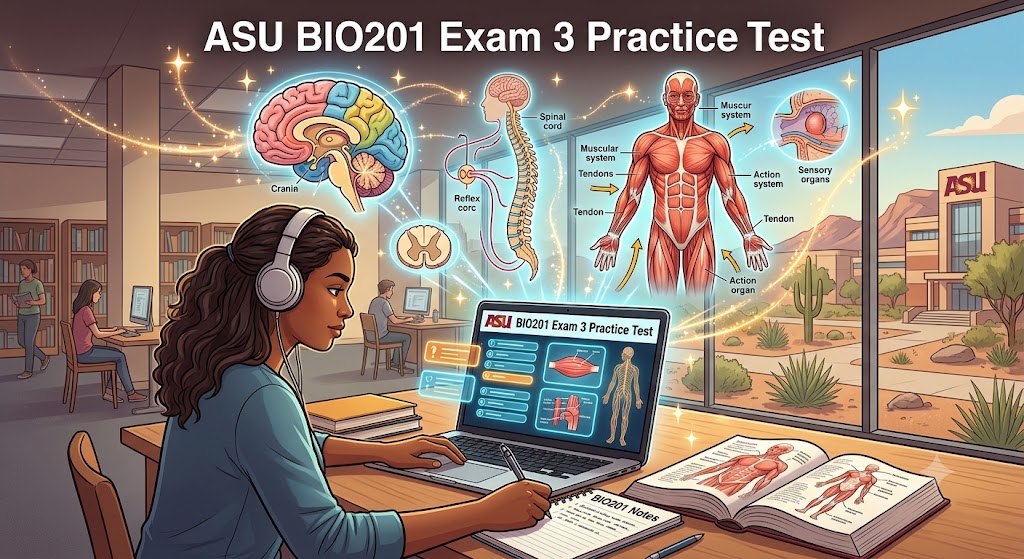
Additional Information
What the Course
Entails and Exam Details
ASU BIO201 is a four-credit course involving both a
comprehensive lecture and a required laboratory component. It covers essential
topics starting with basic terminology and chemical principles, transitioning
through cell biology and histology, and then exploring major body systems. Exam
3 typically focuses intensively on the Muscular System, the Nervous
System, and potentially the Special Senses.
Core content for Exam 3 includes:
- Muscular
System: In-depth study of the types of muscle tissue (skeletal,
cardiac, and smooth); the microscopic anatomy of a muscle fiber and
sarcomere; the physiology of muscle contraction (the sliding filament
theory); neuromuscular junctions; energy sources for contraction; and
identification of major muscle groups, their origins, insertions, and
actions.
- Nervous
System: Detailed examination of neural tissue types (neurons and glial
cells); neuron structure, classification, and function; neurophysiology,
including resting membrane potential, action potential propagation, and
synaptic transmission; organization of the Central Nervous System (brain
and spinal cord structure, function, and ventricles); the Peripheral
Nervous System (cranial and spinal nerves, reflex arcs); and the Autonomic
Nervous System's role in body regulation.
- Special
Senses: (Depending on professor/syllabus) Exploration of the anatomy
and physiology of vision, hearing, balance, smell, and taste.
What to Expect in the Final Exam
While specific exam structures and details are always at the
discretion of the course instructor, a typical high-stakes exam in a course
like ASU's BIO201, such as the actual Exam 3, can be challenging. You should
prepare for an exam that assesses both rote recall and your ability to apply
complex concepts.
- Format:
The exam will heavily consist of multiple-choice questions designed to
test your understanding of detailed anatomy, physiological processes, and
clinical applications. Students should also expect other types of
interactive questions, such as labeling anatomical diagrams, drag-and-drop
identification, or short answer/application questions that require
explaining physiological mechanisms or identifying structures from descriptions.
- Time
Limit: Expect a strict time limit, typically between 60 to 90 minutes,
which is standard for mid-term exams at ASU to mirror a classroom
environment and manage testing resources.
- Passing
Score/Grading: Grading in BIO201 is rigorous. While a score of 60-70%
(D or C range) might be technically passing, competitive health program
prerequisites often demand a grade of B (80%+) or higher in this
foundational course. Your final course grade is typically a weighted
combination of multiple lecture exams, quizzes, laboratory assessments,
and possibly discussion or homework components.
How to Study and
Exam Centers
Preparation for Exam 3 must be comprehensive and strategic.
- Actionable
Study Strategies:
- Master
the Lecture & Lab Materials: Re-watch lectures (if available),
thoroughly read the assigned textbook (often OpenStax or a McGraw-Hill
Connect resource), and complete all online homework/practice questions
meticulously. The actual BIO201 course often uses McGraw-Hill Connect
or a similar platform with interactive learning activities and dynamic
practice questions. Ensure you are completing these.
- Flashcards
(Physical or Digital): Anatomy is heavy on terminology. Create
extensive flashcards for terms, anatomical structures, functions, muscles
(origin/insertion/action), nerves, etc., using a platform like Anki or
Quizlet.
- Visual
Learning: Practice labeling blank diagrams of muscles, brains,
spinal cords, and the sensory organs constantly. A&P is a visual
science. Sketching physiological processes like an action potential or a
muscle contraction cycle can also be very helpful.
- Active
Recall & Spaced Repetition: Test yourself frequently on concepts without
looking at your notes. Group study sessions, where you explain difficult
concepts to each other, are highly effective. Space out your study
sessions over weeks, not in one massive cramming session.
- Use
the Practice Test: The practice test provided here should be used to
simulate exam conditions—time yourself, eliminate distractions, and take
it without notes. Analyze which types of questions you miss and review
those specific topic areas immediately. This practice exam is not an
official ASU product but is modeled on typical BIO201 content and
structure.
- Exam
Centers & Access:
- Official
Course Exams: BIO201 exams at ASU, depending on the section (online,
on-campus, or hybrid), are usually delivered online through the ASU Canvas
learning management system. These are typically proctored online
exams using tools like Respondus LockDown Browser and potentially
a live or recorded proctoring service. For on-campus students, exams
might sometimes be administered in a physically proctored university
classroom or testing center during a scheduled class period.
- Practice
Platform: This practice test and guide are accessible online. They
are a study aid, distinct from the official course exams, and do
not require a proctored setting. Always prioritize and confirm the
official procedures and locations provided by your BIO201 professor. ASU
also offers academic support resources through university tutoring
centers and specialized BIO tutoring.
Job Opportunities
from the Course
Completing ASU BIO201 with a strong grade is not a
standalone certification for a job, but it is an essential, non-negotiable
prerequisite and part of the vital foundation required for admission to and
success in countless competitive graduate programs and career paths within the
healthcare and scientific fields.
This course, as part of your broader degree, unlocks the
path towards careers such as:
- Registered
Nurse (RN) and Advanced Practice Nurses (NPs)
- Physical
Therapist (PT)
- Occupational
Therapist (OT)
- Physician
(MD or DO)
- Physician
Assistant (PA)
- Dentist
(DDS or DMD)
- Veterinarian
(DVM)
- Exercise
Physiologist
- Kinesiologist
- Chiropractor
- Radiologic/Imaging
Technologist
- Surgical
Technologist
- Biomedical
Researcher or Scientist
- Anatomy
& Physiology Instructor (at high school or community college levels,
often requiring further education)
Frequently Asked Questions
Reviews
5.0
Based on 0 reviews
Leave a Review
No reviews yet. Be the first to review!