
Area Detective Practice
$69.00
- Buy to unlock unlimited access to all Quiz questions.
- After purchase you can print a PDF of the whole quiz at any point. The PDF will contain the questions and the correct answers.
About this Exam
Welcome to the comprehensive guide for the [Area Detective Practice Exam]. This certification is the premier benchmark for professionals aspiring to specialize in localized investigative work, risk assessment, and field intelligence. Designed for both aspiring investigators and seasoned security professionals seeking formal recognition, this exam validates your ability to analyze specific environments, interpret localized data, and apply investigative techniques effectively within defined operational zones. Achieving this certification demonstrates a mastery of on-ground surveillance, local law interpretation, and community-based intelligence gathering, setting you apart in the competitive field of private and corporate investigation.
Ready to test your knowledge?
Buy Now to Access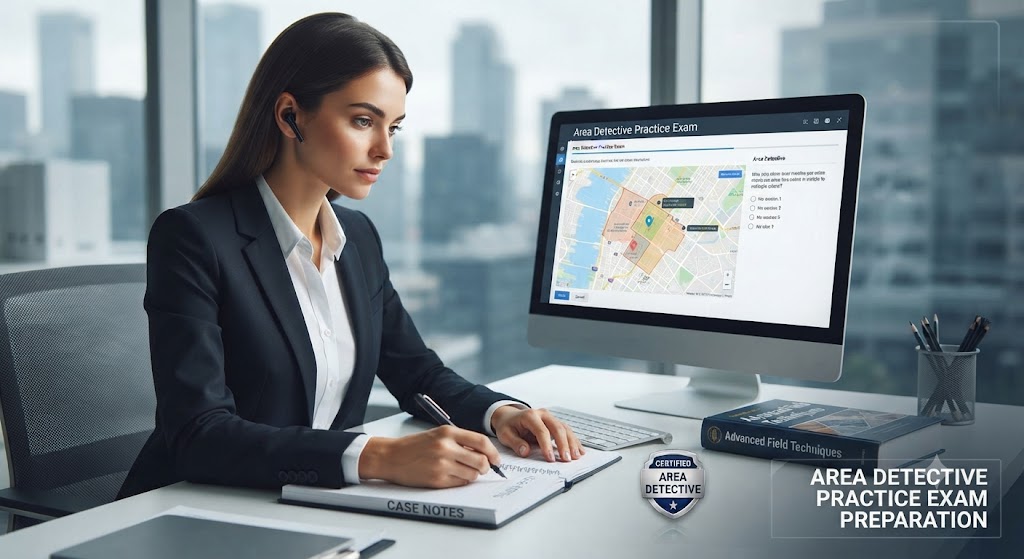
Additional Information
What the Course
Entails and Exam Details
The curriculum and subsequent exam are structured to test a
wide array of practical and theoretical skills essential for modern area
detection. Candidates must demonstrate proficiency in several core modules.
These typically include:
- Advanced
Surveillance Techniques: Mastery of stationary, mobile, and technical
surveillance methods tailored for specific environments (urban vs. rural).
- Local
Law and Ethics: A deep understanding of regional statutes, privacy
laws, and the ethical boundaries governing private investigation and
information collection.
- Area
Profiling and Risk Assessment: The ability to analyze a specific
geographical zone, identify potential security threats, and assess
vulnerability.
- Interview
and Interrogation: Proven techniques for gathering witness statements
and eliciting information within legal constraints.
- Evidence
Collection and Chain of Custody: Proper procedures for identifying,
documenting, preserving, and handling physical and digital evidence.
The exam itself is rigorous and scenario-based, designed to
test not just rote memorization but the application of these skills in
real-world contexts.
What to Expect in the Final Exam
The [Area Detective Certification Exam] is a comprehensive
assessment that typically employs a multi-format approach to thoroughly
evaluate candidate competency.
- Format:
The exam is usually computer-based and consists primarily of
multiple-choice questions, but it also incorporates complex scenario-based
questions. These scenarios present a detailed investigative situation, requiring
you to analyze the facts and select the best course of action based on the
course material.
- Number
of Questions: Candidates can expect between 100 and 150 questions.
- Time
Limit: The examination is strictly timed, usually allowing 3 to 4
hours for completion, reflecting the need for efficient decision-making
under pressure.
- Passing
Score: The passing score is typically set high, often around 75% or
higher, reflecting the professional standard of the certification.
- Exam
Rules: This is a proctored exam. No reference materials, personal
electronic devices, or unauthorized communication are permitted during the
testing period. Strict identification verification is required upon entry.
How to Study and
Exam Centers
Preparation is key to success. A multi-layered study
approach is recommended to ensure comprehensive understanding.
- Official
Course Materials: Begin by thoroughly reviewing all official study
guides, textbooks, and online modules provided by the certifying body. These
materials are the foundation of the exam.
- Practice
Exams: Utilizing a high-quality [Area Detective Practice Exam]
is crucial. These practice tests simulate the actual exam environment,
familiarize you with the question format, and help identify areas where
further study is needed. Take multiple practice exams to build confidence
and timing.
- Flashcards
and Study Groups: Create flashcards for key legal terms, surveillance
codes, and investigative protocols. Joining a study group can also be
beneficial for discussing complex scenarios and sharing insights.
- Focus
on Weak Areas: After each practice exam, analyze your results.
Dedicate extra time to thoroughly reviewing the topics where you scored
lower.
Exam Centers and Registration:
Once you are prepared, registration is completed through the
official certifying body's portal. Upon registration and payment, you will be
directed to schedule your exam.
- Authorized
Testing Centers: The [Area Detective Certification Exam] is
predominantly administered at authorized testing centers worldwide, such
as Pearson VUE or Prometric centers. These secure locations ensure
standardized testing conditions.
- Online
Proctoring: Depending on the specific certification board, the exam
may also be available via secure online proctoring, allowing you to take
the exam from a controlled environment (e.g., a quiet office or home)
using your own computer equipped with a webcam and microphone.
Job Opportunities
from the Course
Earning the [Area Detective Certification] opens the door to
a wide range of specialized and rewarding career paths within the public and
private sectors. This certification serves as a recognized credential,
validating your expertise to employers.
- Licensed
Private Investigator: Work independently or for an agency, conducting
investigations for individuals, law firms, or corporations.
- Corporate
Security Specialist: Focus on internal investigations, asset
protection, and risk mitigation within a specific corporate environment.
- Field
Intelligence Officer: Gather on-ground intelligence for security
firms, government agencies, or risk management organizations.
- Loss
Prevention Manager: Oversee security operations and investigate theft
and loss within retail or supply chain environments.
- Legal
Investigator: Support attorneys by conducting detailed investigations,
locating witnesses, and gathering evidence for legal cases.
- Background
Investigator: Perform comprehensive background checks for employment,
security clearances, or tenant screening.
- Skip
Tracer: Specialize in locating individuals who have absconded or are
evading legal obligations.
Frequently Asked Questions
Reviews
5.0
Based on 0 reviews
Leave a Review
No reviews yet. Be the first to review!