
ARDS and Mechanical Ventilation Practice Exam
$69.00
- Buy to unlock unlimited access to all Quiz questions.
- After purchase you can print a PDF of the whole quiz at any point. The PDF will contain the questions and the correct answers.
About this Exam
The ARDS and Mechanical Ventilation Practice Exam is a comprehensive assessment tool designed for healthcare professionals working in high-acuity environments. This practice exam is explicitly created for Respiratory Therapists (RTs), Critical Care Nurses (RNs), Physician Assistants (PAs), Nurse Practitioners (NPs), and Physicians who wish to validate and enhance their knowledge in the complex management of patients requiring invasive respiratory support. This resource serves as essential preparation for advanced competency validations and highly respected national certifications such as the Adult Critical Care Specialist (ACCS) or Critical Care Registered Nurse (CCRN). It bridges the gap between theoretical knowledge and clinical application, ensuring practitioners are prepared for the challenges of advanced respiratory care.
Ready to test your knowledge?
Buy Now to Access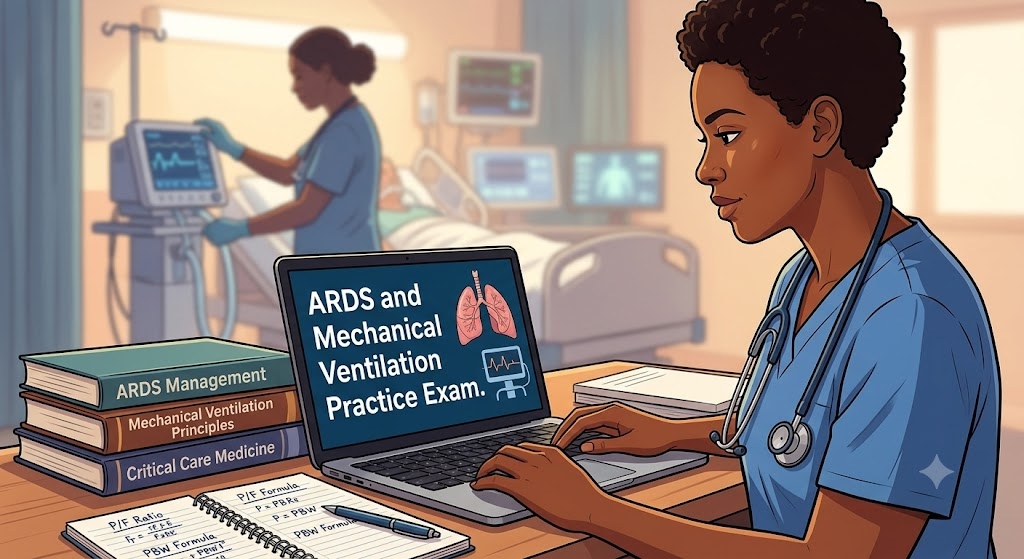
Additional Information
What the Course Entails and Exam Details
This practice exam does not follow a specific course syllabus but rather targets a robust core set of clinical competencies. It covers critical areas including the pathophysiology of Acute Respiratory Distress Syndrome (ARDS) and the application of the Berlin definition for diagnosis. Participants will be tested on advanced mechanical ventilation strategies, focusing heavily on lung-protective ventilation principles (e.g., tidal volume based on ideal body weight, plateau pressure monitoring).
The content includes invasive ventilator modes (Volume Control, Pressure Control, SIMV, APRV), PEEP titration methods, recruitment maneuvers, and the indications for advanced therapies such as prone positioning and Neuromuscular Blockade (NMB). It also requires a strong command of interpreting Arterial Blood Gases (ABGs) and understanding the complex interactions between mechanical ventilation and patient hemodynamics. The practice exam itself is typically comprised of a series of rigorous, multiple-choice questions modeled after actual certification board exams.
What to Expect in the Final Exam
As this is a practice exam, its specific structure—including the total number of questions, passing score, and time limit—will vary depending on the provider. However, this simulation is designed to mimic the high-stakes environment of a formal certification test. Users should expect a heavily clinical, scenario-based format.
A significant portion of the test will be presented as multiple-choice questions (MCQs), requiring the analysis of patient data, ventilator waveforms, and imaging studies to determine the most appropriate next step in management. Unlike simple recall, these questions evaluate higher-level critical thinking and decision-making skills. The passing score is often benchmarked high to reflect the level of competency required in real-world critical care scenarios, encouraging thorough preparation.
How to Study and Exam Centers
Effective preparation requires a multi-faceted approach. Begin by reviewing foundational critical care textbooks and official clinical practice guidelines, particularly those from the ARDS Network (ARDSNet) and the American Association for Respiratory Care (AARC). Take detailed notes on key formulas, diagnostic criteria, and management algorithms.
A crucial study strategy is to take timed practice exams. This not only builds stamina but also helps identify specific areas of weakness. For the actual high-stakes certification exams that this practice test prepares you for (e.g., ACCS or CCRN), testing is administered through dedicated professional testing organizations like the National Board for Respiratory Care (NBRC) or the American Association of Critical-Care Nurses (AACN). These final exams are taken at authorized, secure physical testing centers, such as Pearson VUE, or via live-proctored online platforms, requiring separate registration and fee payment. This practice exam is an preparatory tool to guide you toward success in those final, official settings.
Job Opportunities from the Course
Mastering the complexities of ARDS and mechanical ventilation significantly expands career opportunities within acute and critical care. By successfully demonstrating competency, which this practice exam helps achieve, healthcare professionals are prepared for specialized roles in various high-acuity environments. This advanced knowledge is often a prerequisite for leadership positions and specialized team assignments. Career paths and job opportunities include:
Critical Care Respiratory Therapist (ICU/NICU)
Critical Care Registered Nurse (ICU, Trauma, Cardiovascular)
Adult Critical Care Specialist (ACCS)
Flight / Transport Respiratory Therapist or Nurse
Acute Care Nurse Practitioner (ACNP) - Critical Care
Critical Care Physician Assistant
Intensivist (Critical Care Physician)
Pulmonologist
Clinical Nurse Specialist (CNS) in Critical Care
Anesthesiologist Assistant
Director / Manager of Respiratory Care Services
Frequently Asked Questions
Reviews
5.0
Based on 0 reviews
Leave a Review
No reviews yet. Be the first to review!