
ARDMS Sonography Principles and Instrumentation (SPI) Practice Exam
$69.00
- Buy to unlock unlimited access to all Quiz questions.
- After purchase you can print a PDF of the whole quiz at any point. The PDF will contain the questions and the correct answers.
About this Exam
The American Registry for Diagnostic Medical Sonography (ARDMS) offers the Sonography Principles and Instrumentation (SPI) exam as a foundational prerequisite for many of its professional certifications, including the Registered Diagnostic Medical Sonographer (RDMS) credential. Passing the SPI is typically the first mandatory step for aspiring sonographers and current professionals looking to advance their credentials. The [ARDMS SPI Practice Exam] Practice Exam is designed as a rigorous simulation and self-assessment tool, providing a high-quality preview of the official exam to help candidates gauge their readiness, identify weak areas, and build essential confidence for test day. This comprehensive study guide article aims to demystify both the practice and actual exams, guiding you through preparation to maximize your success.
Ready to test your knowledge?
Buy Now to Access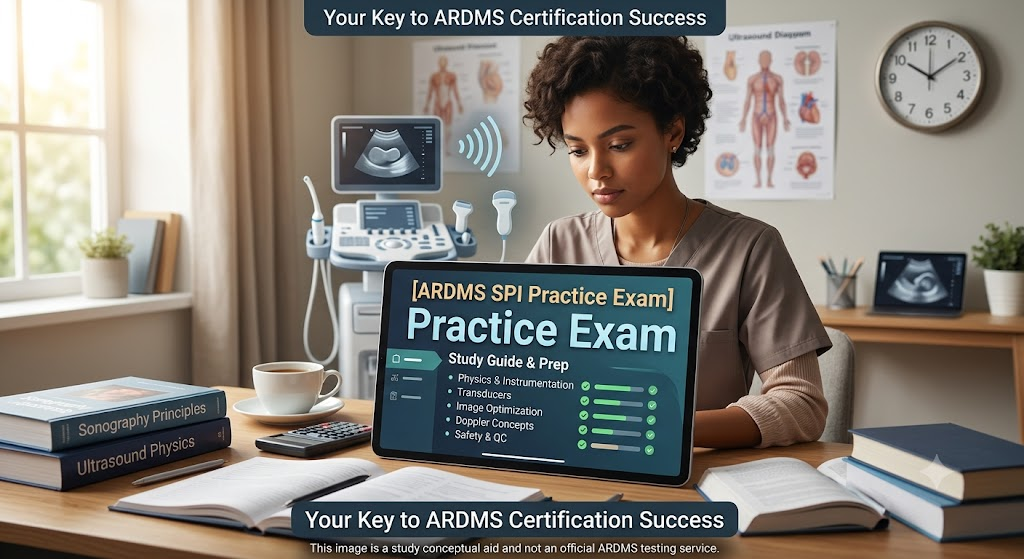
Additional Information
What the Course Entails and Exam Details
It is crucial to understand that neither the SPI exam nor this practice tool are, strictly speaking, a single "course." Rather, the SPI is a high-level examination that tests knowledge and understanding typically acquired through formal sonography programs, relevant physics coursework, and clinical experience. The core domains covered by both the official ARDMS SPI exam and high-quality practice exams include:
Physical Principles: Understanding sound wave propagation, attenuation, acoustic properties of tissue, and interaction of sound and matter.
Instrumentation: Thorough knowledge of ultrasound controls (e.g., gain, time gain compensation, frame rate, output power, etc.), signal processing, dynamic imaging principles, and system operation.
Transducers: Grasping elements of transducer design, types (linear array, phased array, curved array), beam formation, focusing, and selection for specific applications.
Doppler Concepts: Comprehending continuous wave (CW), pulsed wave (PW), color Doppler, power Doppler, interpreting Doppler waveforms, understanding Doppler shift, and artifact recognition.
Image Optimization and Artifacts: Identifying, understanding the causes of, and resolving common imaging artifacts to ensure diagnostic clarity.
Clinical Safety, Patient Care, and Quality Assurance: Adhering to safety standards, proper patient care protocols, confidentiality, and procedures for ensuring equipment performance.
The official SPI exam typically consists of multiple-choice and potential interactive items, totaling around 110 questions, with a strict time limit of approximately two hours for the examination portion. Good practice exams, like the one this guide is designed for, mirror this structure to provide a comparable timed experience and subject breakdown. Remember, a practice exam is not an official ARDMS credential and does not confer any title; its sole purpose is effective preparation for the official test.
What to Expect in the Final Exam
While a practice exam prepares you, the official final ARDMS SPI examination must be scheduled and taken through an authorized computer-based testing provider. Here’s what you can generally expect:
Official Proctored Environment: The official SPI exam is administered at highly secure, third-party computer testing centers, often provided by partners like Pearson VUE. You must present valid, unexpired government-issued identification at the testing center.
Secure Testing Protocols: Testing centers maintain strict security. Personal items, including electronics, bags, notebooks, and watches, are usually not permitted inside the testing room. You may be provided with a whiteboard and pen for notes.
Exam Structure: Prepare for approximately 110 questions, potentially including a combination of multiple-choice and sophisticated interactive question formats. The entire testing appointment, including introductory tutorials and any breaks (which are typically unscheduled and don’t pause your time), usually lasts about two hours for the exam itself.
Passing Requirements: The exam is typically scored on a pass/fail basis using a scaled score. The possible scaled score range commonly ranges from 300 to 700, and a minimum scaled score of 555 is generally required to pass. Your official results will be available shortly after you complete the exam.
Prerequisites and Registration: You must apply directly to ARDMS, pay the required fees, and meet any specific educational or clinical experience prerequisites before you can schedule the official SPI exam. Always consult the official ARDMS website for the most current information.
How to Study and Exam Centers
Effective preparation is key to conquering the SPI. Use these actionable study and practice techniques:
Study Strategies:
Develop a Plan: Create a structured study schedule well in advance of your desired exam date. Allocate dedicated time each day/week to specific domains.
Review Core Material: Revisit and study ultrasound physics and instrumentation textbooks recommended by your program. Focus on understanding key concepts rather than just memorization.
Understand Relationships & Units: Comprehend how frequency, resolution, and penetration are interrelated. Be thoroughly familiar with the units of measurement for all concepts (e.g., frequency in Hz/MHz, attenuation in dB/cm, etc.).
Use Scan Time to Reinforce Knowledge: Apply concepts directly while in your clinical setting. Notice how changing transducer settings affects image quality, temporal resolution, or Doppler flow presentation.
Utilize Practice Exams & Flashcards: Actively integrate taking multiple high-quality practice exams, like the [ARDMS SPI Practice Exam] Practice Exam, into your routine. Create detailed flashcards for difficult concepts, formulas, and terminology, and review them often.
Analyze Your Performance: Thoroughly review the answers and rationales for every question on practice tests, especially those you get wrong. Identify your weak areas and devote extra time to them.
Practice Methods:
Take Timed Practice Tests: Don't just answer questions; practice under timed conditions to build your pacing and stamina.
Simulate Test Day: Occasionally take a full practice exam, without interruptions or outside materials, to truly simulate the test environment.
Practice with Interactive Questions: If possible, find practice materials that include the type of interactive questions found on the actual SPI.
Exam Centers:
Practice Exam: Practice exams and study guides, like this comprehensive article and associated tools, are primarily available online or as downloaded study materials. You can access them from the convenience of your own home, library, or anywhere with internet access.
Official SPI Exam: You cannot take the actual high-stakes ARDMS SPI exam anywhere. The only way to take the official exam is by scheduling and completing it at an authorized computer-based testing center, as specified by the ARDMS. This is usually managed through third-party partners (such as Pearson VUE) and requires registration, payment, and scheduling in advance.
Job Opportunities from the Course
Passing the ARDMS SPI, though not a standalone course completion that directly leads to a job title, is a significant career milestone. It is a critical prerequisite for obtaining coveted sonography credentials that are widely recognized and often required by healthcare employers. Completing a full certification path (e.g., RDMS) typically opens doors to roles including:
Registered Diagnostic Medical Sonographer (RDMS) (specified with one or more specialty certifications such as Abdomen, Obstetrics & Gynecology, Breast)
Registered Diagnostic Cardiac Sonographer (RDCS)
Registered Vascular Technologist (RVT)
Registered Musculoskeletal Sonographer (RMSKS)
Lead Sonographer / Chief Sonographer
Sonography Educator
Applications Specialist (within medical imaging companies)
Medical Sales Representative (for ultrasound equipment)
Prepare diligently, use reliable resources, and practice strategically. This article is your comprehensive guide to understanding and succeeding in your [ARDMS SPI Practice Exam] Practice Exam, and subsequently, your journey to becoming a certified sonographer. Good luck!
Frequently Asked Questions
Reviews
5.0
Based on 0 reviews
Leave a Review
No reviews yet. Be the first to review!