
ARDMS (American Registry for Diagnostic Medical Sonography) Practice Test
$69.00
- Buy to unlock unlimited access to all Quiz questions.
- After purchase you can print a PDF of the whole quiz at any point. The PDF will contain the questions and the correct answers.
About this Exam
The ARDMS Sonography Principles and Instrumentation (SPI) exam is a prerequisite required to earn physical credentials from the American Registry for Diagnostic Medical Sonography, such as the Registered Diagnostic Medical Sonographer (RDMS), Registered Diagnostic Cardiac Sonographer (RDCS), or Registered Vascular Technologist (RVT). This foundational exam is designed for aspiring sonographers and medical professionals who need to demonstrate their knowledge and understanding of essential ultrasound physics and instrumentation concepts necessary for safe and effective practice.
Ready to test your knowledge?
Buy Now to Access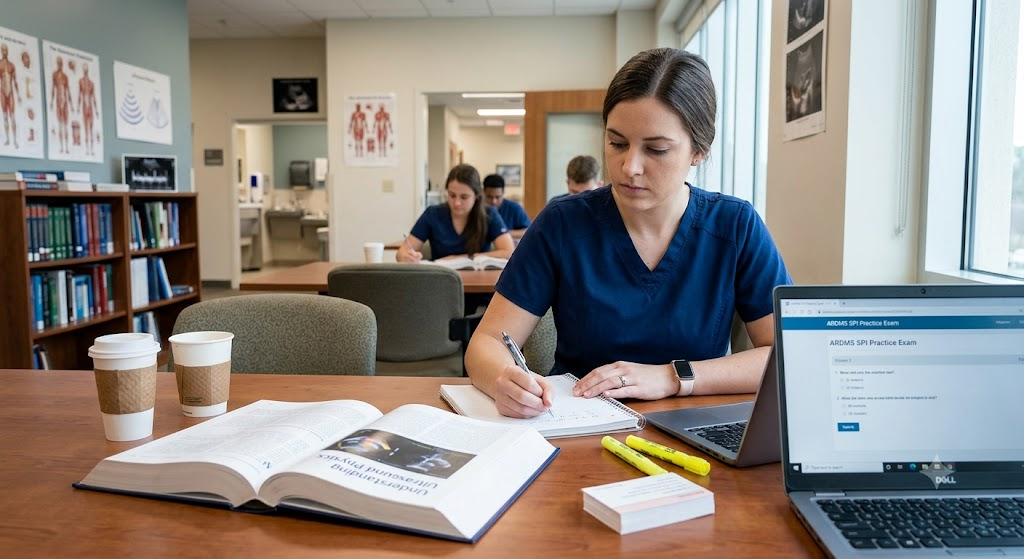
Additional Information
What the Course Entails and Exam Details
The SPI exam is a crucial step in the ARDMS certification process, focusing primarily on physics, safety, and instrumentation, rather than anatomy or pathology (which are covered in specialty exams). The exam content generally covers the following core areas:
Ultrasound Physics: Fundamental principles of sound waves, interactions with tissue, and hemodynamics.
Transducers: Design, function, and selection of transducers for various applications.
Pulse-Echo Instrumentation: Components and operation of ultrasound systems, including image storage and display.
Imaging Features: Mastery of 2D, M-mode, Doppler (color, spectral, and power), and hemodynamics.
Quality Assurance & Safety: Bioeffects, safety guidelines (ALARA principle), artifact identification, and equipment performance monitoring.
New Technologies: Awareness of emerging and specialized ultrasound techniques.
What to Expect in the Final Exam
The SPI exam is a computer-based test (CBT). Here is what you can anticipate on exam day:
Format: Multiple-choice questions, often including image-based scenarios where you must identify artifacts or apply physics principles.
Number of Questions: 110 questions.
Time Limit: 2 hours (120 minutes).
Passing Score: ARDMS uses a scaled scoring system ranging from 300 to 700. A score of 555 is required to pass the SPI exam.
Calculators: You will be provided with an on-screen basic calculator; personal calculators are not permitted.
How to Study and Exam Centers
Preparation is key to passing the SPI exam, which many candidates find challenging due to its technical focus.
Understand the Content Outline: Review the official SPI Content Outline provided by ARDMS to prioritize your studying.
Review Books: Utilize recognized ultrasound physics textbooks (like Edelman or Kremkau). These are considered essential resources.
Practice Tests: Consistently use practice tests and question banks to familiarize yourself with the question style and identify weak areas.
Focus on 'Why': Don't just memorize formulas; understand the concepts behind them and how they relate to the image on the screen.
Official ARDMS Resources: ARDMS offers practice exams and sample questions that closely mimic the actual test.
Exam Centers: The SPI exam is administered through Pearson VUE professional testing centers located globally. You must first apply and receive an Examination Agreement Letter from ARDMS before you can schedule your appointment at a Pearson VUE center. It is a secure, proctored environment.
Job Opportunities from the Course
Passing the SPI exam is the foundation. Once you also pass a specialty exam (such as Abdomen, OB/GYN, Breast, or Adult Echo), you will earn an ARDMS credential that is highly respected in the medical field. These credentials unlock various career paths and job opportunities:
Registered Diagnostic Medical Sonographer (RDMS)
Registered Diagnostic Cardiac Sonographer (RDCS)
Registered Vascular Technologist (RVT)
From these, you can specialize in areas such as:
Abdominal Sonographer
Obstetrics and Gynecology (OB/GYN) Sonographer
Cardiac Sonographer (Echocardiographer)
Vascular Sonographer
Breast Sonographer
Pediatric Sonographer
Musculoskeletal (MSK) Sonographer
These roles are available in hospitals, outpatient clinics, private practices, mobile imaging services, and research facilities, offering competitive salaries and strong career growth potential.
Frequently Asked Questions
Reviews
5.0
Based on 0 reviews
Leave a Review
No reviews yet. Be the first to review!