
AR 735-5 Property Accountability Policies Practice Test
$69.00
- Buy to unlock unlimited access to all Quiz questions.
- After purchase you can print a PDF of the whole quiz at any point. The PDF will contain the questions and the correct answers.
About this Exam
Welcome to your comprehensive guide for the AR 735-5 Property Accountability Policies Practice Test. Army Regulation 735-5 is the definitive guide governing accounting policies and procedures for U.S. Army property. This exam is specifically designed for military personnel—including supply sergeants, logistics officers, and unit commanders—as well as Department of the Army civilians tasked with property management responsibilities. Mastery of this regulation ensures that valuable government resources are tracked, maintained, and accounted for, directly impacting mission readiness and fiscal responsibility. This guide serves as a crucial resource to help you prepare for standard unit assessments, logistics course finals, or professional development qualifications related to property book operations.
Ready to test your knowledge?
Buy Now to Access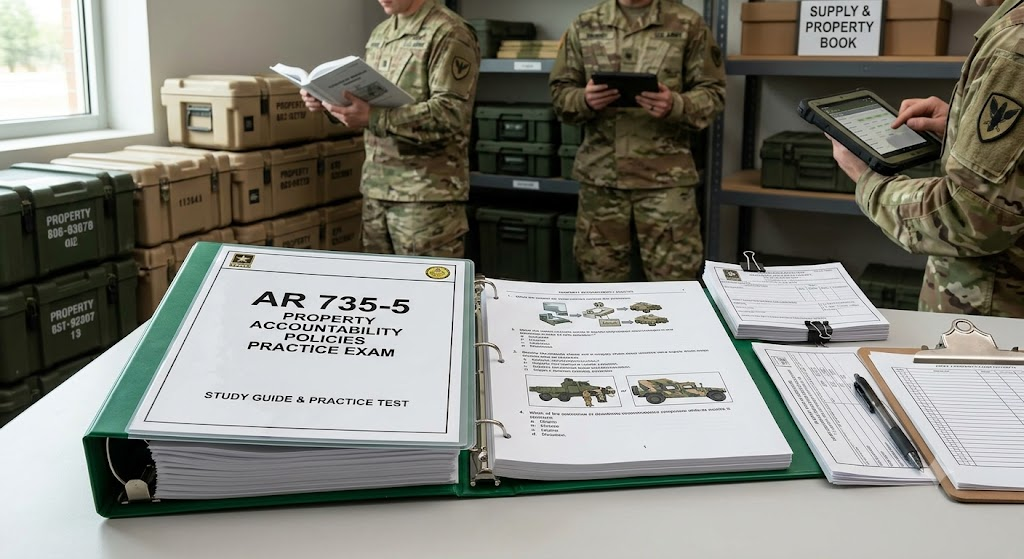
Additional Information
What the Course Entails and Exam Details
Preparing for an AR 735-5 assessment requires a deep dive into the regulatory framework of Army logistics. The primary areas covered include:
Classifications of Property: Distinguishing between real property, government property, and personal property, as well as non-expendable, durable, and expendable items.
Property Accounting: Understanding the processes for establishing and maintaining property books, hand receipts, and component hand receipts.
Types of Responsibility: Detailed knowledge of the five types of responsibility: command, supervisory, direct, custodial, and personal.
Surveys and Inventories: Requirements for conducting cyclic inventories, sensitive item inventories, and change of command inventories.
Adjustment of Property Records: How to document lost, damaged, or destroyed property through Financial Liability Investigations of Property Loss (FLIPL) or other administrative means.
What to Expect in the Final Exam
While specific assessment formats can vary by course or command, most evaluations based on AR 735-5 share common characteristics.
Format: The exam typically consists of multiple-choice and true/false questions. Many tests will include scenario-based questions requiring you to apply regulation guidance to practical logistical challenges.
Passing Score: A minimum passing score of 80% is common for certification within logistics courses (e.g., AIT, BOLC) or to satisfy unit inspection criteria.
Time Limit: Assessments are usually timed, often providing 60 to 90 minutes depending on the number of questions.
Specific Rules: Some advanced logistical courses allow for an "open-book" assessment where the actual regulation may be referenced, focusing on your ability to find and interpret the policy.
How to Study and Exam Centers
Effective preparation is the key to success on any Army regulation assessment.
Master the Core Material: Start by reading AR 735-5 directly, available through the Army Publishing Directorate. Use highlighters and tabs to mark key chapters and tables, focusing on definitions and administrative procedures.
Create Scenarios: Develop flashcards for the different types of property and levels of responsibility. Practice applying these concepts to hypothetical unit supply problems.
Leverage Peers: Engage in study groups with experienced non-commissioned officers (NCOs) or warrant officers who work with property book operations daily.
Exam Accessibility: These exams are typically administered internally within military units, at base education centers, or as part of structured courses at installations like Fort Gregg-Adams. Online delivery may be available through military learning management systems, though proctoring requirements will still apply.
Job Opportunities from the Course
A strong knowledge of AR 735-5, validated by passing related assessments, is highly transferable and qualifies you for critical logistical roles within the military. These positions include:
Unit Supply Specialist (92Y)
Property Book Officer (PBO)
Accountable Officer
Logistics NCO (E5-E9)
Supply Chain Manager
Government Property Administrator (GS/GS Civilians)
Audit Readiness Specialist
Operations Officer
Frequently Asked Questions
Reviews
5.0
Based on 0 reviews
Leave a Review
No reviews yet. Be the first to review!