
AR 30-22 Army Food Service Program Practice Test
$69.00
- Buy to unlock unlimited access to all Quiz questions.
- After purchase you can print a PDF of the whole quiz at any point. The PDF will contain the questions and the correct answers.
About this Exam
The AR 30-22 Army Food Service Program Practice Test is a crucial resource designed to evaluate the knowledge and proficiency of U.S. Army personnel working within the comprehensive Army Food Program. It is specifically tailored for 92G Culinary Specialists, Food Service Officers (FSOs), NCOs, warrant officers, and dining facility (DFAC) managers. Mastering this content is vital for ensuring compliance with official Army regulations, maintaining high operational standards, and passing key proficiency exams, promotional boards, and career-enhancing certifications. This practice test bridges the gap between studying the extensive regulations and applying that knowledge in a testing scenario, offering a realistic preview of the concepts and information that Soldiers and leaders must know to succeed in Army food service roles, both in garrison and in field environments.
Ready to test your knowledge?
Buy Now to Access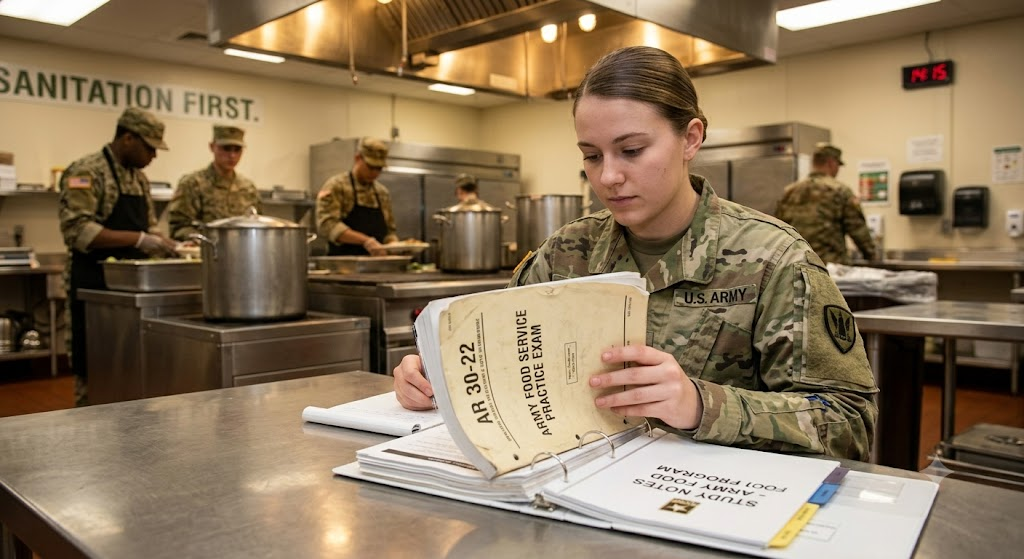
Additional Information
What the Course Entails and Exam Details
This proficiency exam is not a single, standalone "course" in the traditional civilian sense; rather, it is a comprehensive test of knowledge derived from several key Army Regulations and publications, with AR 30-22 (The Army Food Program) and DA PAM 30-22 (Operating Procedures for the Army Food Program) at its core.
The practice test focuses on evaluating the following core competencies and operational areas:
Sanitation and Food Safety: Adherence to strict public health and veterinary standards, including TB MED 530, focusing on proper food handling, personal hygiene, illness prevention, and sanitation of facilities and equipment.
Menu Planning and Nutritional Standards: Developing varied and nutritionally balanced menus that meet specific Army and Surgeon General dietary guidelines to ensure Soldier performance.
Subsistence Supply and Accounting: Procedures for calculating ration requirements, placing subsistence orders (e.g., using Prime Vendor), properly storing, issuing, and maintaining accurate accountability of all food items, and managing food funds/budgets.
Dining Facility (DFAC) Administration: Regulatory requirements for DFAC operations, personnel management, cost control, record-keeping (DA Form 3032, etc.), and overall facility and equipment upkeep.
Garrison and Field Feeding: Differentiating and mastering operational standards for fixed facility dining and remote or field-feeding environments, including the use of specialized mobile kitchen equipment.
Food Defense and Security: Measures to prevent food contamination and secure food assets from intentional and accidental threats.
Portion Control and Food Waste Reduction: Implementing standardized recipes and portioning to minimize waste while ensuring adequate nutrition.
What to Expect in the Final Exam
While the final formal proficiency test may vary slightly depending on the specific Army training command or unit administering it (e.g., as part of MOS training at Fort Gregg-Adams, an NCOES course, or unit proficiency testing), students can generally expect the following:
Format: The primary format is a knowledge-based examination, often using Multiple Choice Questions (MCQs), which may include scenario-based questions that test practical application of regulations. Some components of an actual full evaluation (like AIT or culinary boards) might involve a hands-on, practical cooking or managerial component, but the comprehensive regulatory test is typically knowledge-focused.
Content: The test will cover key definitions, responsibilities of various roles, step-by-step procedures, and precise numbers (e.g., temperature standards for specific storage conditions, timelines for record retention, and specific forms used).
Scoring: A high level of mastery is required. Passing scores in military courses are commonly set at 70% or 80%, reflecting the critical nature of food safety and regulatory compliance. The exam is typically graded on a numerical scale or as pass/fail.
Time Limits: A formal final exam will likely be timed, requiring you to think quickly and demonstrate confident recall of the information.
Rules: The exam will be administered under strict military training guidelines and academic integrity policies. Official manuals (the physical regulations or online equivalents on a computer) are typically not allowed during the exam itself.
How to Study and Exam Centers
Effective preparation requires a structured study plan and dedicated time to learn the technical language of the regulations.
Actionable Study Strategies:
Read and Outline the Core Regulations: Your foundational documents are AR 30-22 and DA PAM 30-22. Read them cover-to-cover. Use a highlighter, take notes, and create your own outlines of the key sections, focusing on the duties, temperatures, forms, and procedures. Also, review relevant sections of TB MED 530 for sanitation.
Use Flashcards: Create flashcards for critical information, such as the safe cooking temperatures of different foods, the functions of various forms (e.g., "What form is the Signature Head Count Sheet?"), key definitions, and the specific responsibilities of a DFAC manager vs. a Food Service Officer. This helps with rapid recall.
Take Practice Tests: Consistent practice with a comprehensive practice test like this is essential. Treat each practice session like the real exam: take it without your notes, time yourself, and carefully review your incorrect answers. Understand why an answer is correct by referencing the specific section in the regulation.
Form a Study Group: If you are with other Soldiers preparing for a similar goal, form a study group. Discussing regulations, questioning each other, and sharing study tips can reinforce learning and help identify your weak spots.
Seek Mentorship: Ask experienced NCOs and warrant officers in your unit or school to clarify complex regulatory points or provide real-world examples of how regulations are applied.
Exam Centers:
The actual final proficiency examination is typically not taken at civilian testing centers. Instead, it is administered at:
Official Army Training Installations: Locations like Fort Gregg-Adams (Virginia), the primary home of Army Logistics and Culinary Specialist (92G) training.
Army Learning Portals (Online): Courses and evaluations may be delivered through systems like the Army Learning Management System (ALMS).
Unit or Command-Specific Facilities: Proficiency exams or promotion board evaluations are often conducted on-site at your unit or installation.
Mobile Training Teams (MTT): Sometimes training and testing are provided at an installation by a visiting team.
Ensure you check your unit's or school's specific instructions for the official exam registration and location.
Job Opportunities from the Course
Mastery of the concepts in AR 30-22 is essential for career progression and unlocks numerous specialized roles and advanced leadership positions within the Army food service track. Knowledge of these regulations is also directly transferable to roles in military food inspection and civilian food service management.
Specific job titles and career paths this proficiency unlocks include:
Army MOS 92G Culinary Specialist (Junior and Senior Enlisted Roles)
Dining Facility (DFAC) Manager
Food Service NCO / NCOIC
Food Service Warrant Officer (922A Food Service Technician)
Food Service Officer (FSO)
Food Service Advisor
Food Program Manager
Culinary Instructor / Trainer
Quality Assurance Inspector
Food Safety and Sanitation Inspector
Success in these roles often requires further formal Army education and other industry-recognized certifications, such as the ServSafe Food Protection Manager certification, which aligns with the sanitation knowledge required. Mastery of AR 30-22 is your key to unlocking these career advancements.
Frequently Asked Questions
Reviews
5.0
Based on 0 reviews
Leave a Review
No reviews yet. Be the first to review!