
Aquatic Pest Management (Category F) Certification Practice Test
$69.00
- Buy to unlock unlimited access to all Quiz questions.
- After purchase you can print a PDF of the whole quiz at any point. The PDF will contain the questions and the correct answers.
About this Exam
The Aquatic Pest Management (Category F) Certification is a specialized professional credential for individuals who apply pesticides to standing or flowing water bodies. This includes lakes, ponds, irrigation systems, canals, and ditches. Designed for pesticide applicators, lake managers, and employees of government agencies (such as water control or mosquito abatement districts), this certification ensures you possess the critical knowledge to manage aquatic nuisances—like algae, weeds, and mosquito larvae—safely and effectively. Earning your Category F certification demonstrates your commitment to environmental stewardship and public health, while legally qualifying you to perform this essential work. It is a vital qualification for anyone whose role involves direct aquatic ecosystem management.
Ready to test your knowledge?
Buy Now to Access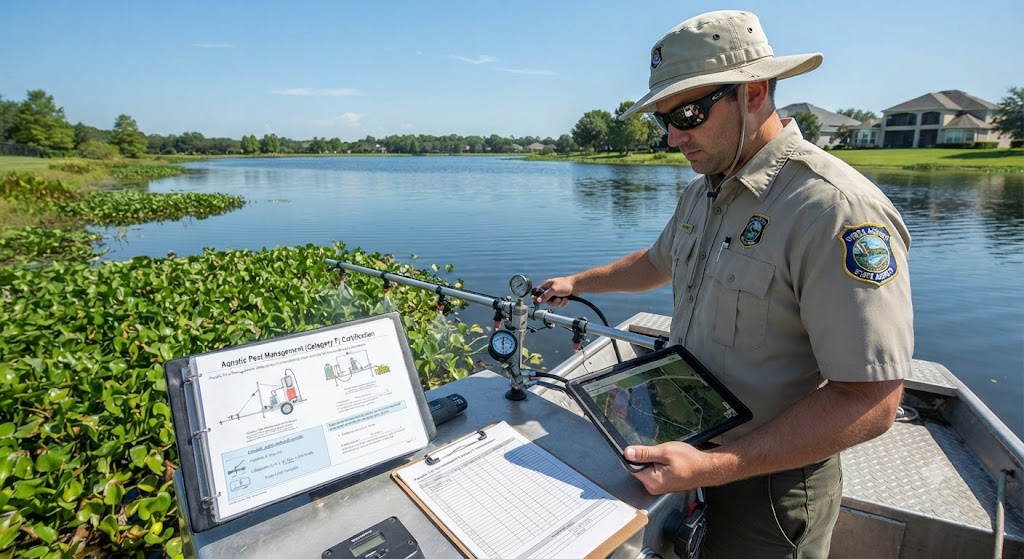
Additional Information
What the Course
Entails and Exam Details
To pass the Category F certification exam, candidates must
master a comprehensive body of knowledge outlined in your state’s specific
pesticide applicator training manual for aquatic environments. The curriculum
is designed to bridge the gap between pest control and water quality
protection.
Core topics covered in the course and exam include:
- Aquatic
Weed and Algae Identification: Understanding the biology and growth
characteristics of various submerged, floating, and emergent plants, as
well as different types of algae.
- Water
Quality and Limnology: Recognizing how water temperature, dissolved
oxygen levels, pH, and hardness affect pesticide efficacy and
environmental impact.
- Aquatic
Ecosystems: Learning the complex relationships between aquatic
organisms, water chemistry, and physical factors within a water body.
- Pesticide
Selection and Application: Identifying the correct herbicide or
algaecide for the target species and calculating proper application rates
(e.g., parts per million (ppm) or acre-feet) to ensure effectiveness and
safety.
- Application
Equipment and Calibration: Understanding the use and maintenance of
specialized application gear, such as boat-mounted sprayers, granular
spreaders, and sub-surface injection systems.
- Environmental
and Human Safety: Mastering the critical skills of reading and
interpreting pesticide labels, implementing safety protocols, preventing
drift and runoff, and protecting non-target species and potable water
sources.
- Laws
and Regulations: Familiarity with federal (FIFRA) and state
regulations governing aquatic pesticide applications, including necessary
permits and record-keeping requirements.
What to Expect in the Final Exam
The Aquatic Pest Management Certification exam is a
rigorous, proctored assessment designed to test your practical knowledge and
regulatory understanding. The format is typically a closed-book, written test
composed primarily of multiple-choice questions. Some states may include
true/false questions or scenario-based questions that require applying your
knowledge to real-world situations described in the manual.
Passing Score: While the exact passing grade varies
by state, you generally need to achieve a score of at least 70% to 75% to pass.
Time Limit: You will be given a set amount of time to
complete the exam, commonly ranging from 1.5 to 2 hours, which is generally
sufficient if you have studied thoroughly.
Materials: You are usually not permitted to use any
study materials, notes, or the training manual during the exam. Basic
calculators may be allowed for the math sections. You must bring valid
government-issued identification and any required registration or examination
fees.
How to Study and
Exam Centers
Success on this exam requires dedicated preparation. Your
primary resource should be the official Aquatic Pest Management (Category F)
training manual provided by your state’s lead agency (e.g., the Department of
Agriculture or Department of Environmental Protection).
Study Strategies:
- Read
the Manual Actively: Do not just skim the text. Take notes on key
terms, concepts, and especially the math formulas for calculating
application rates.
- Master
the Math: A significant portion of the exam will involve calculations.
Practice these repeatedly using the examples in the manual until you can
solve them quickly and accurately.
- Use
Practice Tests: Seek out and complete official or unofficial practice
tests. Taking practice exams helps you become familiar with the question
format and identifies areas where you need further study.
- Focus
on the Label: The mantra "The Label is the Law" is critical.
Be prepared to answer many questions directly related to interpreting and
following product labels.
Where and How to Take the Exam:
The examination process is standardized but administered
regionally.
Registration: You must
first register to take the exam with your state’s certifying agency. This often
requires submitting an application and paying an examination fee.
Exam Locations: The exams
are typically held at designated locations. These may include county extension
offices, state agricultural department regional offices, or authorized testing
centers (such as a university or community college campus).
Online Portals: Many
states are transitioning to online testing through platforms like Pearson
VUE, which offers a secure and convenient way to schedule and take the exam
at a professional testing facility near you.
Authorized Schools: In
some cases, states may approve specific training courses or workshops that
conclude with the certification exam.
Check your state agency’s website directly for the most
current information on schedules, locations, and registration procedures.
Job Opportunities
from the Course
Earning your Aquatic Pest Management (Category F)
Certification opens the door to a variety of specialized and rewarding career
paths focused on environmental stewardship and water resource management. This
certification is often a mandatory requirement for positions that involve the
direct application of pesticides to public or private waters.
This certification qualifies you for the following job
titles and career opportunities:
- Licensed
Aquatic Applicator: Work for private pest control companies
specializing in lake, pond, and canal management.
- Lake
Manager: Oversee the ecological health and recreational quality of
private and public lakes, often working for homeowner associations or lake
management firms.
- Water
Resources Technician/Specialist: Work for county or municipal water
control districts, managing vegetation in irrigation canals, drainage
ditches, and reservoirs.
- Vector
Control Technician/Specialist: Focus on public health by controlling
mosquito larvae in standing water bodies as part of a mosquito abatement
program.
- Golf
Course Superintendent/Assistant: Apply necessary aquatic pesticides to
water hazards and ponds on golf courses as part of overall grounds
maintenance.
- Fisheries
Management Technician: Assist biologists in managing fish populations,
which sometimes involves controlling aquatic vegetation to improve fish
habitat.
- Pesticide
Sales Representative: Utilize your technical expertise to sell aquatic
herbicides, algaecides, and application equipment to professional
applicators and end-users.
Frequently Asked Questions
Reviews
5.0
Based on 0 reviews
Leave a Review
No reviews yet. Be the first to review!