
Aquaculture Technician Certification Practice Exam
$69.00
- Buy to unlock unlimited access to all Quiz questions.
- After purchase you can print a PDF of the whole quiz at any point. The PDF will contain the questions and the correct answers.
About this Exam
The Aquaculture Technician Certification Exam is a vital credential for individuals aspiring to build a successful career in the rapidly expanding field of fish, shellfish, and aquatic plant farming. This certification, often administered by national or regional aquaculture associations (such as the National Aquaculture Association in the U.S.) or authorized agricultural colleges, is designed to validate the practical skills and theoretical knowledge necessary to work effectively on a commercial fish farm, hatchery, or research facility. It is ideally suited for entry-level technicians, farm workers seeking advancement, and students in fisheries or marine biology programs who want to demonstrate their readiness for hands-on roles in aquatic animal husbandry. Passing this exam proves to employers that you possess the core competencies required to maintain healthy stock, manage water quality, and operate essential aquaculture equipment.
Ready to test your knowledge?
Buy Now to Access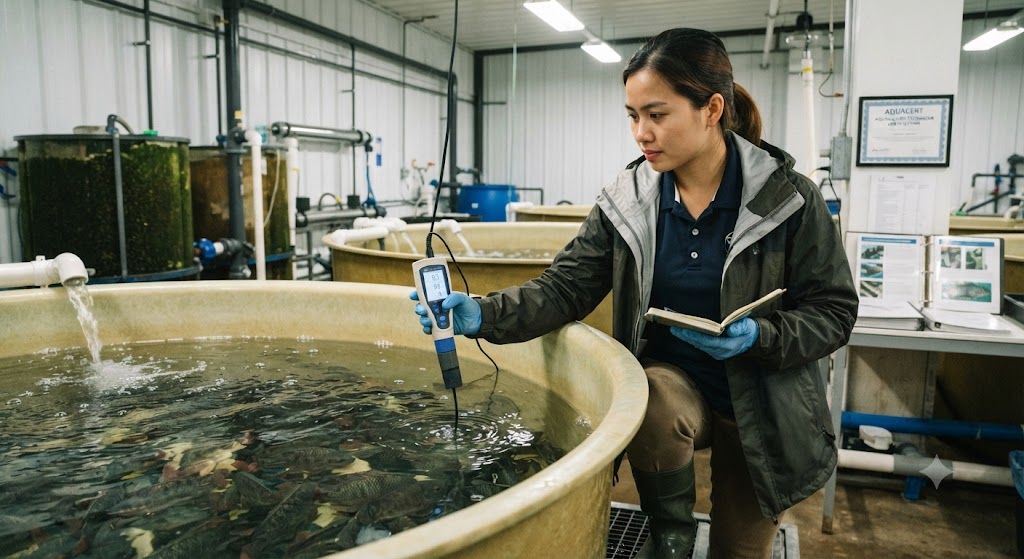
Additional Information
What the Course Entails and Exam Details
While the certification itself is an exam, preparation often
involves reviewing specific training modules or coursework aligned with
industry standards. The scope of the knowledge required is comprehensive,
covering the entire lifecycle of farmed aquatic species.
Key topics covered in the preparatory coursework and the
exam include:
- Water
Quality Management: Understanding and monitoring critical parameters
such as dissolved oxygen, pH, temperature, ammonia, nitrites, and
alkalinity, and knowing how to correct imbalances.
- Aquatic
Animal Husbandry: Best practices for stocking, handling, grading, and
transferring fish or shellfish. This includes understanding density
management and minimizing stress.
- Fish
Nutrition and Feeding: Knowledge of different feed types, feed
conversion ratios (FCR), feeding methods (hand vs. automated), and
nutritional requirements at various life stages.
- Health
and Disease Management: Recognizing common signs of disease,
implementing biosecurity protocols to prevent outbreaks, understanding
basic parasite and pathogen identification, and administering treatments
under supervision.
- Facility
Operation and Maintenance: Practical knowledge of various aquaculture
systems, including flow-through raceways, pond management, recirculating
aquaculture systems (RAS), and net pens. This includes basic maintenance
of pumps, aerators, and filtration systems.
- Record
Keeping and Regulations: The importance of maintaining accurate daily
logs for inventory, mortality, feeding, and water quality, as well as an
overview of environmental regulations and permits governing aquaculture
operations.
What to Expect in the Final Exam
The Aquaculture Technician Certification Exam is typically a
comprehensive, proctored assessment designed to test both theoretical knowledge
and practical application.
- Format:
The exam is usually composed of multiple-choice questions, true/false
questions, and scenario-based questions that require you to apply your
knowledge to real-world farm situations. Some certifying bodies may
include a practical component, where you must demonstrate skills like
water testing or equipment troubleshooting in a controlled setting.
- Number
of Questions: The exam generally consists of 100 to 150 questions.
- Time
Limit: Candidates are usually given 2 to 3 hours to complete the
written portion of the exam.
- Passing
Score: A passing score of 70% or higher is typically required to
achieve certification.
- Exam
Rules: This is a closed-book exam. No reference materials, electronic
devices, or outside assistance are permitted during the testing period.
How to Study and Exam Centers
Effective preparation is key to success on certification
day.
- Study
Strategies: Begin by thoroughly reviewing any official study guides or
recommended reading lists provided by the certifying organization. Focus
heavily on the core pillars of water quality, fish health, and system
operation. Hands-on experience is invaluable; if possible, spend extra
time working directly with the systems and species covered by the exam.
Flashcards are excellent for memorizing water quality parameters, disease
symptoms, and feed conversion formulas. Practice tests, such as the one
associated with this guide, are crucial for familiarizing yourself with
the question format and identifying areas where you need further study.
- Exam
Centers: The exam is typically administered in several ways. Many are
offered as computer-based tests at authorized testing centers (similar to
Pearson VUE locations) partnered with the certifying body. Alternatively, the
exam may be held in conjunction with major aquaculture industry
conferences or at designated vocational colleges and universities that act
as testing sites. You must register for the exam in advance through the
certifying organization's website, where you can select a convenient
location and date. Some organizations may also offer secure online
proctoring, allowing you to take the exam remotely from a controlled
environment.
Job Opportunities
from the Course
Earning your Aquaculture Technician Certification opens the
door to a variety of rewarding career paths within the diverse aquaculture
industry. This credential demonstrates your commitment to the profession and
your readiness to take on significant responsibilities.
Certified Aquaculture Technicians are qualified for roles
such as:
- Hatchery
Technician: Working in the specialized environment of a fish or
shellfish hatchery, focusing on broodstock care, egg incubation, and
larval rearing.
- Fish
Culturist: A hands-on role responsible for the daily care of growing
fish stock, including feeding, monitoring health, and maintaining tanks or
pens.
- Water
Quality Technician: Specializing in the critical task of monitoring
and managing water chemistry across a facility to ensure optimal growing
conditions and environmental compliance.
- Assistant
Farm Manager: An entry-level management position that involves
overseeing daily operations, supervising junior staff, and assisting with
production planning.
- RAS
(Recirculating Aquaculture System) Technician: Working specifically
with complex, technology-driven indoor systems, managing biofilters, ozone
generators, and water sterilization equipment.
- Shellfish
Farm Technician: Focused on the cultivation of oysters, clams, or
mussels, involving tasks like seed handling, gear maintenance, and
harvest.
- Aquaculture
Research Assistant: Supporting research scientists in universities or
private companies by conducting experiments, collecting data, and
maintaining study populations.
This certification is your first step toward a stable and
impactful career in sustainable food production.
Frequently Asked Questions
Reviews
5.0
Based on 0 reviews
Leave a Review
No reviews yet. Be the first to review!