
AQA Product Design Practice Exam
$69.00
- Buy to unlock unlimited access to all Quiz questions.
- After purchase you can print a PDF of the whole quiz at any point. The PDF will contain the questions and the correct answers.
About this Exam
The AQA Product Design specification is a creative and thought-provoking qualification that gives students the practical skills, theoretical knowledge, and confidence to succeed in a number of careers, especially those in the creative industries. Students will investigate historical, social, cultural, environmental, and economic influences on design and technology, whilst enjoying opportunities to put their learning into practice by producing prototypes of their choice.
This qualification is designed for students who are passionate about creation, innovative problem-solving, and have a strong interest in understanding how products are developed and manufactured in the real world. It serves as an excellent foundation for further study in areas such as industrial design, engineering, and various creative design disciplines, and is sought after by employers who value critical thinking and practical application.
Ready to test your knowledge?
Buy Now to Access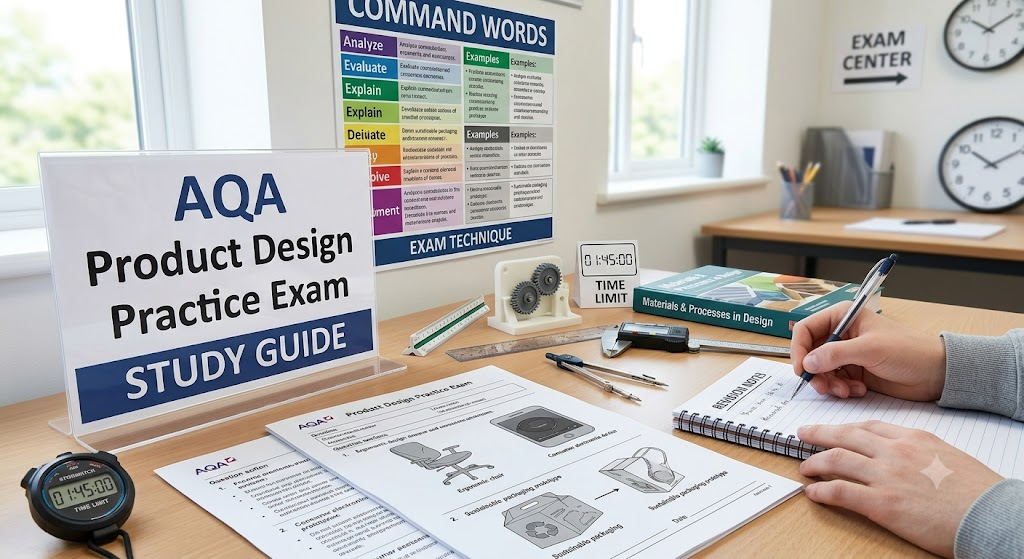
Additional Information
What the Course Entails and Exam Details
The core topics and syllabus cover a comprehensive blend of theory and practice. Students will delve into:
Technical Principles: This includes understanding materials and their applications (papers, boards, polymers, woods, metals, composites, smart and modern materials), their enhancement, performance characteristics, and testing. It also covers forming, redistribution, and addition processes, adhesives, fixings, jigs, fixtures, and finishing processes. Furthermore, it encompasses modern industrial and commercial practice, computer systems, rapid prototyping, production management, legislation, health and safety, and intellectual property.
Designing and Making Principles: This section focuses on design methods, the iterative design process, user needs, and primary/secondary data. Students will study design theory, the work of key designers and design movements, socio-economic and ethical influences, and sustainability. They will learn to develop a specification, model, and plan for industrial iteration, and perform evaluation and testing. The course emphasizes accuracy in manufacture, responsible design, quality assurance and control, and relevant national/international standards.
The AQA Product Design assessment is linear, meaning all components are taken at the end of the course. It typically consists of both non-exam assessment (NEA) coursework and final written examinations. For the specific details:
The NEA is a substantial 'design and make' project that accounts for 50% of the final qualification. It consists of a written or digital design portfolio and photographic evidence of a final prototype.
The Final Exams account for the remaining 50% and include assessment of mathematical and scientific skills within a design context. The format involves short and extended response questions.
What to Expect in the Final Exam
While the exact structure may differ between GCSE and A Level, a representative practice exam provides invaluable insight into what to expect in the official final assessment. The papers are designed to test a breadth of knowledge and the depth of understanding.
For the purposes of this study guide, which is based on the general AQA Product Design format, you should prepare for the following across multiple papers:
Written Exam Format: Expect a mixture of multiple-choice, short-answer questions (worth 2–5 marks), and extended-response questions. The use of specific command words, such as "describe," "explain," "analyze," and "evaluate," is key to unlocking top marks, as they signpost the type and depth of response required.
Marks and Weighting: A practice exam of this type will have a defined number of marks. In the full qualification, written exams are typically split into different papers with varied weightings, for example, 30% and 20% of the final grade.
Time Limits: A realistic practice exam will have a strict time limit, typically between 1.5 and 2.5 hours, to mimic the high-pressure environment of the official test. Practice managing your time effectively between sections.
Specific Rules: All AQA examinations must be taken under strict invigilated conditions at an authorized center. Standard examination rules regarding equipment, materials, and behavior apply.
How to Study and Exam Centers
Preparation for the AQA Product Design exam requires a multi-faceted approach, balancing theoretical knowledge with practical understanding. Here are actionable strategies:
Use the Specification as Your Checklist: Download the official AQA Product Design specification. It details exactly what is in the exam. Tick off each topic as you revise to ensure comprehensive coverage.
Practice with Past Papers: This is crucial. Get hold of as many past exam papers and mark schemes as possible. This will familiarize you with the question style, the distribution of marks, and how to structure your answers to meet the criteria. Try a full paper under timed conditions to improve your pacing.
Focus on Command Words: Understand the difference between "list," "describe," "explain," "analyze," and "evaluate." This is often the differentiator between a good and an excellent score.
Create Flashcards for Key Terminology: The course has a lot of technical terms. Creating digital or physical flashcards for materials, processes, legislation, and design theories is an efficient way to commit them to memory.
Review Your NEA: The knowledge you gained during your 'design and make' project is directly applicable to the exam, especially in the designing and making principles sections. Review your portfolio and reflect on your decisions.
Brush Up on Your Maths and Science: Remember, at least 15% of the exam marks will assess mathematical skills, and 10% will assess science in a design and technology context. Practice these calculations and application scenarios.
Where to Take the Exam: The AQA Product Design final examinations are formal academic qualifications that cannot be taken online. They are held at authorized examination centers, which primarily include registered schools, sixth form colleges, and specific further education establishments throughout the United Kingdom. If you are a private candidate, you must find a center that is willing to host you. You will typically be required to attend a physical examination hall on set dates to sit the papers.
Job Opportunities from the Course
A qualification in AQA Product Design unlocks a diverse range of creative and technical career paths. It is valued for developing core skills such as problem-solving, iterative design, planning, and evaluation. Successful students are well-prepared for entry-level roles or higher education in related fields, which can lead to specific job titles, including:
Product Designer: The most direct career path, involving the complete design cycle of creating new products, from concept to manufacture.
Industrial Designer: Focused on designing mass-produced consumer goods, from electronics to cars.
Design Engineer: Combining engineering principles with creative design to develop functional and manufacturable solutions.
CAD Technician / Designer: Creating detailed 2D technical drawings and 3D models and renderings for various industries.
Furniture and Lighting Designer: Specializing in creating bespoke or mass-produced items for residential and commercial spaces.
User Experience (UX) Designer: Applying a deep understanding of user needs to design intuitive physical and digital products.
Prototype Technician / Model Maker: Constructing physical models and working prototypes using traditional and modern manufacturing techniques.
Packaging Designer: Developing functional, branded packaging that protects and markets products.
Quality Assurance Specialist: Ensuring that manufactured products meet specific safety, durability, and compliance standards.
Interior and Spatial Designer: Applying design and aesthetic principles to interior environments.
Exhibition Designer: Creating visual layouts and structures for museums, trade shows, and events.
Medical and Healthcare Product Designer: Designing specialized equipment and devices for the healthcare sector.
This course serves as a critical first step for anyone aspiring to shape the world through innovative design.
Frequently Asked Questions
Reviews
5.0
Based on 0 reviews
Leave a Review
No reviews yet. Be the first to review!