
AQA GCSE Music Practice Exam
$69.00
- Buy to unlock unlimited access to all Quiz questions.
- After purchase you can print a PDF of the whole quiz at any point. The PDF will contain the questions and the correct answers.
About this Exam
The AQA GCSE Music qualification is an exciting and rigorous course designed for secondary school students in the United Kingdom who have a passion for music.
This exam is perfect for young musicians who want to deepen their understanding of musical theory, history, and composition, while also honing their performance skills.
It provides a strong foundation for further study in music at A-Level or through vocational pathways, appealing to those who enjoy both the creative and analytical aspects of the art form.
Ready to test your knowledge?
Buy Now to Access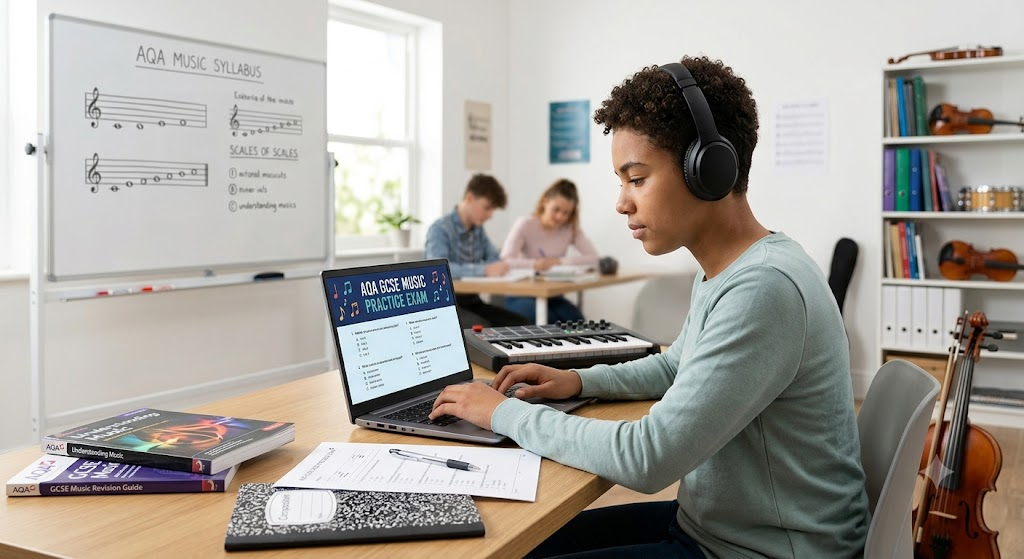
Additional Information
What the Course Entails and Exam Details
The course is comprehensively structured around three main components: Understanding Music, Performing Music, and Composing Music.
Students explore diverse "Areas of Study," which typically include Western Classical Tradition (1650–1910), Popular Music, Traditional Music, and the Western Classical Tradition since 1910.
Within these areas, learners develop critical listening skills, analyze set works, and master musical vocabulary.
The details of the exam involve a mixture of practical assessments (performance and composition coursework) and a final written paper, ensuring a balanced evaluation of both practical and theoretical knowledge.
What to Expect in the Final Exam
The final assessment structure is clearly defined. The written exam (Component 1: Understanding Music) is approximately 1 hour and 30 minutes long and accounts for 40% of the total marks.
This paper requires students to answer questions based on listening extracts, ranging from multiple-choice to short-answer and extended analysis of set works.
The remaining 60% is coursework-based: 30% for Performance (Component 2), requiring a minimum of four minutes of music (including solo and ensemble pieces), and 30% for Composition (Component 3), requiring students to compose two original pieces totaling at least three minutes.
Passing scores are determined by grade boundaries set by AQA each year, ranging from Grade 9 (highest) to Grade 1.
How to Study and Exam Centers
Effective study strategies for this exam require a multifaceted approach.
For the written paper, students should engage in regular active listening across all genres, utilize flashcards for key terms, and practice analyzing the specific set works outlined in the specification.
For the practical elements, consistent rehearsal on their chosen instrument or voice is essential, alongside seeking regular feedback from music teachers on compositions.
The actual written exam is typically taken at authorized schools and high schools, which serve as the official exam centers.
Coursework assessments (performance and composition) are internally marked by teachers and externally moderated by AQA.
Job Opportunities from the Course
While AQA GCSE Music is an initial step, it unlocks numerous educational and career pathways. The course develops transferable skills like discipline, creativity, and critical analysis.
Potential future career paths that this qualification supports include:
Professional Musician (Soloist or Ensemble Member)
Music Teacher (Primary, Secondary, or Private Tutor)
Composer or Arranger for Film, TV, and Games
Sound Engineer or Music Producer
Arts Administrator or Artist Manager
Music Therapist
Radio or TV Researcher/Presenter
Music Journalist or Critic
Frequently Asked Questions
Reviews
5.0
Based on 0 reviews
Leave a Review
No reviews yet. Be the first to review!