
APSE Certified Employment Support Professional (CESP) Practice Exam
$69.00
- Buy to unlock unlimited access to all Quiz questions.
- After purchase you can print a PDF of the whole quiz at any point. The PDF will contain the questions and the correct answers.
About this Exam
The APSE Certified Employment Support Professional (CESP) certification is a prestigious, nationally recognized credential designed for individuals dedicated to supporting people with disabilities in achieving integrated employment. Offered by the Association of People Supporting Employment First (APSE), this exam validates the knowledge and skills necessary to provide high-quality, community-based employment services. The CESP certification is for professionals committed to advancing the principles of competitive, integrated employment and empowering individuals with disabilities to pursue meaningful career paths in the general workforce.
Ready to test your knowledge?
Buy Now to Access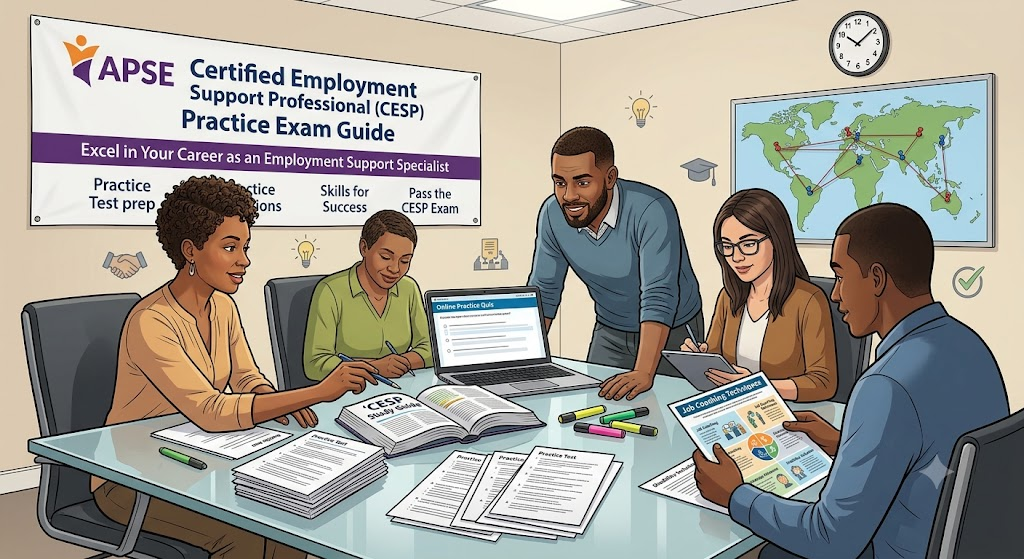
Additional Information
What the Course Entails and Exam Details
Preparing for the CESP exam involves mastering the core competencies essential for effective employment support. The exam content focuses heavily on practical knowledge and ethical application of principles. Key subject areas covered in the practice and final exam include:
Foundation for Disability and Support Services: Understanding different types of disabilities, the history of support services, and disability legislation like the Americans with Disabilities Act (ADA).
Employment Support Process: Mastering the entire employment cycle, including assessment, discovery, job development, job coaching, and long-term support planning.
Discovery and Career Planning: Learning how to identify an individual's strengths, interests, skills, and unique contributions to create personalized career plans.
Job Development and Employer Engagement: Techniques for building relationships with employers, negotiating job duties, and identifying workforce needs.
Individualized Support and Job Coaching: Strategies for providing on-site and off-site job coaching, implementing task analysis, and fostering a supportive work environment.
Ethics and Professional Conduct: Adhering to professional standards of conduct, confidentiality, and promoting self-determination for individuals with disabilities.
What to Expect in the Final Exam
The final APSE CESP exam is a rigorous assessment consisting of approximately 100 to 125 multiple-choice questions. It is designed to evaluate both theoretical knowledge and situational judgment. The content is divided into domains related to the core competencies listed above. Candidates are given approximately 2 to 3 hours to complete the exam. While the passing score is standardized and determined by the APSE Board, it generally falls within the range of 70-75%, but this can vary. Success requires a solid grasp of not just the 'how' of employment support, but also the 'why'—applying best practices ethically and effectively in diverse real-world scenarios. The exam is often proctored.
How to Study and Exam Centers
Effective preparation for the CESP exam requires a comprehensive approach. Here are actionable study strategies:
Review Official Resources: Start with the official CESP Exam Content Outline and recommended reading lists provided by APSE.
Practice with Purpose: Utilize comprehensive practice exams to familiarize yourself with the question format, time constraints, and content areas. Analyze incorrect answers to understand the underlying concepts.
Join Study Groups: Collaborate with colleagues or peers preparing for the exam to discuss concepts, share resources, and provide mutual support.
Attend Workshops and Training: Look for training sessions and workshops focused on supported employment and job coaching best practices, which often align with the CESP competencies.
Regarding exam logistics, the CESP exam is typically administered through authorized test centers and online proctoring platforms. APSE frequently partners with organizations like Meazure Learning (formerly ProctorU) and physical testing facilities, including community colleges and vocational rehabilitation centers, to offer convenient testing options. For the most up-to-date list of approved testing locations and to register for the exam, visit the official APSE certification webpage.
Job Opportunities from the Course
Earning the CESP certification demonstrates commitment and professional competence, opening doors to a range of rewarding careers in employment support. Specific job titles and roles include:
Employment Support Professional (ESP)
Job Coach
Vocational Rehabilitation Counselor
Employment Specialist
Career Developer
Case Manager (with a focus on employment)
Transition Coordinator (for students moving from school to work)
Disability Program Manager (in corporate settings)
Frequently Asked Questions
Reviews
5.0
Based on 0 reviews
Leave a Review
No reviews yet. Be the first to review!