
Approaches in Psychology AQA Practice Test
$69.00
- Buy to unlock unlimited access to all Quiz questions.
- After purchase you can print a PDF of the whole quiz at any point. The PDF will contain the questions and the correct answers.
About this Exam
The "Approaches in Psychology" section is a foundational and critical component of the AQA A-Level Psychology specification. It is designed to introduce students to the primary theoretical frameworks that have shaped the discipline of psychology. This module is essential for all A-Level Psychology students, as understanding these core approaches—such as the Cognitive, Biological, and Psychodynamic perspectives—is a prerequisite for analyzing complex psychological debates, issues, and methods later in the course. Mastering this material is not only crucial for achieving high marks in your A-Level exams but also for developing a sophisticated understanding of why psychologists study human behavior in the ways that they do.
Ready to test your knowledge?
Buy Now to Access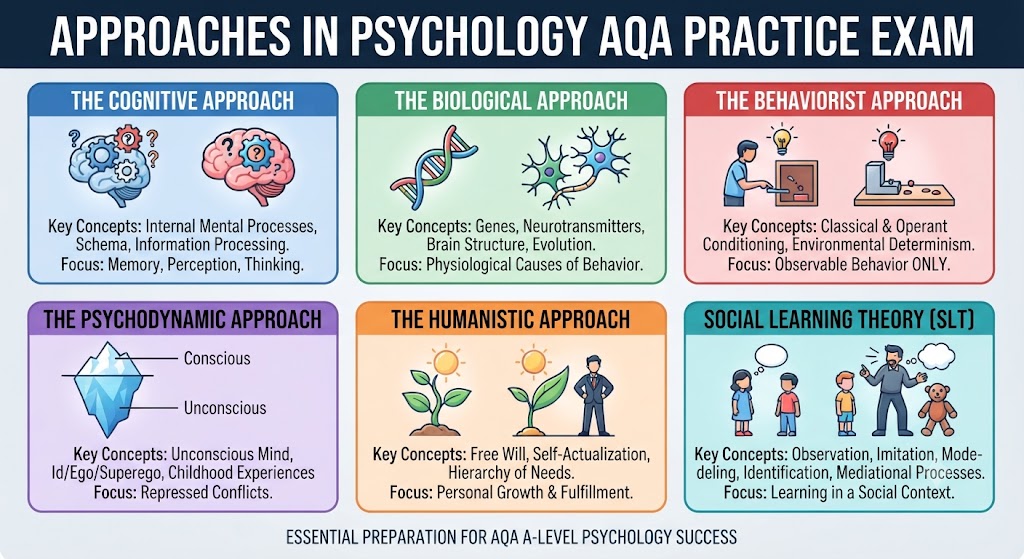
Additional Information
What the Course Entails and Exam Details
This module requires students to develop a detailed
knowledge and critical understanding of six major psychological approaches. The
course entails an in-depth exploration of the origins, key assumptions, methods
of investigation, and contributions of each perspective. The specific
approaches covered are:
- The
Cognitive Approach: Focusing on internal mental processes like memory,
perception, and thinking, often using computer analogies and experimental
methods.
- The
Biological Approach: Emphasizing the role of physiological and genetic
factors, such as the brain, nervous system, neurotransmitters, and
hormones, in influencing behavior.
- The
Behaviorist Approach: Arguing that all behavior is learned through
interaction with the environment, primarily via classical and operant
conditioning. This approach rejects the study of internal mental states.
- The
Psychodynamic Approach: Founded by Sigmund Freud, this perspective
highlights the influence of the unconscious mind, childhood experiences,
and tripartite personality structure (Id, Ego, Superego) on behavior.
- The
Humanistic Approach: Focusing on free will, self-actualization, and
the inherent drive for personal growth. This approach emphasizes
subjective experience and the concept of the "self."
- Social
Learning Theory (SLT): Bridging the gap between behaviorism and
cognitive psychology, SLT proposes that learning occurs through
observation, imitation, and modeling of others within a social context.
Additionally, students must be able to effectively compare
and contrast these approaches, evaluating their strengths and weaknesses in
terms of their scientific rigor, determinism (versus free will), and
nature-nurture debates.
What to Expect in the Final Exam
The assessment for "Approaches in Psychology" is
integrated into the overall AQA A-Level Psychology papers. You will not sit a
separate, standalone exam for this module. Instead, questions related to this
topic will appear across your three main written papers (Paper 1, Paper 2, and
Paper 3).
The exam format for these questions typically includes a mix
of:
- Multiple-Choice
Questions (MCQs): Testing factual recall of key assumptions or
terminology.
- Short-Answer
Questions: Requiring concise explanations of concepts, such as
"Outline one assumption of the biological approach."
- Extended-Response
(Essay) Questions: These are high-tariff questions (often 12 or 16
marks) that demand a comprehensive, well-structured essay. An example
might be: "Discuss the contributions of the psychodynamic approach to
psychology. Refer to other approaches in your answer."
- Scenario-Based
Application Questions: Presenting a real-world situation and asking
you to explain it from the perspective of a specific approach.
There is no specific passing score for this section.
Your performance on these questions contributes to your overall A-Level grade
(A*-E). The time allocated for each paper is 2 hours, and you must manage your
time effectively across all sections. A general rule of thumb is to allocate
approximately 1.5 minutes per mark. For example, a 16-mark essay should be
completed in about 24-26 minutes.
How to Study and
Exam Centers
Success in the Approaches module requires more than just
memorizing definitions; it requires deep understanding and the ability to apply
and evaluate theoretical concepts.
Actionable Study Strategies:
- Create
Concept Maps: For each approach, create a detailed visual map linking
its founder, key assumptions, methods, and supporting studies.
- The
"Compare and Contrast" Matrix: Develop a large grid to
directly compare all six approaches across key debates (e.g., nature vs. nurture,
reductionism vs. holism, idiographic vs. nomothetic). This is invaluable
for essay preparation.
- Use
Flashcards: Utilize digital tools like Anki or physical flashcards for
rapid-fire recall of key terms, theorists, and research studies associated
with each approach.
- Practice
Past Paper Questions: This is non-negotiable. Obtain past AQA
Psychology papers from the official AQA website and complete the
Approaches questions under timed conditions. Pay close attention to the
mark schemes to understand what examiners are looking for in terms of
detail and evaluative depth.
- Write
Timed Essays: Regularly practice writing full 12-16 mark essays on
potential topics. Focus on developing a strong argument, using accurate
terminology, and providing critical evaluation.
Exam Centers:
You do not book a specific center for the Approaches
test itself. As part of the full AQA A-Level Psychology qualification, you will
sit your exams at an authorized school, college, or private exam center where
you are registered as a student or private candidate. Your center is
responsible for managing all aspects of your exam entry and administration.
Job Opportunities
from the Course
While the "Approaches in Psychology" module itself
is an academic unit of study, it is a foundational building block for a vast
array of careers that value an understanding of human behavior, cognition, and
motivation. This certification is a stepping stone toward numerous fulfilling
professions.
Directly Related Career Paths:
- Clinical
Psychologist: Assessing and treating mental health conditions, often
using therapies rooted in cognitive or psychodynamic approaches.
- Counseling
Psychologist: Providing therapeutic support to individuals, drawing on
humanistic and psychodynamic principles.
- Educational
Psychologist: Working with students, teachers, and parents to address
learning and behavioral challenges, utilizing behavioral and cognitive
theories.
- Health
Psychologist: Researching and promoting healthy behaviors, applying
principles from behavioral and cognitive approaches to lifestyle change.
- Forensic
Psychologist: Applying psychological principles to legal and criminal
justice issues, often informed by biological and social learning theories.
- Psychological
Wellbeing Practitioner (PWP): Delivering low-intensity interventions
for common mental health problems, primarily based on cognitive-behavioral
therapy (CBT).
- Neuropsychologist:
Specializing in the relationship between the brain and behavior, a direct
application of the biological approach.
Careers Where Psychology is Valued:
- Human
Resources (HR) Manager: Understanding employee motivation, behavior,
and group dynamics.
- Marketing
and Advertising Executive: Applying knowledge of consumer behavior and
cognitive processing to influence purchasing decisions.
- Social
Worker: Supporting vulnerable individuals and families, utilizing an
understanding of social learning and developmental psychology.
- Teacher/Lecturer:
Applying educational and developmental psychology to facilitate learning.
- Career
Coach/Life Coach: Guiding individuals in personal and professional
development, often using humanistic approaches.
Frequently Asked Questions
Reviews
5.0
Based on 0 reviews
Leave a Review
No reviews yet. Be the first to review!