
Appraiser I & II Practice Exam
$69.00
- Buy to unlock unlimited access to all Quiz questions.
- After purchase you can print a PDF of the whole quiz at any point. The PDF will contain the questions and the correct answers.
About this Exam
The Appraiser I & II Licensure Exams represent a critical first step toward a successful and stable career in professional real estate valuation. These state-administered certifications are designed for aspiring real estate appraisers who need to demonstrate foundational knowledge of valuation principles, property law, and appraisal methodology. The Appraiser I exam typically leads to licensure as an Trainee or Apprentice Appraiser, authorizing individuals to begin accruing required experience hours under the supervision of a Certified Appraiser. The Appraiser II exam often corresponds to the Licensed Residential Appraiser classification, allowing for independent work on less complex residential properties. Successfully passing these rigorous exams is the gateway to gaining the professional standing required to enter this essential field of real estate finance and assessment.
Ready to test your knowledge?
Buy Now to Access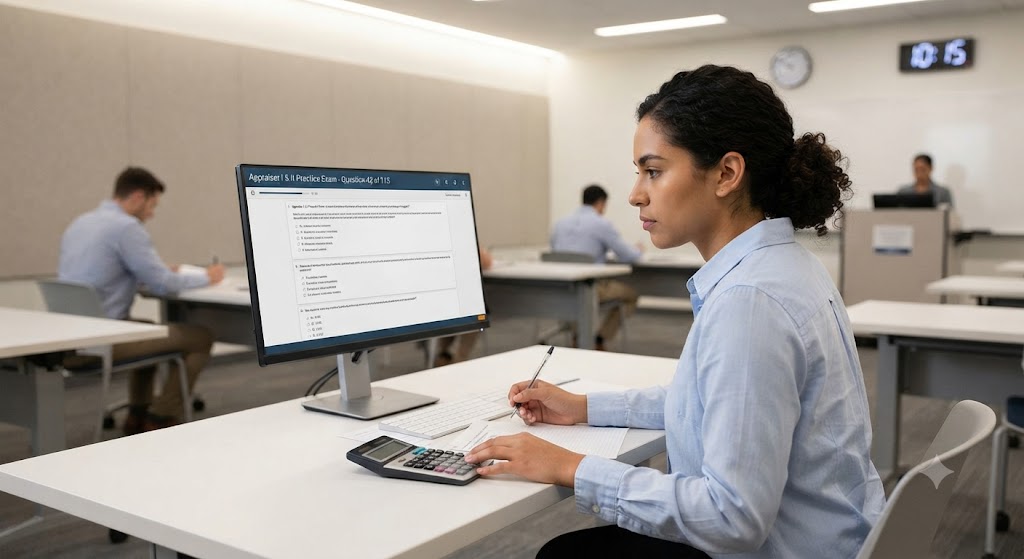
Additional Information
What the Course Entails and Exam Details
While the specific nomenclature can vary slightly by state,
Appraiser I & II curriculum is universally structured around the core
competencies established by the Appraiser Qualifications Board (AQB) of The
Appraisal Foundation. These foundational courses are intensive and
comprehensive.
Candidates must master several key content areas, including:
- Basic
Appraisal Principles: This covers real property concepts, legal
considerations, influences on real estate value, types of value, economic
principles, and an introduction to real estate markets and analysis.
- Basic
Appraisal Procedures: This entails an in-depth study of the valuation
process, property identification, data collection and analysis, and an
introduction to the three primary approaches to value: the Cost Approach,
the Sales Comparison Approach, and the Income Approach.
- Uniform
Standards of Professional Appraisal Practice (USPAP): Both Appraiser I
and II candidates must have a flawless understanding of USPAP, the
generally accepted standards for professional appraisal practice in the
United States. This section covers ethics, competency, scope of work, and
reporting obligations.
- Residential
Market Analysis and Highest and Best Use: Appraiser II candidates, in
particular, must demonstrate proficiency in analyzing market data to
determine the highest and best use of a property, which is fundamental to
the valuation process.
- Residential
Appraiser Site Valuation and Cost Approach: This involves detailed
instruction on valuing land and estimating the cost to reproduce or
replace improvements, adjusted for depreciation.
- Residential
Sales Comparison and Income Approaches: A deep dive into the mechanics
of these two critical valuation methodologies, including the selection and
adjustment of comparable sales and the derivation of capitalization rates
or gross rent multipliers.
What to Expect in
the Final Exam
The Appraiser I & II exams are challenging, secure, proctored
examinations that test both rote memorization of facts and the application of
complex valuation concepts.
The format for both exams is predominantly multiple-choice
questions. For the Appraiser I (Trainee) exam, you should anticipate
approximately 75-115 scored questions, with an additional 15 or so non-scored
pretest questions. The Appraiser II (Licensed Residential) exam is often longer
and more complex, typically featuring 110-125 scored multiple-choice questions.
Candidates are allotted a generous amount of time, usually
between 3 and 4.5 hours, to complete the examination. This time limit is
designed to allow for careful reading and analysis of scenario-based questions.
The passing score for both Appraiser I and II exams is set
by the state licensing board, but it is uniformly standardized nationally. You
must achieve a scaled score of at least 75 points to pass. This is a rigorous
threshold, demanding thorough preparation.
A critical rule for these exams is the prohibition of
personal items. You will be allowed a secure locker for your belongings. You
will generally be permitted to use a basic, non-programmable financial
calculator (such as the HP 12C or a standard Texas Instruments model) that has
been approved by the testing administrator. Scratch paper and pencils will be
provided at the test center. All mathematical calculations must be performed on
the approved calculator.
How to Study and
Exam Centers
Success on the Appraiser I & II exams requires a
disciplined, multi-faceted study approach.
First and foremost, you must thoroughly review the required
coursework material from your approved education provider. Do not rely solely
on one source; use multiple textbooks and study guides to reinforce your
understanding of concepts like depreciation, reconciliation, and the
intricacies of USPAP.
Practice is essential. Utilize the official practice exams
provided by The Appraisal Foundation or your state board. Additionally, invest
in high-quality commercial exam preparation materials that offer hundreds of
practice questions, including detailed scenarios and math problems. These
resources help you acclimate to the testing format and identify areas where you
need further review. Focus heavily on mastering the mathematics of the three
approaches to value.
Forming a study group with fellow candidates can also be
invaluable for discussing complex scenarios and testing each other's knowledge
of USPAP.
The Appraiser I & II exams are not available online.
They must be taken in person at a secure, authorized professional testing
center. In many states, these exams are administered by third-party testing
vendors like Pearson VUE. You must register for the exam through your state's
real estate appraiser board or the designated testing service provider's
website. The website will allow you to create an account, select a testing
location nearest to you, schedule your exam date and time, and pay the required
examination fee. Ensure you bring the required forms of identification to the
test center on exam day.
Job Opportunities
from the Course
Achieving licensure as a Trainee (Appraiser I) or Licensed
Residential Appraiser (Appraiser II) unlocks a diverse and rewarding career
path within the real estate industry. This foundational credential is the first
step toward becoming a Certified Residential or Certified General Appraiser.
Licensed individuals are qualified for a variety of roles,
including:
- Trainee
Appraiser: Work under the mentorship of a Certified Appraiser to gain
the required experience hours for higher licensure, assisting with
residential property appraisals.
- Staff
Appraiser for Lenders/Banks: Perform internal valuations for mortgage
lending, refinancing, and portfolio management on residential properties.
- Appraisal
Reviewer: Work for financial institutions or appraisal management
companies to review completed appraisals for compliance and accuracy.
- Junior
Real Estate Analyst: Assist senior analysts in conducting market
research, feasibility studies, and valuation for real estate developers
and investment firms.
- County
Tax Assessor's Office: Work as a property appraiser for local
government, assessing residential properties for tax purposes.
- Relocation
Appraiser: Specialize in appraising homes for individuals and families
relocating for corporate or military assignments.
- Real
Estate Agent/Broker with Valuation Expertise: Leverage appraisal
knowledge to provide clients with more accurate pricing strategies and
market insights.
This licensure provides the essential foundation for a
long-term and prosperous career in the dynamic world of real estate valuation.
Frequently Asked Questions
Reviews
5.0
Based on 0 reviews
Leave a Review
No reviews yet. Be the first to review!