
Applied Salon Practice exam
$69.00
- Buy to unlock unlimited access to all Quiz questions.
- After purchase you can print a PDF of the whole quiz at any point. The PDF will contain the questions and the correct answers.
About this Exam
The Applied Salon Practice exam is a pivotal step for aspiring cosmetology and beauty professionals. This certification serves as a comprehensive assessment of the practical skills and theoretical knowledge necessary to excel in a real-world salon environment. Designed for students who have completed their required coursework in cosmetology, esthetics, or nail technology, this exam validates your readiness to provide high-quality services to clients. Passing the Applied Salon Practice exam is often a mandatory requirement for state licensure, marking the transition from student to licensed practitioner. It is a rigorous evaluation that ensures you possess the technical expertise and professional judgment to maintain safety, sanitation, and client satisfaction in the beauty industry.
Ready to test your knowledge?
Buy Now to Access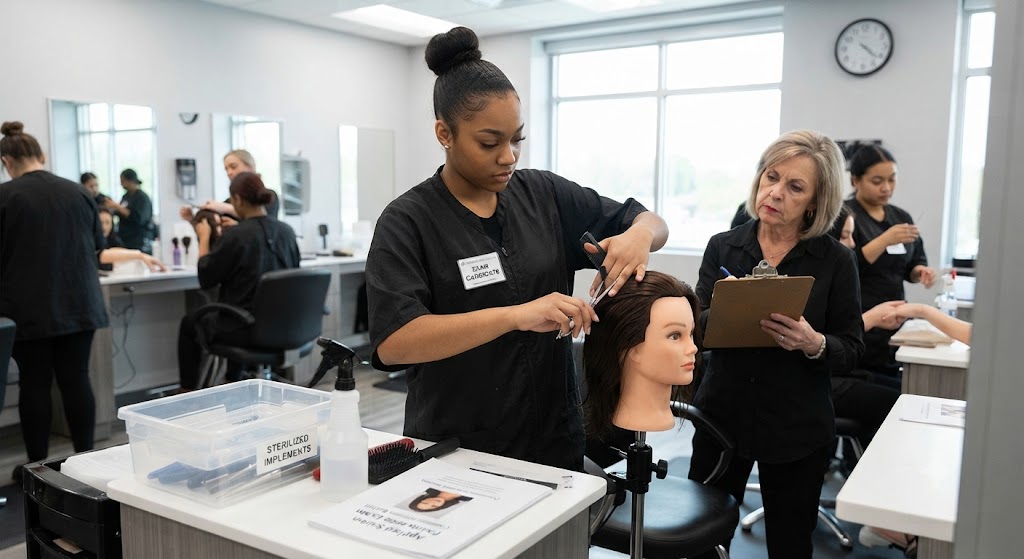
Additional Information
What the Course Entails and Exam Details
Before attempting the Applied Salon Practice exam, candidates
must complete a comprehensive training program that covers a wide array of
beauty disciplines. The curriculum is designed to build a strong foundation in
both theory and practical application. Core topics typically include:
- Hair
Care and Design: This encompasses hair cutting, styling, coloring,
chemical texture services (like perms and relaxers), and intricate
braiding techniques. Students learn to analyze hair types, select
appropriate products, and execute various styles with precision.
- Skin
Care and Esthetics: Training in this area covers facial treatments,
skin analysis, hair removal (waxing and threading), makeup application,
and advanced esthetic procedures. Emphasis is placed on understanding skin
physiology and maintaining hygiene standards during treatments.
- Nail
Technology: Candidates study manicure and pedicure procedures, nail
enhancements (acrylics, gels, wraps), nail art, and the anatomy of the
nails and hands. Sanitation protocols are paramount in this module.
- Safety,
Sanitation, and Sterilization: This is the most critical component of
the curriculum. Students must master the principles of infection control,
including the proper use of disinfectants, sterilization of tools, and
maintaining a clean and safe work environment as mandated by state boards
and OSHA.
- Salon
Management and Professionalism: The course also touches on the
business side of the salon, including client consultation, communication
skills, retail sales, professional ethics, and understanding salon laws
and regulations.
What to Expect in the Final Exam
The Applied Salon Practice exam is a multi-part assessment
designed to evaluate your ability to perform services competently and safely.
It typically consists of two main sections: a written (theory) examination and
a practical (hands-on) examination.
Written Examination: This section is usually
administered via a computer-based testing platform. It features multiple-choice
questions that test your theoretical knowledge of the subjects covered in your
course. Expect questions on chemistry (especially regarding hair color and
chemical services), anatomy and physiology, bacteriology, infection control
procedures, salon safety protocols, and state board rules and regulations. You
will have a set time limit, usually around 90 to 120 minutes, to complete this
portion.
Practical Examination: The practical exam is the core
of the Applied Salon Practice assessment. In a controlled, simulated salon
environment, you will be required to perform a series of designated services on
a mannequin or, in some cases, a live model (though mannequins are more common
for standardization). Proctors will evaluate your performance based on specific
criteria for each service. Common practical exam services include:
- Haircutting:
Demonstrating proficiency with shears, razors, and clippers to achieve a
specific style or haircut.
- Chemical
Services: Performing a virgin hair color application, retouch, or a
permanent wave service while strictly adhering to safety and timing
protocols.
- Hairstyling:
Creating an updo, roller set, or blow-dry style that showcases technical
skill and creativity.
- Esthetics
Procedures: Executing a basic facial, cleansing, massage, and mask
application, followed by makeup application.
- Nail
Care: Performing a complete manicure and/or applying nail enhancements
(e.g., sculpting an acrylic nail on a designated finger).
Passing Requirements: To pass the Applied Salon
Practice exam, you generally need to achieve a minimum score of 75% or higher
on both the written and practical sections. Failure in one section may require
you to retake only that portion, depending on your state's board of cosmetology
regulations.
Time Limits and Rules: The practical exam is strictly
timed, and you must complete each service within the allotted period. Time
management is crucial. Strict sanitation rules apply throughout the practical
exam; you will be penalized for failing to maintain a sanitary setup,
cross-contaminating tools, or not following proper hand-washing procedures.
How to Study and Exam Centers
Preparing for the Applied Salon Practice exam requires a
combination of dedicated study and consistent hands-on practice.
Actionable Study Strategies:
Review Your Textbook and
Course Materials: Thoroughly revisit your primary cosmetology textbook. Pay
close attention to the chapters on infection control, sanitation, chemistry,
and the specific procedures for each service.
Create a Study Schedule:
Break down the material into manageable sections and dedicate specific study
times each week. Focus on weaker areas first.
Utilize Flashcards: Create
flashcards for key terminology, definitions, infection control guidelines, and
chemical formulas.
Practice the Practical Exam:
This is the most critical part of your preparation. Set up a mock station and
practice each service from start to finish. Time yourself to ensure you can
complete the services within the required limits. Use your mannequin
repeatedly.
Seek Feedback: Have your
instructors or experienced salon professionals observe your practical
procedures and provide constructive criticism.
Form Study Groups: Collaborate
with classmates to quiz each other on theory and observe each other's practical
performances.
Take Practice Tests: Many
state boards or third-party testing providers (like PSI or Prometric) offer
candidate information bulletins (CIBs) and practice written exams. Utilize
these resources to familiarize yourself with the exam format and question
style.
Where and How to Take the Exam:
The Applied Salon Practice exam is typically administered by
your state's Board of Cosmetology or an authorized testing vendor. You must
first submit an application to your state board to determine your eligibility
to sit for the exam. Once approved, you will receive instructions on how to
schedule your written and practical examinations.
- Written
Exam Centers: These are usually located at designated test centers
(e.g., Prometric, PSI centers) within your state. You will schedule your
exam date and location through the vendor's online portal.
- Practical
Exam Centers: The practical exam is held at specific locations
authorized by the state board. This could be a large testing facility, an
approved vocational school, or a hotel conference center set up with
temporary salon stations. Be sure to confirm the exact location and the
required materials you must bring (e.g., mannequin, kit, implements) well
in advance.
Job Opportunities from the Course
Successfully passing the Applied Salon Practice exam and
obtaining your cosmetology license opens the door to a wide range of exciting
career opportunities in the beauty and wellness industry. This certification is
your gateway to professional practice.
Licensed professionals can pursue the following job titles
and career paths:
- Hair
Stylist / Cosmetologist: Working in a salon providing a full range of
hair services, including cutting, coloring, and styling.
- Color
Specialist: Focusing exclusively on hair coloring techniques and
trends.
- Barber:
Specializing in men's grooming, including hair cutting, shaving, and beard
trimming (some states require a separate barber license, but cosmetology
training is a foundation).
- Esthetician
/ Skin Care Therapist: Performing facials, chemical peels,
microdermabrasion, and hair removal in salons or spas.
- Makeup
Artist: Working in salons, for bridal parties, on photo shoots, or in
retail settings.
- Nail
Technician: Specializing in manicures, pedicures, and nail
enhancements in salons or nail bars.
- Salon
Manager or Owner: With experience and business acumen, you can advance
to management or open your own salon.
- Platform
Artist / Educator: Demonstrating new techniques and products for
beauty brands at trade shows and workshops.
- Beauty
Blogger / Influencer: Creating content about beauty trends, products,
and techniques online.
- Product
Representative: Selling beauty products and equipment to salons and
professionals.
Frequently Asked Questions
Reviews
5.0
Based on 0 reviews
Leave a Review
No reviews yet. Be the first to review!