
Apparatus Safety and Operating Emergency Vehicles Practice Test
$69.00
- Buy to unlock unlimited access to all Quiz questions.
- After purchase you can print a PDF of the whole quiz at any point. The PDF will contain the questions and the correct answers.
About this Exam
The "Apparatus Safety and Operating Emergency Vehicles Practice Test" is a critical preparatory tool for individuals seeking certification in emergency vehicle operations. This study guide is designed to simulate the final comprehensive written exam for the standard Emergency Vehicle Operator Course (EVOC) or equivalent state and local certifications (often based on NFPA 1002 for fire service). It is specifically engineered for a wide range of emergency personnel, including firefighters, paramedics, emergency medical technicians (EMTs), law enforcement officers, and heavy rescue operators. The goal of this exam and the corresponding certification is to ensure that drivers possess the advanced knowledge and practical skills required to navigate large, high-value, and life-critical apparatus safely and responsibly through traffic, minimizing the risk of accidents while maximizing response efficiency. For those looking to master the specific rules and challenges, including special maneuvers and vehicle systems, the <!----><!----><!----><!----><!----><!----><!----><!----><!----><!----><!----><!----><!----><!----><!----><!----><!----><!----><!----><!----><!----><!----><!----><!----><!----><!----><!----><!----><!----><!----><!----><link-block _nghost-ng-c2614856368="" class="ng-star-inserted"><!----><!---->EVOC Test<!----></link-block><!----><!----><!----><!----><!----><!----><!----><!----><!----><!----><!----><!----><!----><!----><!----><!----><!----><!----><!----><!----><!----><!----><!----><!----><!----><!----><!----><!----><!----><!----><!----><!----><!----><!----><!----><!----><!----><!----><!----><!----><!----><!----><!----><!----><!----><!----><!----><!----><!----><!----><!----> provides a highly realistic environment for focused practice.
Ready to test your knowledge?
Buy Now to Access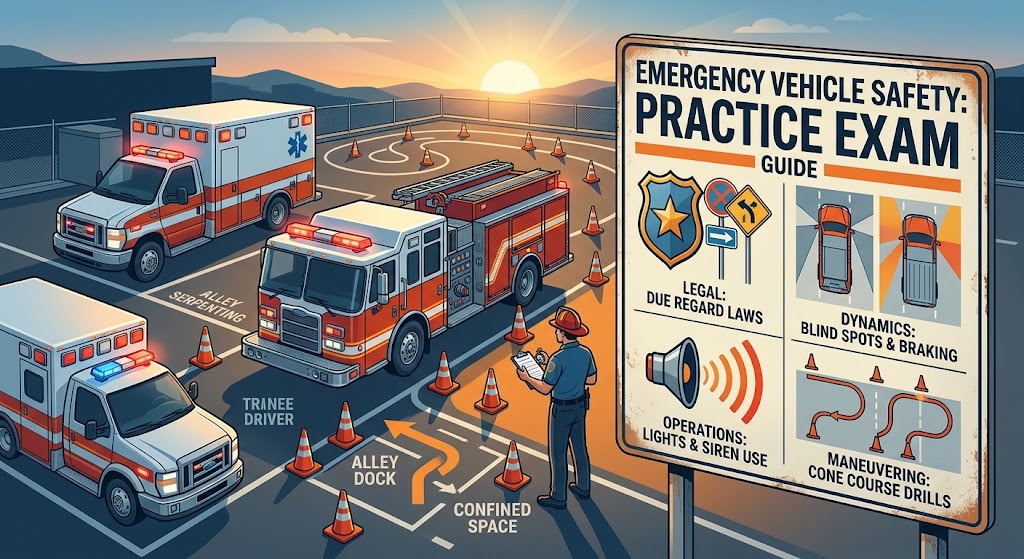
Additional Information
What the Course Entails and Exam Details
This course is comprehensive, combining theoretical
knowledge with physical skill development. The syllabus covers the entire
lifecycle of an emergency response from the driver's perspective. Key
instructional areas include:
- Legal
Responsibilities and "Due Regard": A fundamental pillar,
this section covers federal, state, and local driving laws, emphasizing
the standard of care—driving with "due regard for the safety of all
persons"—and how this differs during emergency versus non-emergency
modes.
- Vehicle
Dynamics and Design: Understanding the unique handling characteristics
of heavy apparatus, including high centers of gravity, braking distances,
acceleration capability, weight distribution (especially with liquid loads
like water tenders), and common blind spots.
- Defensive
Driving Techniques: Mastering spatial awareness, scanning techniques
(e.g., proper eye lead time), intersection management, and proactive
strategies for anticipating the unpredictable actions of civilian drivers.
- Emergency
Vehicle Systems and Operations: In-depth training on the proper and
legal use of audible and visual warning devices (sirens, lights, air
horns) and understanding their limitations in different environments.
- Maneuvering
and Practical Skills: This includes crucial low-speed control drills
like precise backing with spotters, navigating obstacle courses (cone
courses, serpentines, alley docks), and confined space turnarounds.
- Preventive
Maintenance and Inspection: Essential daily and weekly checks of
critical systems (brakes, tires, fluids, lights) to ensure the vehicle is
always road-ready.
- Scene
Positioning and Incident Management: Strategic placement of the
apparatus upon arrival at an incident for crew safety, pump access (for
fire engines), or patient loading (for ambulances).
The exam itself is usually a multiple-choice written test,
requiring candidates to apply all these theoretical principles to
scenario-based questions. Passing scores typically range from 70% to 80%,
depending on the certifying agency.
What to Expect in
the Final Exam
While the final practice test will focus on a written
examination, it's vital to remember that a complete EVOC certification
typically involves two distinct, mandatory components:
- Component
1: The Written Examination: This is what the practice test prepares
you for. It is a time-limited (often 1 to 2 hours), multiple-choice
test. Questions will cover all course syllabus areas, asking about legal
exemptions, appropriate siren use, vehicle height restrictions, and
optimal blind spot clearing. You should expect numerous scenario-based
questions that test your judgment rather than just recall.
- Component
2: The Practical Skills Evaluation: This portion, not covered by the
practice test, requires you to physically operate the apparatus in a
controlled environment. A certified instructor will evaluate your ability
to navigate the prescribed obstacle course, demonstrate safe backing
procedures, and perform a full circle-of-safety inspection.
You must pass both sections to receive your final
certification. The written component is often the prerequisite for the driving
skills assessment.
How to Study and
Exam Centers
Effective preparation is key. Here are actionable study
strategies and how to register for your final certification:
- Study
Strategies:
Engage with a High-Quality
Practice Exam: Use tools like the EVOC
Test repeatedly. Treat each attempt as a real simulation to identify weak
points in your legal knowledge or understanding of vehicle physics.
Master Your Vehicle's
Operating Manual and NFPA Standards: Become deeply familiar with the
specific quirks of the apparatus you operate (e.g., aerial height, pumper
weight). Also, review NFPA 1002 (Standard for Fire Apparatus
Driver/Operator Professional Qualifications) or your organization's specific
EVOC manual.
Review Local and State Driving
Codes: Laws regarding emergency response vary. Know exactly which laws
apply to "Code 3" operations in your specific jurisdiction, including
intersection right-of-way.
Visualize Scenario-Based
Questions: When studying concepts, ask yourself: "How would this apply
at 3:00 AM at a high-speed highway intersection?"
- How
to Take the Final Certification: Unlike centralized testing
organizations like Pearson VUE, EVOC certification is usually
decentralized and managed locally. You cannot typically schedule this exam
through a national center. You must take your official exam and practical
test through:
- State
Fire Academies and Training Centers: The most common location for
firefighter certifications.
- Local
EMS Regions or Health Departments: For ambulance-specific EVOC.
- Law
Enforcement Post-Training Commissions (POST): For police officer
operator certifications.
- Specific
Emergency Services Agencies: Many large fire, EMS, and police
departments have internal, certified EVOC programs for their own
personnel. Registration is typically facilitated by your department's
training officer.
Job Opportunities from the Course
Earning an emergency vehicle operator certification unlocks
numerous career paths and is often a mandatory requirement for advancement in
public safety. Successful completion allows you to pursue careers such as:
- Career
Firefighter (e.g., Pumper, Aerial, Tanker Driver)
- Paramedic
- EMT
(Emergency Medical Technician)
- Police
Officer
- Heavy
Rescue Operator
- Aerial
Ladder Operator / Engineer
- Mobile
Water Supply / Tanker Operator
- Specialized
Rescue Technician
- Private
Ambulance Driver
Frequently Asked Questions
Reviews
5.0
Based on 0 reviews
Leave a Review
No reviews yet. Be the first to review!