
APM Project Management Qualification (PMQ) Practice Exam
$69.00
- Buy to unlock unlimited access to all Quiz questions.
- After purchase you can print a PDF of the whole quiz at any point. The PDF will contain the questions and the correct answers.
About this Exam
The APM Project Management Qualification (PMQ) is the flagship qualification offered by the Association for Project Management, the Chartered body for the project profession in the UK. This comprehensive certification is designed for project professionals who have approximately two to three years of experience in a project environment. It signifies that you possess a thorough knowledge of project management, from initial business cases to final handovers, and are capable of managing full-project lifecycles. Whether you are already a seasoned project manager looking to validate your skills or a professional making a significant move into the field, the PMQ qualification can provide the professional recognition, enhanced knowledge, and competitive edge to advance your career significantly. Understanding the qualification and utilizing quality practice exams are vital steps to success.
Ready to test your knowledge?
Buy Now to Access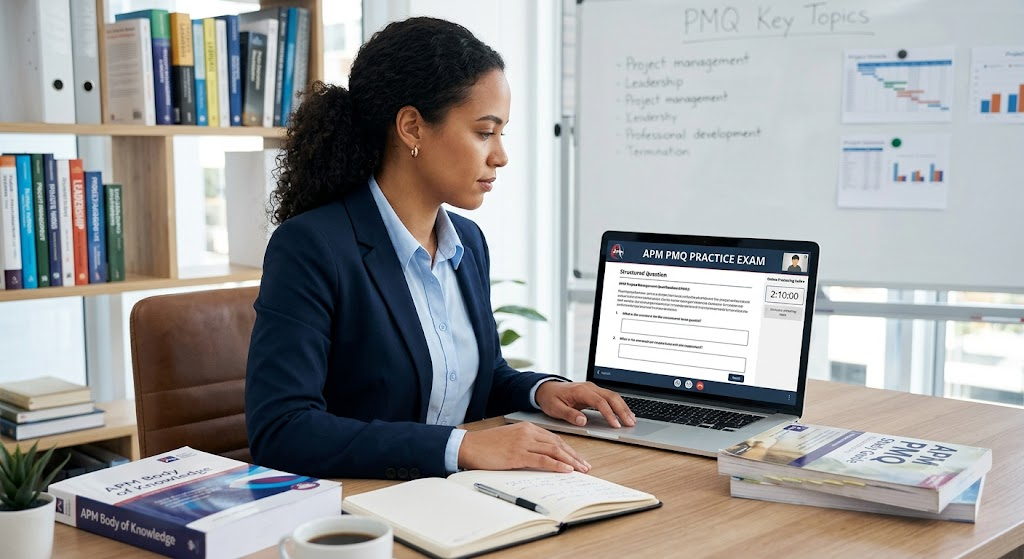
Additional Information
What the Course Entails and Exam Details
Preparing for the APM PMQ isn't just about reading a book; it’s about absorbing a standardized framework for project success. The PMQ covers a comprehensive syllabus derived directly from the APM Body of Knowledge, reflecting the full range of professional competences. Key areas include:
Project Context and Environment: Understanding how projects fit into broader organizational strategies and commercial settings.
Life Cycles: Different project life cycles (linear, iterative, hybrid) and how they adapt to different situations.
Governance: The structured framework of authority and accountability for the delivery of projects.
Scope and Requirements: Managing project objectives and what needs to be delivered.
Time and Schedule: Effective scheduling, resource optimization, and monitoring progress.
Cost Management and EVM: Budgeting, cost control, and using Earned Value Management for performance measurement.
Quality Management: Ensuring project outcomes meet required standards and fit their purpose.
Risk and Issue Management: Proactively identifying, assessing, and responding to potential risks and realized issues.
Communication and Stakeholder Engagement: Effectively managing relationships, expectations, and information flow.
Procurement and Suppliers: Developing procurement strategies and managing supplier relationships.
People and Behaviours: Principles of leadership, motivation, conflict resolution, and teamwork.
Deployment and Transition: Successful project execution, handover, and closing.
The study often involves a combination of formal training (either in-person, online, or a mix) and substantial independent study, estimated to require around 70+ hours overall. Practice exams are an essential tool throughout this learning journey.
What to Expect in the Final Exam
The actual APM PMQ exam is a comprehensive and challenging assessment. It has been recently updated to a structured direct format designed to test understanding and practical application, moving beyond simple recollection. Here are the crucial final exam details:
Format: A structured online examination comprising 40 questions.
Question Types: It is NOT purely multiple choice. It is a mix of structured question formats including:
Multiple Response (e.g., 20 questions worth 1 mark each)
Select-from-list (e.g., 5 questions worth 2 marks each)
Short Response (e.g., 5 questions worth 2 marks each)
Brief Long Response/Structured Scenario-Based items (e.g., 10 questions worth 5 marks each)
Duration: The total exam time is typically 2.5 hours, often with an optional 30-minute break included, dividing the exam into distinct parts. This highlights the importance of effective time management.
Total Marks: The exam is out of 90 marks.
Passing Score: The typical passing score is approximately 63%, although this can vary slightly based on the specific exam and version.
Rules & Proctoring: The exam is taken online under controlled, remote proctored conditions, requiring a working webcam, microphone, stable internet, and a private, quiet room. Your environment will be checked by the proctor before you begin. For open-book aspects (if applicable to specific sections/materials), strict guidelines exist regarding approved resources. The use of practice exams is a safe way to simulate these rules.
How to Study and Exam Centers
Effective study is the key to conquering the PMQ. Combine thorough conceptual learning with strategic practice:
Study Plan: Create a structured study plan that covers all syllabus topics, allocating sufficient time for each, including substantial practice exam time.
Official Resources: Utilize the official APM PMQ Handbook, the APM PMQ Study Guide, and relevant sections of the APM Body of Knowledge. Familiarize yourself with all official learning outcomes.
Accredited Training: Strongly consider an accredited APM PMQ training course. Training providers offer valuable context, tutoring, and often their own resources.
APM PMQ Practice Exams: This is non-negotiable. Regularly engage with full-length, high-quality APM PMQ Practice Exams. This will help you:
Familiarize yourself with the various structured question formats.
Master the command verbs (e.g., List, Describe, Explain) and structure your answers around the marks available.
Identify knowledge gaps and improve retention.
Simulate timed exam conditions to manage your time effectively and reduce anxiety.
Learn to apply knowledge to realistic scenario-based questions.
Technical Check: Well in advance, ensure your computer and network meet all APM online exam technical requirements. The official assessment platform should offer a technical specification document and system check.
Study Environment: Establish a quiet study space and practice in a private, well-lit room similar to how you will take the actual online proctored exam.
Exam Centers: The primary way to sit the final APM PMQ exam is via APM's own remote proctoring service, using the Surpass assessment platform. This allows you to schedule the exam 24/7 at your convenience. APM also has authorized physical exam centers and physical locations where accredited training providers deliver the course and administer the exam, but the online remote option is the most flexible and widely used for individuals. Contact APM directly or your specific training provider for their offered exam locations or proctoring methods.
Job Opportunities from the Course
Earning the APM PMQ qualification unlocks numerous exciting career paths in project management. Here are some specific job roles and career paths this qualification can unlock:
Project Manager
Senior Project Manager
Project Coordinator
Project Analyst
Program Manager (Often requires further experience, but PMQ is a strong stepping stone)
Portfolio Manager (Often requires further experience)
Project Officer
Change Manager
PMO (Project Management Office) Analyst / Specialist
Operations Manager
Project Lead
Consultant in Project Management
Team Leader in project environments
Sector-Specific Project Roles (e.g., IT Project Manager, Construction Project Manager, Healthcare Project Manager)
Remember, combining your qualification with experience is essential for career progression, and your dedication to thorough preparation with practice exams is the first step towards achieving this.
Frequently Asked Questions
Reviews
5.0
Based on 0 reviews
Leave a Review
No reviews yet. Be the first to review!