
API 936 – Refractory Personnel Certification Practice Exam
$69.00
- Buy to unlock unlimited access to all Quiz questions.
- After purchase you can print a PDF of the whole quiz at any point. The PDF will contain the questions and the correct answers.
About this Exam
The API 936 Refractory Personnel Certification is a crucial industry credential for individuals involved in the installation, inspection, and maintenance of refractory systems within the refining, petrochemical, and power generation sectors.
This certification validates essential knowledge regarding standard refractory materials, application methods, quality control procedures, and safety protocols.
It is designed for inspection and quality control personnel, installation technicians, project managers, and anybody responsible for ensuring the reliability and longevity of critical equipment linings, such as reactors, heaters, and FCCU components.
Earning this certification demonstrates a professional commitment to safety, efficiency, and adhering to established industry best practices, making it a valuable asset for career advancement in heavy industry maintenance.
Ready to test your knowledge?
Buy Now to Access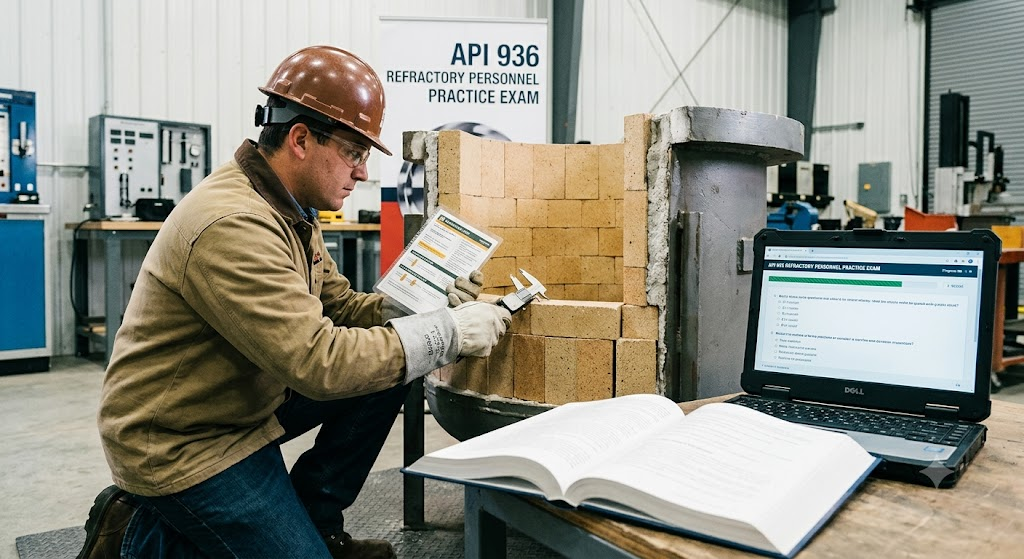
Additional Information
What the Course Entails and Exam Details
The core focus of the API 936 body of knowledge centers on the principles of high-temperature material science and practical installation techniques.
The curriculum extensively covers key topics from the API Standard 936, which is the foundational document.
Students must master material classification, understanding the properties of various refractories such as castables, gunning mixes, plastics, and firebricks.
The exam evaluates proficiency in quality control and inspection procedures, including pre-installation, installation, and post-installation monitoring.
Proper material storage, anchoring systems, and critical curing and bake-out processes are detailed, ensuring personnel can oversee or execute durable refractory installations that prevent premature equipment failure.
Candidates are also expected to know testing methodologies for qualifying materials and workmanship.
What to Expect in the Final Exam
The API 936 certification is typically awarded upon passing a computer-based final examination.
The exam usually consists of 75 multiple-choice questions, which candidates must complete within a 3.25-hour time limit.
It is an open-book exam, and candidates are permitted to reference pre-approved industry publications during the test, with a heavy emphasis placed on API Standard 936 itself.
Success requires navigating these publications efficiently and applying knowledge under pressure.
The passing criteria are determined by statistical analysis, but candidates generally aim for a high correct-answer percentage to ensure success.
Maintaining this certification often requires recertification periodically, ensuring professionals stay current with evolving industry standards.
How to Study and Exam Centers
An effective study plan for the API 936 practice exam is essential for success, given the specialized nature of the content.
Begin by obtaining and thoroughly reading the API Standard 936 itself, as this document forms the foundation for the entire assessment.
Create a structured study schedule and utilize comprehensive study guides specifically designed for this certification.
Practice exams are highly recommended, as they simulate the actual testing experience and help candidates identify knowledge gaps.
These practice sessions should focus not only on getting answers right but also on referencing material quickly, simulating the open-book exam environment.
For scheduling the official exam, candidates must register through the API website, and examinations are administered at authorized computer-based testing centers globally, often provided by Pearson VUE.
Candidates can use the vendor's online portals to find testing locations and schedule their appointments once approved.
Job Opportunities from the Course
Obtaining the API 936 certification significantly boosts career prospects within heavy industries like oil and gas processing and manufacturing.
This credential signals advanced technical proficiency and can unlock specialized roles with increased responsibility and earning potential.
Certified professionals are often sought after for critical oversight positions.
A list of potential job titles and career paths includes:
Refractory Inspector
Quality Control Manager
Turnaround Coordinator
Refractory Installation Technician
Project Manager (Maintenance & Turnarounds)
Reliability Engineer
Plant Maintenance Supervisor
Technical Sales Representative (Refractory Materials)
This certification is widely recognized as proof of dedication to maintaining equipment integrity and ensuring operational safety, making it a critical asset for upward mobility in high-stakes industrial environments.
Frequently Asked Questions
Reviews
5.0
Based on 0 reviews
Leave a Review
No reviews yet. Be the first to review!