
API 574 – Inspection Practices for Piping System Components Practice Test
$69.00
- Buy to unlock unlimited access to all Quiz questions.
- After purchase you can print a PDF of the whole quiz at any point. The PDF will contain the questions and the correct answers.
About this Exam
The American Petroleum Institute (API) provides the world's most widely recognized standards for the oil and natural gas industries. API 574, titled 'Inspection Practices for Piping System Components', is a crucial recommended practice standard that guides professionals in evaluating the structural integrity and reliability of piping systems in refineries, chemical plants, and related facilities.
This comprehensive guide and practice test are specifically designed for professionals preparing for the API 570 Piping Inspector Certification examination. Understanding and applying API 574 is essential for achieving this prestigious certification, and this practice test helps candidates assess their readiness and mastery of its contents.
API 574 inspection practices are fundamental for maintaining safety, preventing leaks, and ensuring the continued safe operation of vital piping infrastructure. This practice test is an invaluable tool for asset integrity engineers, corrosion specialists, maintenance professionals, and individuals aspiring to become certified API Piping Inspectors.
Ready to test your knowledge?
Buy Now to Access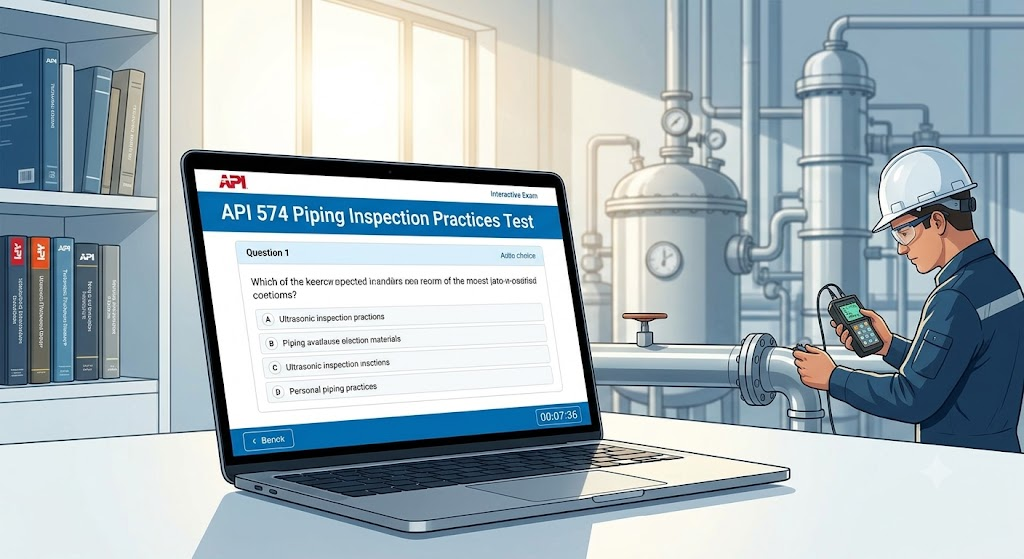
Additional Information
What the Course Entails and Exam Details
API 574 is not a course in itself, but rather a core document that forms a critical part of the API 570 Piping Inspector Certification exam syllabus. The official API 570 examination tests a candidate's knowledge, skills, and ability to apply various standards, with API 574 being a key component.
The content tested derived from API 574 focuses heavily on practical inspection methodologies and practices. Key topics covered include:
Scope and General Application: Understanding where and when API 574 applies to piping systems.
Normative References: Familiarity with related industry standards.
Terms, Definitions, and Acronyms: Mastering the specific terminology used in piping inspection.
Initial Inspection: Requirements for new piping systems and components.
In-Service Inspection: Various inspection techniques (visual, non-destructive testing) for operational piping.
Inspection Data: How to collect, record, and utilize inspection findings.
Pressure-Relieving Devices: Inspection considerations for relief valves and rupture disks.
Repairs, Alterations, and Re-rating: Guidance on modifications to existing piping.
Corrosion and Materials: Understanding degradation mechanisms and material performance.
The practice test is designed to mirror the types of questions a candidate will face on the actual API 570 certification exam concerning API 574, allowing for self-assessment and targeted study.
What to Expect in the Final Exam
The actual API 570 Piping Inspector Certification exam, which incorporates questions on API 574, is a rigorous and comprehensive test administered by the American Petroleum Institute.
Here's what candidates can typically expect from the API 570 final exam:
Format: The exam is computer-based testing (CBT), consisting of multiple-choice questions.
Structure: It is divided into two parts: a "closed-book" section where no materials are allowed, and an "open-book" section where candidates can refer to specified code books (including API 574).
Duration: The total exam time is typically 6.5 hours (including a short break).
Questions: There are a significant number of questions, covering all standards and codes included in the API 570 Body of Knowledge.
Passing Score: API uses a statistical method for scoring; candidates are aiming for a score that indicates proficiency, typically in the range of 70% or higher, though precise numbers aren't officially disclosed.
Results: Official results are mailed to candidates several weeks after taking the exam.
API 574 Portion: Questions specifically related to API 574 will be integrated throughout both the open and closed-book sections, testing practical knowledge and the ability to find and apply information from the standard. Practice tests like this one are crucial for preparing for this challenging integration.
How to Study and Exam Centers
Preparing for the API 570 exam, and specifically mastering API 574, requires a structured and diligent study plan. Here are actionable strategies:
Read API 574 Thoroughly: This is the most crucial step. Read the entire document multiple times. Understand the rationale behind each recommended practice, not just the rules.
Use the Official Body of Knowledge: API provides an official 'Body of Knowledge' for the 570 exam, which lists all standards and codes that will be covered. Ensure you have the current versions.
Take Practice Tests: Consistent practice with practice exams like this one is invaluable. This helps you familiarize yourself with the question style, manage your time, identify weak areas, and practice navigating the open-book section efficiently.
Focus on Calculations: While API 574 is more procedural, the overall API 570 exam includes calculations related to corrosion rates, remaining life, and inspection intervals. Practice these thoroughly.
Utilize Study Guides and Resources: Many commercial training providers offer study guides, flashcards, and online courses specifically for the API 570 exam, often including deep dives into API 574.
Create Flashcards: Create flashcards for key definitions, code references, and common equations to aid memory recall.
Form or Join a Study Group: Collaborating with colleagues also preparing for the exam can provide motivation and different perspectives.
The official API 570 certification exam is administered globally by API at authorized CBT test centers, typically run by companies like Prometric. You must register for the exam through the API portal and then schedule your specific test time and location at an authorized center. Practice tests are typically taken online or through software provided by various training companies, helping you prepare for the format of the actual computer-based test at these centers.
Job Opportunities from the Course
Successfully passing the API 570 examination (for which understanding API 574 is vital) unlocks a wide range of rewarding career opportunities in industrial inspection and asset management. Obtaining the API Certified Piping Inspector credential makes you highly sought after across multiple sectors, especially the energy and petrochemical industries.
Here is a list of job opportunities this certification unlocks:
API Certified Piping Inspector
QA/QC Inspector (Piping)
Pressure Equipment Inspector
Asset Integrity Engineer (Piping)
Maintenance Engineer (Piping)
Risk-Based Inspection (RBI) Engineer
Corrosion Specialist
Welding Inspector
Safety Manager/Compliance Officer
Freelance/Consultant Piping Inspector
Frequently Asked Questions
Reviews
5.0
Based on 0 reviews
Leave a Review
No reviews yet. Be the first to review!