
API 510 – Pressure Vessel Inspector Certification Practice Test
$69.00
- Buy to unlock unlimited access to all Quiz questions.
- After purchase you can print a PDF of the whole quiz at any point. The PDF will contain the questions and the correct answers.
About this Exam
The API 510 Pressure Vessel Inspector Certification is a globally recognized credential for professionals involved in the in-service inspection, repair, alteration, and rerating of pressure vessels. This rigorous certification is designed for experienced inspectors, engineers, and quality control personnel working in the oil, gas, chemical, and power generation industries. It validates your expertise in applying the key American Petroleum Institute (API) codes and American Society of Mechanical Engineers (ASME) standards.
Achieving this certification demonstrates a high level of technical proficiency and commitment to safety, efficiency, and environmental responsibility within complex industrial environments. The program is accredited by the American National Standards Institute (ANSI) and is typically aimed at individuals with a combination of relevant education and years of documented experience in the field.
Ready to test your knowledge?
Buy Now to Access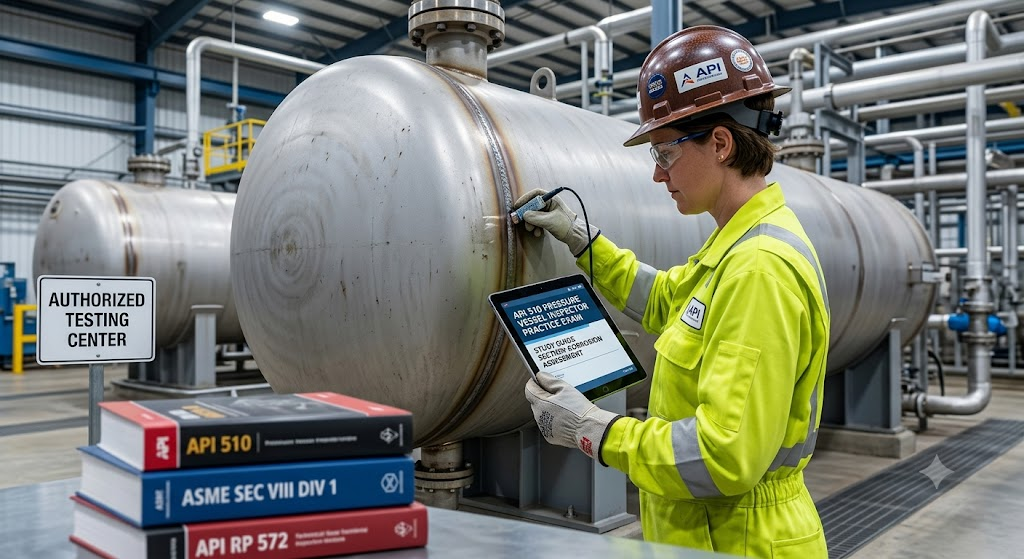
Additional Information
What the Course Entails and Exam Details
To become an API 510 certified inspector, you must master a comprehensive body of knowledge drawn from several primary standards. While there is no mandatory "course" provided by API itself, candidates typically engage in intensive self-study or enroll in third-party preparatory training to prepare for the exam. The essential core topics covered include:
API 510: Pressure Vessel Inspection Code: In-service Inspection, Rating, Repair, and Alteration.
API RP 571: Damage Mechanisms Affecting Fixed Equipment in the Refining Industry.
API RP 572: Inspection Practices for Pressure Vessels.
API RP 576: Inspection of Pressure-Relieving Devices.
API RP 577: Welding Processes, Inspection, and Metallurgy.
ASME Boiler and Pressure Vessel Code: Including Section V (Nondestructive Examination), Section VIII Division 1 (Rules for Constructing Pressure Vessels), and Section IX (Welding and Brazing Qualifications).
You will be expected to demonstrate practical skills and theoretical knowledge in area such as calculating corrosion rates and inspection intervals, determining joint efficiencies, evaluating pressure test results, and reviewing welding procedures (WPS and PQR) and welder performance qualifications.
What to Expect in the Final Exam
The API 510 examination is a challenging, computer-based test that typically spans a full day. The exam is divided into two distinct parts:
Closed-Book Portion: This section tests your fundamental knowledge of the API 510 code and related reference documents. You are expected to answer questions based on your everyday understanding, without access to any standard publications. It consists of multiple-choice questions.
Open-Book Portion: This part requires you to locate and apply more detailed information, such as specific formulas, tables, and procedural rules, found within the required code books. You may bring official copies of the permitted reference materials into the testing room. This section also uses multiple-choice questions.
Candidates are usually given a total day (approximately 7.5 to 8.5 hours) for the entire process, including a tutorial and a designated lunch break. The total number of questions can vary (often around 170 questions, with a certain portion being non-scored pretest questions). A criterion-referenced passing score is established, which means it may fluctuate slightly for each exam form based on statistical equating to ensure consistency. You will receive your results approximately eight weeks after the test.
How to Study and Exam Centers
Effective preparation for the API 510 exam requires a structured study plan and dedication. Strong code navigation is perhaps the most critical skill for success in the open-book portion, as time is limited. Actionable strategies include:
Obtain and Read Official Codes: Purchase current editions of all required API and ASME reference materials. Read them thoroughly, paying close attention to definitions, applications, and procedural steps.
Practice Navigation: Create tabbing systems (if permitted by the test center) and practice quickly locating key sections, tables, and formulas within the physical code books.
Perform Code Calculations: Solve numerous practice problems related to corrosion rate, remaining life, static head, joint efficiency, and pressure testing.
Use Practice Exams: Take timed practice exams and simulated tests to familiarize yourself with the question style, difficulty, and time pressure of the actual exam.
Review the Body of Knowledge: Cross-reference your study material with the official API 510 Body of Knowledge to ensure full coverage of potential exam topics.
The API 510 exam is administered four times a year at Prometric or Pearson VUE computer-based testing centers worldwide. To schedule your exam, you must first create an account and apply through the American Petroleum Institute’s online Individual Certification Programs (ICP) portal, where you will select your testing date and preferred center.
Job Opportunities from the Course
Earning the API 510 certification unlocks numerous high-demand and rewarding career paths across industrial sectors, particularly within the energy industry. Certified inspectors are crucial for ensuring the safety and compliance of operations. Potential job opportunities and career advancement include:
API 510 Pressure Vessel Inspector: The direct application of this credential, involving leading inspection programs.
QA/QC Specialist (Pressure Equipment): Focusing on the fabrication, maintenance, and repair stages to ensure all work meets standard.
NDT Technician (with API 510 Specialization): Combining advanced nondestructive testing methods with code expertise for deep vessel analysis.
Integrity Engineer/Specialist: Developing and managing comprehensive asset integrity management programs for entire facilities.
Regulatory Compliance Analyst: Ensuring company procedures and equipment operations remain in line with state and federal regulations.
Senior Inspector/Inspection Manager: Progressing into supervisory or management roles, overseeing teams and large-scale inspection projects.
Frequently Asked Questions
Reviews
5.0
Based on 0 reviews
Leave a Review
No reviews yet. Be the first to review!