
APGAP Winter Term Practice Exam
$69.00
- Buy to unlock unlimited access to all Quiz questions.
- After purchase you can print a PDF of the whole quiz at any point. The PDF will contain the questions and the correct answers.
About this Exam
The APGAP Winter Term Practice Exam is a comprehensive preparatory tool designed for students enrolled in Advanced Placement (AP) United States Government and Politics courses, specifically during a winter academic term or semester. This practice exam is an essential resource for high school students aiming to excel in the official AP U.S. Government and Politics Exam administered by the College Board. It provides an opportunity to gauge understanding of foundational political concepts, institutional frameworks, and political behaviors that define American democracy. By mirroring the format and rigor of the official test, the practice exam helps identify areas of strength and weakness, allowing for focused study and skill development before the actual examination date.
Ready to test your knowledge?
Buy Now to Access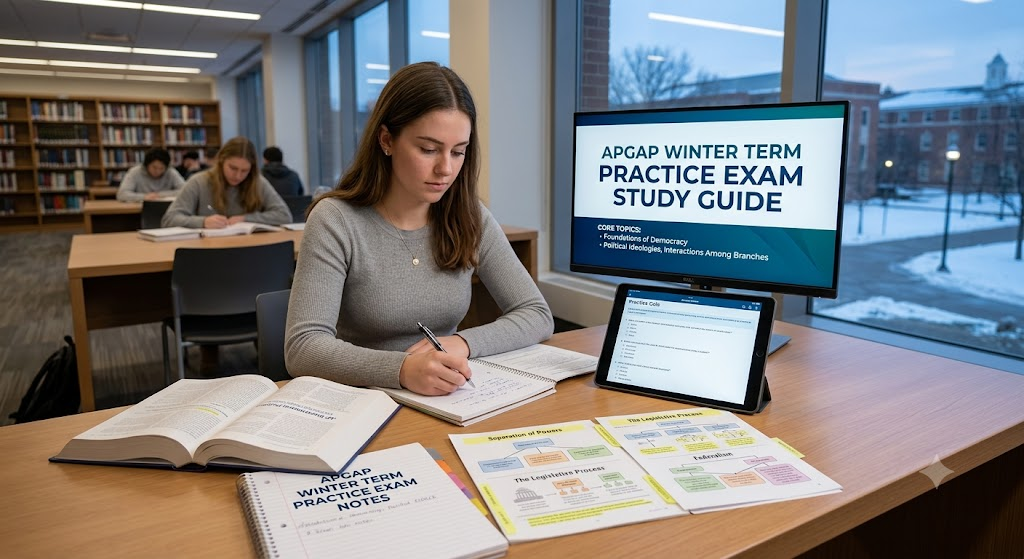
Additional Information
What the Course Entails and Exam Details
The core course topics covered in the APGAP curriculum and reflected in the winter term practice exam include:
Foundations of American Democracy: Examines the historical underpinnings, key documents (Declaration of Independence, Constitution), and political theories of the United States government.
Interactions Among Branches of Government: Explores the roles, powers, and relationships between the legislative, executive, and judicial branches.
Civil Liberties and Civil Rights: Analyzes the fundamental rights protected by the Constitution and how they have evolved through landmark Supreme Court cases.
American Political Ideologies and Beliefs: investigates the diverse political beliefs held by Americans and how they shape political behavior and public policy.
Political Participation: Covers various ways citizens engage in the political process, including voting, campaigning, and interest group activities.
The practice exam consists of multiple-choice questions and often includes free-response questions (FRQs) designed to test analytical skills and the ability to articulate political arguments.
What to Expect in the Final Exam
While specific term practice exam structures vary by institution, they generally model the official AP U.S. Government and Politics Exam. Students can expect:
Format: A significant multiple-choice section testing recall, analysis, and interpretation of political scenarios. A free-response section requiring structured essays on topics like constitutional application, quantitative analysis, argument development, and comparison.
Time Limit: Approximately three hours for the complete official AP exam, with separate time allocations for the multiple-choice and free-response sections. Practice exams will typically adhere to similar constraints.
Scoring: Official AP scores are on a 1-5 scale. Practice exams may provide weighted scoring systems consistent with this metric to estimate potential AP performance.
Specific Rules: Familiarize yourself with authorized materials and guidelines, such as prohibited electronic devices, during the testing session.
How to Study and Exam Centers
Effectively preparing for the APGAP Winter Term Practice Exam requires a strategic study plan:
Review Course Material: Thoroughly review textbooks, class notes, and all official AP course materials provided by the College Board and your instructor.
Practice with Real Questions: Utilize past AP released questions and practice problems to understand the question style and level of difficulty.
Understand the Rubrics: Carefully study the free-response question rubrics to know exactly what scorers look for in high-scoring essays.
Join Study Groups: Collaborate with peers to discuss complex political concepts and review practice responses.
Formulate a Study Schedule: Allocate consistent time leading up to the exam to cover all key units systematically.
The exam is usually administered internally by high school AP teachers. Contact your instructor or guidance counselor for specific dates, locations, and instructions regarding the practice exam. The final official AP exam is taken at authorized AP testing centers (often the high school itself or designated venues).
Job Opportunities from the Course
Scoring well on the APGAP exam can provide college credit, allowing students to skip introductory courses and explore career paths earlier. This course builds critical thinking and analytical skills essential for numerous fields:
Political Scientist
Policy Analyst
Legislative Assistant
Lobbyist
Public Relations Specialist
Journalist/Political Reporter
Lawyer/Legal Aide
High School Government Teacher
Non-Profit Program Manager
City/County Manager
Diplomat/Foreign Service Officer
Frequently Asked Questions
Reviews
5.0
Based on 0 reviews
Leave a Review
No reviews yet. Be the first to review!