
APES Air Pollution Practice Test
$69.00
- Buy to unlock unlimited access to all Quiz questions.
- After purchase you can print a PDF of the whole quiz at any point. The PDF will contain the questions and the correct answers.
About this Exam
The AP Environmental Science (APES) Air Pollution Practice Test is a crucial study resource designed for high school students currently enrolled in AP Environmental Science. This specific practice exam focuses intensely on Unit 7 of the APES curriculum: Atmospheric Pollution. It is an essential tool for students aiming to achieve a high score (4 or 5) on the comprehensive AP Environmental Science Exam, which can earn them valuable college credit. This practice test helps students identify knowledge gaps, practice time management, and become familiar with the specific phrasing and rigor of AP-level questions before the final examination.
Ready to test your knowledge?
Buy Now to Access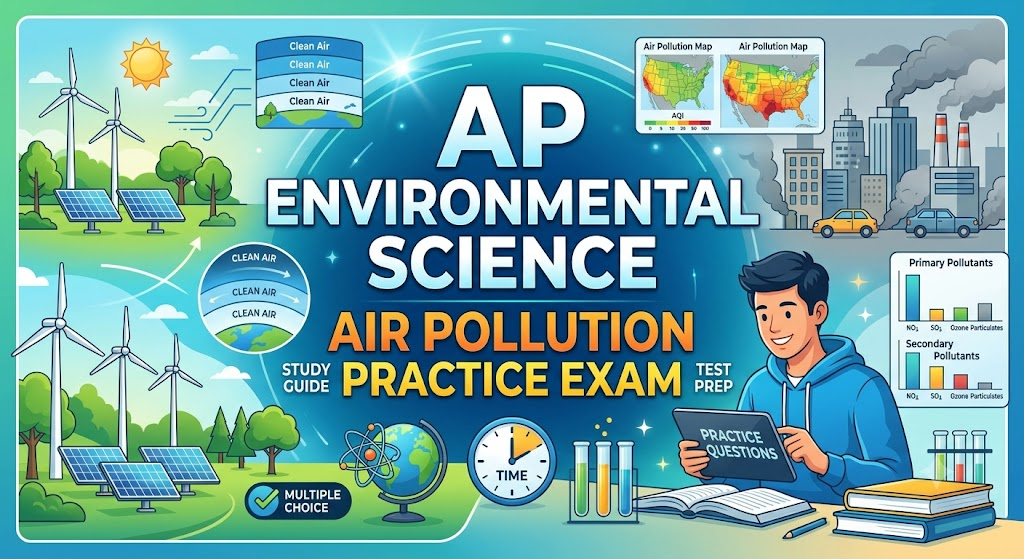
Additional Information
What the Course Entails and Exam Details
The core AP Environmental Science course explores the interrelationships of the natural world, identifying and analyzing environmental problems, both natural and human-made. The Air Pollution component (Unit 7) covers a vast array of technical topics. A thorough practice test will cover:
Major Air Pollutants: Understanding the sources, characteristics, and impacts of primary pollutants (e.g., CO, NOx, SOx, particulate matter, lead) and secondary pollutants (e.g., ground-level ozone, acid deposition).
Photochemical Smog: The chemical reactions involving sunlight, NOx, and VOCs that create smog, and its environmental and health effects.
Acid Deposition: The causes (SO2 and NOx emissions) and consequences of acid rain on aquatic and terrestrial ecosystems.
Indoor Air Pollution: Identifying common indoor pollutants like radon, mold, asbestos, VOCs, and formaldehyde, and their health risks.
Noise Pollution: The sources and effects of noise pollution on human health and wildlife.
Solutions and Regulations: Strategies for reducing air pollution, including technologies (scrubbers, electrostatic precipitators, catalytic converters) and critical legislation like the Clean Air Act.
A dedicated practice exam will mimic the official AP format, consisting primarily of high-quality Multiple-Choice Questions (MCQs) that test both conceptual understanding and data analysis.
What to Expect in the Final Exam
While a practice test is a tool you use on your own schedule, the official AP Environmental Science Exam is a structured event. The final APES exam is 2 hours and 40 minutes long, divided into two sections:
Section I: Multiple Choice: 80 questions | 1 hour 30 minutes | 60% of score. Expect a significant portion of these questions to be directly or indirectly related to Unit 7 (Air Pollution).
Section II: Free-Response: 3 questions | 1 hour 10 minutes | 40% of score. One or more Free-Response Questions (FRQs) frequently ask students to analyze a real-world environmental scenario, design an experiment, or propose a solution to an air pollution problem.
The full AP exam covers nine units. To score well, you must demonstrate a comprehensive understanding of all topics, but mastering Unit 7 is critical because its concepts often appear in complex, multi-unit questions. There is no penalty for guessing on multiple-choice questions.
How to Study and Exam Centers
Effective studying requires active engagement. Do not just read your textbook. Use this practice test as the centerpiece of your revision Strategy:
Take an Initial Practice Test: Start by taking a full APES Air Pollution practice test under timed conditions without using notes. This will establish your baseline.
Analyze Your Errors: This is the most important step. Don't just check if you got a question right or wrong; understand why the correct answer is correct and why your choice was incorrect. Categorize your errors (e.g., conceptual misunderstanding, data analysis error, missed a definition).
Targeted Review: Focus your studying on the areas where you underperformed. Review your class notes, textbook chapters, and reliable online resources (like the College Board’s AP Classroom or reputable educational videos) specifically for those weak topics (e.g., if you struggled with acid rain chemistry, review that section).
Practice FRQs: Look up past APES FRQs from the College Board website that deal with air pollution. Practice outlining and writing complete answers, and then use the official scoring guidelines to grade your own work.
Form a Study Group: Discussing difficult concepts like photochemical smog formation with peers can reinforce your own understanding.
Where and How to Take the Exams:
Practice Tests: You can take APES practice tests (like this one) online or by downloading PDFs provided by teachers or educational platforms. They are designed for flexible, self-paced study.
Final AP Exam: The official AP Environmental Science Exam is administered in person once a year in May. Registration is handled through your high school’s AP Coordinator. Exams are taken at your high school or a designated testing center. If your school does not offer AP, you may be able to arrange to take the exam at a participating nearby school.
Job Opportunities from the Course
A strong foundation in AP Environmental Science, particularly Unit 7 on Air Pollution, opens doors to diverse and impactful career paths in sustainability and environmental protection.
Air Quality Specialist: Monitor air pollutants, analyze data, and ensure compliance with air quality regulations for government agencies (like the EPA) or private consulting firms.
Environmental Scientist: Conduct research, perform field work, and develop solutions to various environmental problems, including pollution, resource depletion, and habitat loss.
Atmospheric Scientist/Meteorologist: Study the atmosphere, weather patterns, and climate change, focusing on how pollutants distribute and react globally.
Urban and Regional Planner: Develop land-use plans that mitigate traffic congestion and industrial emissions, promoting healthier urban air quality.
Sustainability Coordinator/Manager: Help corporations, universities, or cities implement eco-friendly practices, manage emissions inventories, and improve overall environmental performance.
Environmental Engineer: Design technology and systems to prevent or control air, water, and soil pollution.
Environmental Policy Analyst: Analyze existing environmental laws and propose new policies to combat pollution and climate change for think tanks, NGOs, or government agencies.
Park Ranger / Conservation Scientist: Manage and protect natural resources, often involving air quality monitoring in sensitive ecosystems.
Climate Scientist: Research the causes and effects of climate change, with air pollution (like greenhouse gases) being a primary focus area.
Environmental Law: Attorneys specializing in environmental law interpret and litigate cases related to pollution control and regulatory compliance.
APES isn't just about passing a test; it’s a gateway to understanding the technical challenges of modern society and equipping yourself to contribute to a cleaner, sustainable future. Good luck with your preparation!
Frequently Asked Questions
Reviews
5.0
Based on 0 reviews
Leave a Review
No reviews yet. Be the first to review!