
APEA Pharmacology Women's Health Practice Test
$69.00
- Buy to unlock unlimited access to all Quiz questions.
- After purchase you can print a PDF of the whole quiz at any point. The PDF will contain the questions and the correct answers.
About this Exam
The APEA Pharmacology Women's Health Practice Test is a crucial assessment tool designed for nurse practitioner students specializing in Women’s Health (WHNP) or Family Practice (FNP) who are preparing for their national certification exams. Advanced Practice Education Associates (APEA) developed this resource to bridge the gap between classroom learning and the rigorous demands of clinical practice. It evaluates a candidate's mastery of the pharmacological management specific to female patients across the lifespan. Who is it for? Primarily, it serves graduating NP students who need to identify knowledge gaps, validate their readiness, and build confidence before taking the formal boards. By simulating the actual exam environment and providing rationales, this practice test ensures future prescribers can deliver safe, effective, and evidence-based care in a variety of women's health settings.
Ready to test your knowledge?
Buy Now to Access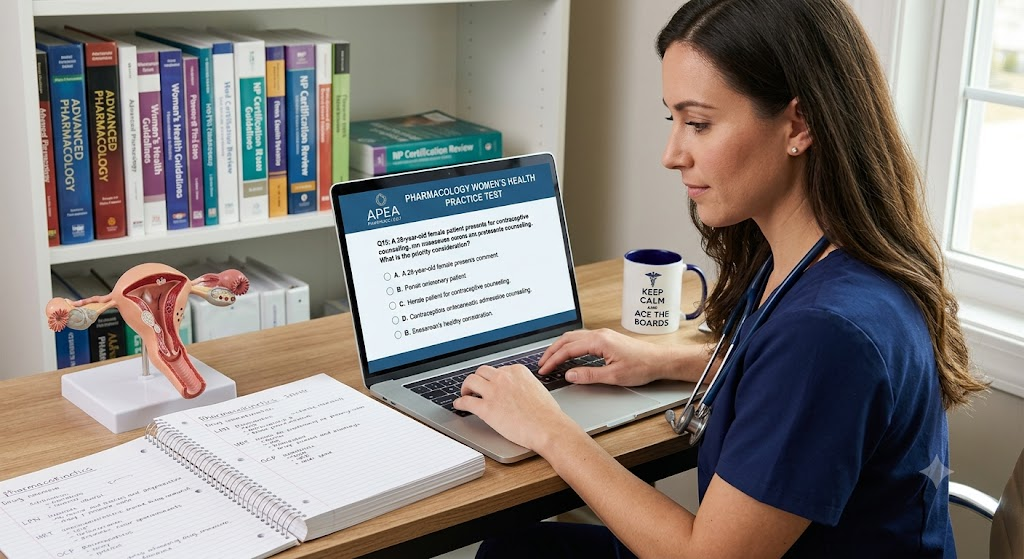
Additional Information
What the Course Entails and Exam Details
This practice test focuses on the advanced principles of pharmacology as they apply specifically to the complex needs of women. The core topics covered in the questions are aligned with national certification blueprints, ensuring a highly relevant testing experience. The "course," if linked to APEA's review materials, includes dynamic streaming video lectures, clinical updates, and detailed course manuals that form the foundation for these practice questions.
Key syllabus areas and topics covered within the practice test include:
Principles of Advanced Pharmacology: Applied pharmacokinetics, pharmacodynamics, pharmacogenomics, and the management of significant drug interactions.
Reproductive Health & Contraception Care: Pharmacological options for family planning, nonhormonal and hormonal contraception, emergency contraception, and pregnancy termination.
Pregnancy and Lactation: Medication safety in special populations, pregnancy-associated conditions, managing high-risk pregnancies, and postpartum pharmacotherapy.
Menstrual and Ovarian Conditions: Management of premenstrual syndrome (PMS), PMDD, endometriosis, polycystic ovary syndrome (PCOS), and menopause-related therapies.
Women's Health Specialist Topics: Medication use for gender-affirming care, sexual health and function, and genitourptive issues.
Cancer in Women: Principles of pharmacological therapy for breast, endometrial, ovarian, and cervical cancers.
Primary Care Conditions in Women: Managing chronic diseases with sex/gender differences, including cardiovascular disease, neurological disorders (like migraines), and mental wellness.
What to Expect in the Final Exam
When taking the APEA Pharmacology Women's Health Practice Test, candidates should expect a realistic simulation of the national board experience. While a single "practice test" product is often part of a larger bank of multiple-choice questions (MCQs), it is designed to be taken under timed conditions to mirror the actual exam’s pace and pressure.
Format: The exam consists entirely of multiple-choice questions. It includes case-based scenarios that require candidates to apply, rather than simply recall, pharmacological principles in a clinical context.
Question Count and Time Limit: A typical APEA practice test or diagnostic assessment can vary. For specialized predictive exams (like the Pre-Predictor or Predictor), you can expect 150 questions administered over a single 3-hour session. When purchasing custom quiz banks, the number of questions can be user-defined.
Passing Score and Predictability: While practice tests do not provide a "license," they provide immediate scoring. On APEA’s University Predictor exams, a score of 70% or higher is considered indicative of a "high likelihood of success" on the formal national certification exam. Lower scores provide clear signals for remediation.
Rules and Access: Practice exams are typically accessed online via a secure personal account on the APEA portal. They may have limited views or use windows, encouraging students to take them when fully prepared for a timed, uninterrupted session.
How to Study and Exam Centers
Actionable strategies for success begin with integrating APEA’s comprehensive review materials before attempting the practice test. Candidates should not use the practice test as their primary learning source but as a final assessment tool.
Effective Study Strategies:
Review First, Test Later: Complete the dynamic streaming video lectures (which often contain over 13–18 hours of content) and thoroughly study the provided APEA course manuals for Women's Health, which offer clear, concise teaching.
Leverage Custom Quizzes: Use APEA’s MyQBank to create focused quizzes on specific, weak subject areas (e.g., just "pregnancy health care" or "contraception") before taking the full-length test.
Analyze the Reports: The true value is in the results. After completing the practice test, immediately analyze the detailed diagnostic reporting. This breaks down performance by knowledge area, diagnosis, and testing domain, creating a precise study plan for remediation.
Practice with Rationales: Review every answer, both correct and incorrect. The rationale for the correct choice must be understood conceptually to answer similar future questions.
Where and How to Take the Exam:
The APEA Pharmacology Women's Health Practice Test is taken exclusively online. It is administered through APEA's secure student or university portal, and can be accessed from any location with a reliable internet connection using compatible browsers (like Google Chrome). It does not require travel to a physical Pearson VUE center; it is designed for convenient, accessible, and repeatable home or university-based practice.
Job Opportunities from the Course
Earning a national certification (such as WHNP-BC or FNP-BC) is the necessary final step, for which this practice test is a critical preparation aid. Mastering women's health pharmacology unlocks specific advanced practice roles across diverse medical settings.
Below is a list of job titles and career paths unlocked by this certification readiness:
Women’s Health Nurse Practitioner (WHNP-BC): Providing comprehensive primary, reproductive, gynecological, and obstetric care to women in outpatient and private practice clinics.
Family Nurse Practitioner (FNP-BC) with a Women’s Health Focus: Serving as a primary care provider across the lifespan, but leveraging specialization to manage a significant panel of female patients within family practice settings.
Locum Tenens Advanced Practice Clinician: Working on a contract basis in high-demand or underserved locations, with the ability to choose roles specific to women’s health.
Specialist NP in Reproductive Endocrinology: Managing infertility, complex hormonal disorders, and assisted reproductive technologies.
Specialist NP in Gynecologic Oncology: Providing supportive, pharmacological, and follow-up care for women undergoing treatment for gynecological cancers.
Specialist NP in Urogynecology: Treating pelvic floor disorders and complex genitourinary conditions in women.
Nurse Educator or Faculty Member: Teaching undergraduate or graduate nurse practitioner students in clinical or pharmacological courses focused on women's health.
Clinical Research Coordinator/Nurse Practitioner: Designing, managing, or practicing in clinical trials focusing on novel women’s health pharmaceuticals.
Frequently Asked Questions
Reviews
5.0
Based on 0 reviews
Leave a Review
No reviews yet. Be the first to review!