
APEA Pathophysiology – Eye, Ear, Nose & Throat (EENT) Practice Exam
$69.00
- Buy to unlock unlimited access to all Quiz questions.
- After purchase you can print a PDF of the whole quiz at any point. The PDF will contain the questions and the correct answers.
About this Exam
The APEA EENT Pathophysiology Practice Exam is a powerful learning tool designed specifically for Advanced Practice Registered Nurses (APRNs), Physician Assistants (PAs), and other advanced healthcare students. This targeted practice exam is ideal for individuals preparing for larger board certification exams, such as the ANCC or AANP certifications. It focuses exclusively on mastering complex physiological processes and disease states of the eye, ear, nose, and throat. The exam is engineered to simulate the rigorous nature of professional licensure, helping students identify knowledge gaps and build confidence before the big day.
Ready to test your knowledge?
Buy Now to Access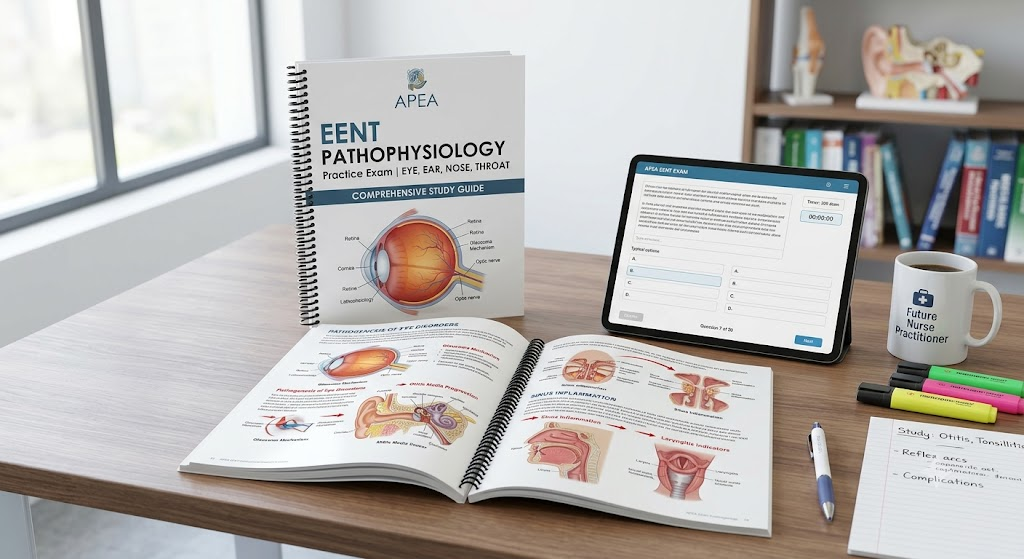
Additional Information
What the Course Entails and Exam Details
This comprehensive practice exam covers an extensive syllabus detailing the pathophysiological mechanisms of key EENT conditions. Students should expect in-depth questions on ocular disorders, including glaucoma, cataracts, and macular degeneration, alongside their associated structural and functional changes. Mastery of ear conditions, such as otitis media, Meniere's disease, and sensorineural hearing loss, is crucial. Furthermore, the exam probes knowledge of disorders affecting the nose and throat, including sinusitis, allergic rhinitis, tonsillitis, and laryngitis. Questions will assess an understanding of disease etiology, risk factors, clinical manifestations, complications, and the complex physiological interactions at play. Note that as a practice exam, details on scoring or specific testing formats can vary slightly by provider or specific course version, so review individual resource guidelines carefully.
What to Expect in the Final Exam
While formats vary between practice platforms and the final certification exams, the APEA EENT Pathophysiology Practice Exam typically employs a structure similar to national board assessments. Candidates often encounter multiple-choice questions designed to test knowledge application and critical thinking. The exam format might include scenario-based questions, where students must analyze patient presentations to determine underlying physiological issues. Although this is a practice tool, treating it with professionalism is essential. Timed formats and specific rules are frequently implemented to enhance realism. For a truly authentic simulation, students are encouraged to complete the practice exam under conditions matching their target certification, adhering to any provided time limits and without external resources. Check the specific platform for exact question counts and passing benchmarks.
How to Study and Exam Centers
Effective preparation begins with a strong foundation in EENT anatomy and physiology. Integrate comprehensive pathophysiology textbooks, peer-reviewed articles, and professional guidelines into your study regimen. Create detailed concept maps linking specific structures, functions, and common pathologies. Utilize digital flashcards for key terms, disease characteristics, and complex physiological mechanisms. Taking timed practice tests is a cornerstone strategy; review incorrect answers thoroughly to understand the underlying pathophysiological reasoning. Form study groups to discuss challenging cases and quiz each other. Regarding exam centers, the APEA EENT Pathophysiology Practice Exam is typically accessed online through a secure, proprietary portal. Candidates purchase the practice tool and complete it within the specified timeframe from any location with internet access. Be aware that this differs from actual licensure exams, which are often administered at proctored testing facilities like Pearson VUE or specialized university centers. Always verify access instructions with your exam provider.
Job Opportunities from the Course
Successful completion of the underlying coursework and associated certifications unlocks diverse career opportunities for advanced practice clinicians. The expert-level understanding of EENT pathophysiology acquired through this comprehensive study guide is vital for high-quality care in many settings. Key job titles and career paths include:
Primary Care Nurse Practitioner, specializing in a wide range of patients.
Family Nurse Practitioner, providing comprehensive care to families.
Adult-Gerontology Nurse Practitioner, focusing on the adult and aging populations.
Physician Assistant (PA-C), working in various medical and surgical specialties.
Otolaryngology (ENT) Practice Specialist, working directly with EENT issues in specialized practices or hospital settings.
Emergency Department Provider, evaluating and treating acute EENT conditions.
Urgent Care Clinician, managing common illnesses, including many affecting the eye, ear, nose, and throat.
Research and academic positions within advanced nursing or PA programs.
Frequently Asked Questions
Reviews
5.0
Based on 0 reviews
Leave a Review
No reviews yet. Be the first to review!