
APCO Public Safety Telecommunicator 1 Practice Test
$69.00
- Buy to unlock unlimited access to all Quiz questions.
- After purchase you can print a PDF of the whole quiz at any point. The PDF will contain the questions and the correct answers.
About this Exam
The APCO Public Safety Telecommunicator 1 (PST1) certification is an foundational program designed for individuals entering the high-stakes field of public safety communications. This comprehensive training provides the critical knowledge and skills required for emergency call-takers, dispatchers, and 9-1-1 professionals across law enforcement, fire service, and emergency medical services (EMS). Successfully earning this certification demonstrates that you meet and exceed national basic training standards, marking you as a prepared and professional entry-level telecommunicator. Whether you are a new hire or a candidate looking to begin your career, this guide will help you understand how to approach your preparation and the exam itself.
Ready to test your knowledge?
Buy Now to Access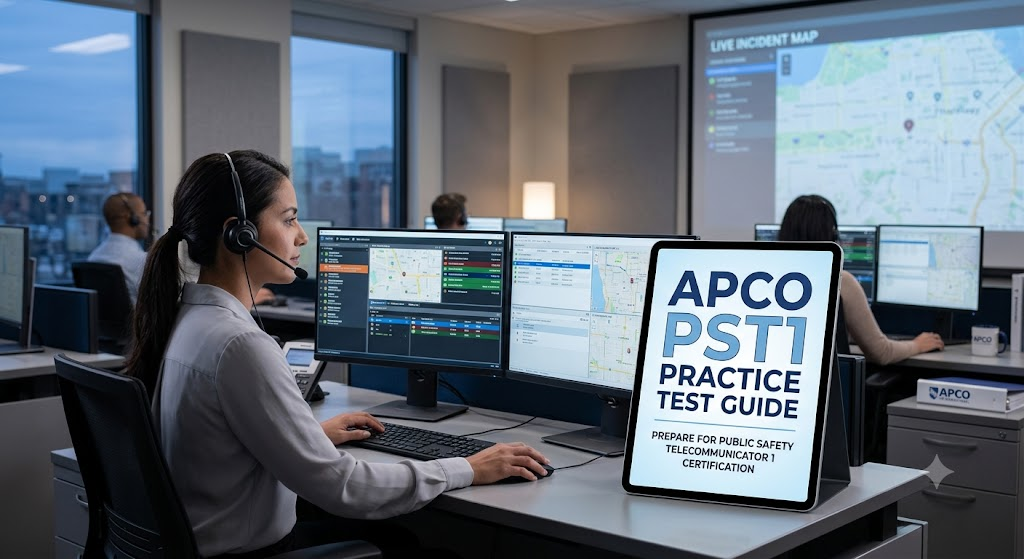
Additional Information
What the Course Entails and Exam Details
The underlying PST1 course is the essential training curriculum developed by APCO International, often considered the gold standard in public safety communication education. The final certification exam assesses your understanding of these core competencies.
Key topics covered by the course and tested in the exam include:
Introduction to Public Safety Telecommunications: Understanding the role of a telecommunicator, the history of 9-1-1, and operational relationships within a Public Safety Answer Point (PSAP).
9-1-1 Systems and Technology: Knowledge of the Enhanced 9-1-1 system, including Automatic Number Identification (ANI) and Automatic Location Identification (ALI), and emerging trends.
Communication Skills: Mastery of active listening techniques, call analysis, call processing, and handling various caller types, including the child caller, the elderly caller, and people with disabilities.
Public Safety Operational Procedures: Procedures for call processing on both emergency and non-emergency lines, call classification, and prioritizing requests for service.
Radio Communication: Techniques for clear, effective radio dispatch, use of the phonetic alphabet, and understanding radio systems.
Legal Concepts, Ethics, and Quality Assurance: Awareness of legal liability, confidentiality, ethical conduct, and the importance of Quality Assurance (QA) and Quality Improvement (QI) programs.
Incident Command System (ICS) and NIMS: Fundamentals of the National Incident Management System and the Incident Command System as applied to public safety communications.
Stress Management: Techniques for managing the unique and critical stress associated with the profession.
What to Expect in the Final Exam
While the exact structure of the official APCO PST1 certification exam may vary slightly by delivery method (e.g., online, in-person within a specific agency), it typically follows a multiple-choice format designed to test both your retention of facts and your ability to apply knowledge to realistic scenarios.
You can generally expect:
Question Format: The exam consists entirely of multiple-choice questions, which may include matching and true/false variations.
Number of Questions: A comprehensive examination typically features 100 to 150 questions, ensuring a deep assessment of the course curriculum.
Time Limit: Candidates are usually given between 1.5 to 2 hours to complete the exam.
Passing Score: A passing score of 80% or higher is generally required to achieve certification.
Proctoring: The official exam is usually proctored to maintain its integrity, either in-person by an authorized agency instructor or through secure online proctoring services.
How to Study and Exam Centers
Preparation is crucial for success on the PST1 exam, and using a variety of resources will provide the most comprehensive readiness.
Actionable Study Strategies:
Practice Tests: Utilizing a comprehensive APCO Public Safety Telecommunicator 1 Practice Test is one of the most effective ways to identify your knowledge gaps and familiarize yourself with the question style. Use these iteratively to measure your progress.
Review the Official Manual: Thoroughly study the APCO PST1 course manual, which is the primary resource for all testable material. Pay close attention to definitions, key procedures, and ethical guidelines.
Active Recall and Flashcards: Create flashcards for critical terms, acronyms (like CYMBALS, ANI/ALI, ICS), and procedures to enhance memory retention.
Group Study: If possible, form a study group to discuss scenarios, share knowledge, and test each other.
Focus on Scenarios: Don't just memorize; think about how each concept applies to a public safety dispatch environment.
Where and How to Take the Exam:
Agency-Led Testing: Many public safety agencies across the country integrate the APCO PST1 course into their internal new hire training. In this case, the exam will be administered locally, in a physical testing center within the agency or department, following the completion of the coursework.
Online and Virtual Classrooms: APCO International offers the PST1 course in online and virtual classroom formats. For these, candidates typically complete lessons and take the official proctored exam through APCO’s secure, dedicated online testing platform.
Regional and APCO Institute Centers: In some instances, exams may be offered at larger regional training centers or during APCO International events, like its annual conference.
Job Opportunities from the Course
Earning your APCO PST1 certification is a significant achievement that opens the door to a challenging and rewarding career in public safety. This certification is widely recognized and frequently required or preferred by employers across the nation.
Specific job titles and career paths this certification can unlock include:
911 Dispatcher
Public Safety Telecommunicator
Emergency Call Taker
Police Dispatcher
Fire Dispatcher
EMS Dispatcher
Communications Officer
Public Safety Communication Supervisor (with experience)
The certification serves as a powerful professional credential, indicating to potential employers that you have the essential basic training and are committed to the highest standards of the public safety communications profession.
Frequently Asked Questions
Reviews
5.0
Based on 0 reviews
Leave a Review
No reviews yet. Be the first to review!