
AP World History Practice Test Chapter 4
$69.00
- Buy to unlock unlimited access to all Quiz questions.
- After purchase you can print a PDF of the whole quiz at any point. The PDF will contain the questions and the correct answers.
About this Exam
This "AP World History Practice Test Chapter 4" is an essential study tool designed for high school students enrolled in Advanced Placement (AP) World History: Modern.
It specifically targets a critical period in world history, often encompassing the transitions from the post-classical era to the early modern period.
This practice test is ideal for students seeking focused revision on units covering the formation of transoceanic empires, global trade interactions, and the expansion of land-based empires between 1450 and 1750.
By focusing on these pivotal centuries, it helps students test their readiness for full-length AP exams by mastering these localized, intense content areas.
Ready to test your knowledge?
Buy Now to Access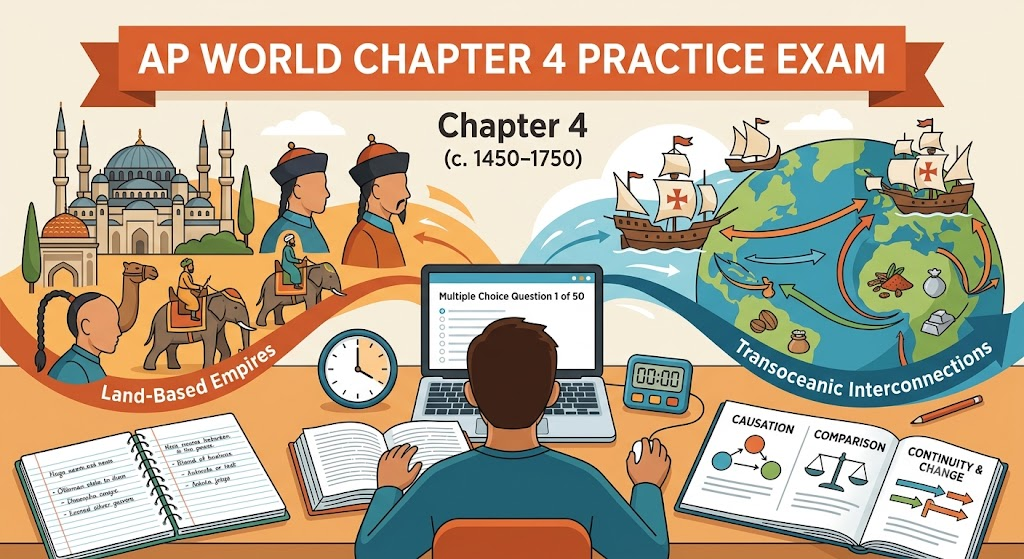
Additional Information
What the Course Entails and Exam Details
The "AP World History Practice Test Chapter 4" covers the key conceptual frameworks and historical developments of the early modern period, roughly corresponding to the AP World History: Modern course units on "Land-Based Empires" and "Transoceanic Interconnections" (c. 1450 – c. 1750).
The course syllabus, reflected in this practice exam, emphasizes understanding how empires across Eurasia and the Americas consolidated and expanded their power.
Key topics include the administrative methods and challenges of major Asian land empires such as the Ottomans, Safavids, Mughals, and Manchu.
Simultaneously, it delves into the rise of maritime empires, examining the causes, effects, and global interactions catalyzed by European oceanic exploration.
Students must also master content regarding the Columbian Exchange, including its profound environmental and demographic impacts, and the evolution of global economic systems, such as mercantilism and the creation of transoceanic labor systems.
What to Expect in the Final Exam
While "AP World History Practice Test Chapter 4" is a localized assessment, the final AP World History: Modern exam is a comprehensive standardized test administered by the College Board, structured to evaluate both historical knowledge and critical analytical skills.
The full exam is divided into two main sections with distinct sub-parts, lasting a total of three hours and fifteen minutes.
Section I begins with 55 stimulus-based Multiple-Choice Questions (MCQs), which must be completed within 55 minutes, accounting for 40% of the composite score.
This is immediately followed by Section I, Part B, which presents three Short-Answer Questions (SAQs) that students must answer in 40 minutes, contributing 20% to the total score.
Section II starts with the required Document-Based Question (DBQ), where students have 60 minutes to write an essay using seven provided primary source documents, weighing 25% of the total score.
The exam concludes with Section II, Part B, the Long Essay Question (LEQ), offering a choice from three prompts and requiring a reasoned historical argument in 40 minutes, contributing the final 15%.
There is no single official "passing score," as scores are reported on a 1–5 scale, with many colleges typically offering credit for scores of 3, 4, or 5.
Strict adherence to time limits and testing protocol is mandatory in authorized testing centers, typically located within high schools or authorized College Board partner locations.
How to Study and Exam Centers
Preparing effectively for the AP World History exam requires a multifaceted approach that goes beyond simple content recall to focus on critical historical thinking skills.
A foundational study strategy involves mastering the foundational historical reasoning processes: causation, comparison, and continuity and change over time, applying them to the key themes and regions.
Students should prioritize developing the specific skills demanded by the different exam sections, such as analyzing primary and secondary sources, constructing evidence-based arguments, and making complex historical claims.
Engaging with practice questions, specifically high-quality Multiple-Choice questions that mimic the exam's stimulus-based format, is essential; this localized "AP World History Practice Test Chapter 4" is excellent for targeted practice.
Furthermore, consistent practice with timed essay writing using official College Board free-response questions and rubrics is critical for the DBQ and LEQ components.
Forming study groups to peer-review essays and discuss difficult concepts can significantly enhance comprehension and retention.
Regarding taking the final exam, AP exams are administered globally in the month of May as scheduled by the College Board.
The test is a standardized paper-and-pencil assessment proctored primarily within high schools for students enrolled in the AP class or through a registered AP coordinator.
Students whose schools do not offer AP World History or independent learners can register with the College Board to take the exam at authorized local high schools or specific authorized testing centers, often coordinated with local school districts.
The specific exam centers and registration information can be found directly on the College Board website or through an AP program coordinator.
Job Opportunities from the Course
While AP World History and its constituent practice tests like the "AP World History Practice Test Chapter 4" are primarily academic stepping stones providing advanced content and skill-building that can earn college credit, they build a robust foundation for numerous engaging and high-level career paths across various sectors.
The course's heavy emphasis on critical reading, nuanced analysis of primary and secondary sources, making evidence-based arguments, and understanding global cross-cultural interactions is highly valued in fields that demand sophisticated critical thinking.
Success in AP World History can accelerate progress towards degrees in history, international relations, political science, sociology, anthropology, and related humanities and social science fields.
This foundational knowledge can lead to a diverse array of rewarding careers, including, but not limited to, High School History or Social Studies Teacher, Archivist, Museum Curator or Exhibit Designer, Historical Researcher or Preservationist, Political Analyst or Advisor, Foreign Service Officer or Diplomat, International Relations Specialist, Policy Analyst in governmental or non-profit organizations, Journalist focusing on global affairs, Author or Editor of historical content, and many research and analytical roles within libraries, cultural heritage organizations, and private companies.
Frequently Asked Questions
Reviews
5.0
Based on 0 reviews
Leave a Review
No reviews yet. Be the first to review!