
AP Psychology UNIT 9 Practice Test 2025 (Social Psychology)
$69.00
- Buy to unlock unlimited access to all Quiz questions.
- After purchase you can print a PDF of the whole quiz at any point. The PDF will contain the questions and the correct answers.
About this Exam
The AP Psychology Unit 9 Practice Test is an essential tool for high school students preparing for the official Advanced Placement (AP) Psychology Exam administered by the College Board. This comprehensive practice resource focuses specifically on Social Psychology, providing a targeted review of one of the most significant and engaging units in the curriculum. The practice test is designed to evaluate understanding of how individuals think, feel, and behave in social contexts, helping students gauge their readiness and identify areas for improvement before taking the actual exam. By simulating the format and rigor of AP Psychology questions, this practice test empowers students to build confidence and refine their test-taking strategies.
Ready to test your knowledge?
Buy Now to Access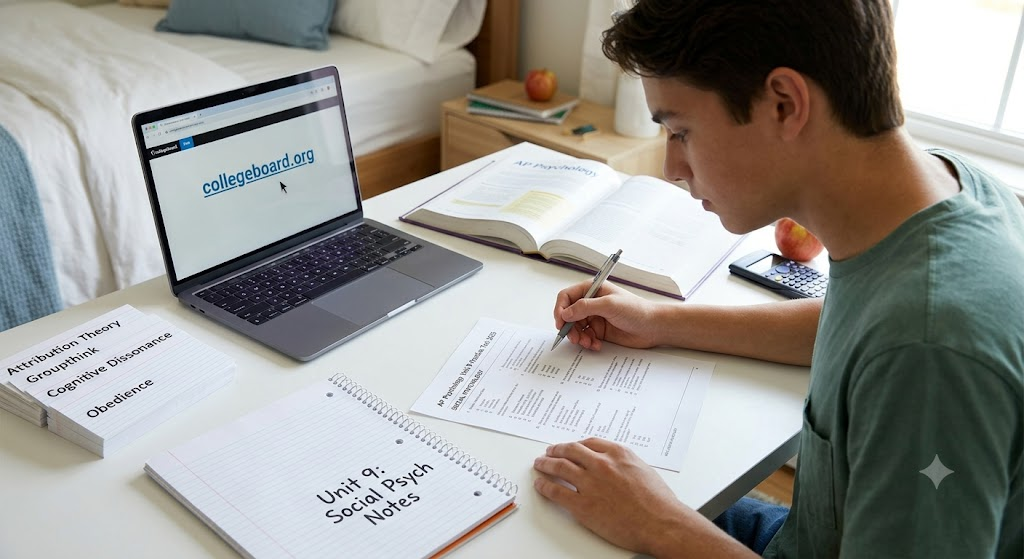
Additional Information
What the Course Entails and Exam Details
This practice test assesses mastery of the core concepts within Social Psychology as defined by the AP Psychology Course and Exam Description. Students can expect to encounter questions covering various foundational topics, including attribution theory, attitude formation, and the persuasive techniques used in social influence. The content deepens to explore group dynamics, such as conformity (as demonstrated in the Asch experiments), obedience (as studied by Milgram), and the powerful effects of social roles (exemplified by the Stanford Prison Experiment). Additional essential areas include prejudice and discrimination, stereotypes, altruism, aggression, and interpersonal attraction, ensuring a robust evaluation of a student’s ability to apply psychological principles to real-world social scenarios.
What to Expect in the Final Exam
While this practice test provides a vital benchmark, the definitive assessment is the official AP Psychology Exam held annually in May. The full exam consists of two main sections: a 100-question multiple-choice section that accounts for two-thirds of the score and is timed for 70 minutes, and a free-response section containing two questions worth one-third of the score, timed for 50 minutes. Students must demonstrate not only recall of key terms but also the critical thinking skills required to apply psychological theories to new situations and analyze complex social behavior. Success is typically defined as achieving a score of 3, 4, or 5 on the College Board's 5-point scale, which many colleges and universities accept for advanced placement or course credit.
How to Study and Exam Centers
Effective preparation for this Unit 9 practice test, and the subsequent AP exam, requires a strategic study plan. Utilize active recall methods by creating flashcards for crucial terms like cognitive dissonance, fundamental attribution error, and groupthink. Supplement these efforts with repeated practice on past multiple-choice questions to familiarize yourself with the question formats and time constraints. Reviewing sample free-response questions (FRQs) from previous AP exams is equally critical to master the skill of applying psychological concepts to scenario-based prompts. Collaborate with peers in study groups to discuss and debate social psychology theories, reinforcing understanding through collaborative learning. The actual AP Psychology Exam is administered globally on specified dates in May at authorized high schools and testing locations, and registration typically takes place through your school’s AP coordinator early in the academic year.
Job Opportunities from the Course
A strong performance on the AP Psychology Exam, often a direct result of thorough preparation with targeted practice tests, opens the door to numerous impactful career paths that value understanding human behavior in social contexts. Students who pursue higher education in psychology or related fields may find rewarding careers as:
Social Worker
Human Resources Manager
Market Research Analyst
Mental Health Counselor
Marriage and Family Therapist
Industrial-Organizational Psychologist
Community Health Worker
Public Relations Specialist
Sales Manager
Frequently Asked Questions
Reviews
5.0
Based on 0 reviews
Leave a Review
No reviews yet. Be the first to review!