
AP Psychology UNIT 7 Practice Test 2025 (Motivation, Emotion, and Personality)
$69.00
- Buy to unlock unlimited access to all Quiz questions.
- After purchase you can print a PDF of the whole quiz at any point. The PDF will contain the questions and the correct answers.
About this Exam
The AP Psychology Unit 7 Practice Test focuses on the fundamental principles of Motivation, Emotion, and Personality. This unit explores the internal drives that push human behavior, the complex biological and cognitive experiences of feelings, and the varied theoretical frameworks that explain consistent patterns of thoughts and actions over time. This exam is designed for high school students enrolled in an AP Psychology course who are preparing for the culmination of their year’s study: the official AP Psychology Exam in May. This unit test serves as a critical diagnostic tool, highlighting a student's strengths and weaknesses within this vital subsection of the psychology curriculum. It helps refine test-taking strategies and content mastery before the high-stakes final examination.
Ready to test your knowledge?
Buy Now to Access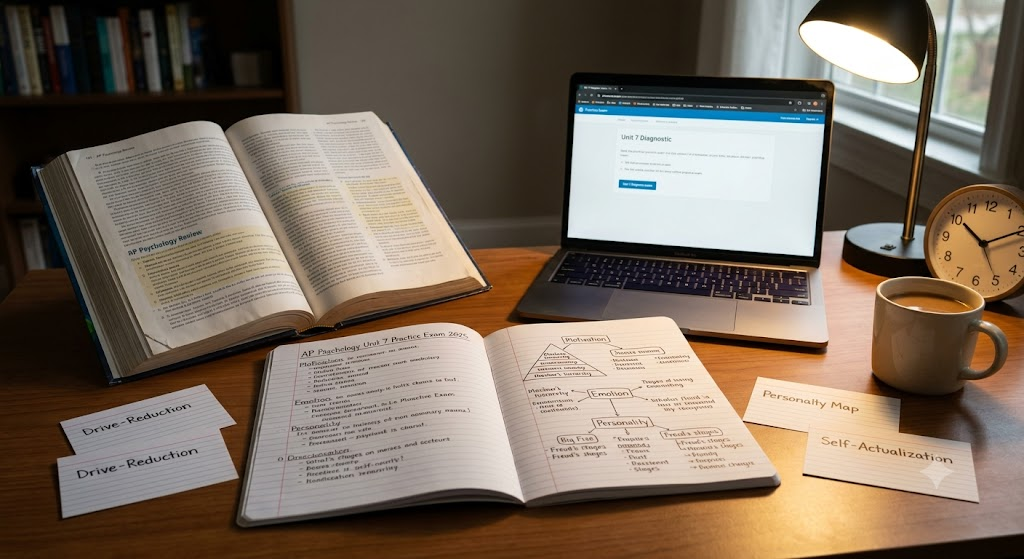
Additional Information
What the Course Entails and Exam Details
This unit encompasses several interrelated core areas of psychology. "Motivation" covers classical theories like drive-reduction, arousal theory, and optimal stimulation, as well as complex human drives such as hunger (including biological regulators like hypothalamus function), achievement, and sex. "Emotion" addresses the physiological, expressive, and cognitive components of feelings, exploring theories like the James-Lange, Cannon-Bard, and Schachter-Singer two-factor models, as well as cultural variations in emotional expression. "Personality" dives deep into different theoretical perspectives: Psychoanalytic (Freud's theories of the unconscious, id, ego, superego, and defense mechanisms), Psychodynamic, Humanistic (Rogers and Maslow's focus on self-actualization and unconditional positive regard), Trait (measuring personality dimensions like the Big Five), and Social-Cognitive (Bandura's reciprocal determinism). The course demands understanding how these theories are researched and applied. The exam requires the application of these specific definitions and theoretical frameworks to real-world scenarios.
What to Expect in the Final Exam
While a practice test for Unit 7 mirrors a section of the final AP Exam, the official College Board AP Psychology Exam (administered annually in May) is structured into two main sections: Section I consists of 100 multiple-choice questions, contributing 66.7% of the total score, with a time limit of 70 minutes. This section covers all units from the AP Psychology curriculum, meaning questions on Motivation, Emotion, and Personality will be interspersed throughout. Section II features 2 free-response questions (FRQs), contributing 33.3% of the total score, with a time limit of 50 minutes. The FRQs test a student’s ability to define concepts and apply them across different contexts, often requiring knowledge synthesis across multiple psychological domains. To pass and earn college credit, students must achieve a score of 3, 4, or 5 (on a 1-5 scale); policies on acceptable scores vary by university. Specific rules for test day are governed by the College Board, including the use of approved identification and a strict prohibition on electronic devices and outside resources during the test.
How to Study and Exam Centers
Effective studying for the AP Psychology Unit 7 Exam requires a strategic blend of content review and active practice. Students should first ensure a solid grasp of key terminology and major psychological theories (e.g., distinguishing between the James-Lange and Cannon-Bard theories, and knowing the facets of the Big Five personality traits). Creating concept maps that link these theories to specific studies or real-world behavior is highly beneficial. Utilizing the officially released AP Psychology course descriptions and practice exams from the College Board website is crucial for understanding the exact question format and difficulty level. Forming study groups to discuss and debate FRQ prompts helps build critical thinking skills. To take the official AP Psychology Exam, students must register through their AP coordinator at their high school, as these exams are generally administered at the school or a specific authorized testing site, such as a local convention center or college campus, arranged by the school district. Online-only versions are not the standard offering for AP Exams.
Job Opportunities from the Course
A strong performance on the AP Psychology exam can be an early step toward various careers that value psychological insights. While a single AP test does not license any specific career, the knowledge gained serves as a foundation for degrees and professions such as Clinical Psychologist, Counseling Psychologist, Psychiatrist, Social Worker, Human Resources Specialist, Market Research Analyst, Educational Consultant, Occupational Therapist, Neuropsychologist, and Forensic Psychologist.
Frequently Asked Questions
Reviews
5.0
Based on 0 reviews
Leave a Review
No reviews yet. Be the first to review!