
AP Psychology UNIT 4 Practice Test 2026
$69.00
- Buy to unlock unlimited access to all Quiz questions.
- After purchase you can print a PDF of the whole quiz at any point. The PDF will contain the questions and the correct answers.
About this Exam
The AP Psychology Unit 4 Practice Exam is an essential tool for high school students preparing for the official Advanced Placement (AP) Psychology examination administered by the College Board. Specifically, this unit test focuses solely on "Sensation and Perception," which represents approximately 12–16% of the total exam weight. It is designed for students enrolled in an AP Psychology course who are looking to assess their understanding of how humans input and process sensory information before moving on to broader concepts. Mastery of Unit 4 is critical because these foundational processes underpin almost all other psychological phenomena. A strong performance on this practice test helps identify knowledge gaps, reducing anxiety and increasing confidence for the final, comprehensive AP exam in May.
Ready to test your knowledge?
Buy Now to Access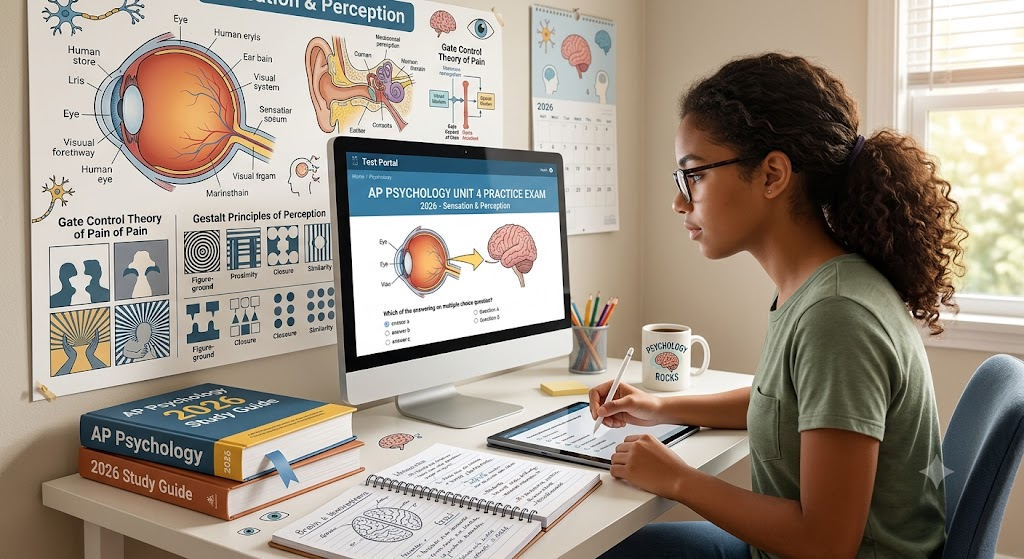
Additional Information
What the Course Entails and Exam Details
This unit delves into the biological and psychological processes that allow us to experience the world. The AP Psychology curriculum outlines the following core topics and learning objectives for Unit 4:
Introduction to Sensation and Perception: Understanding the distinction between sensation (input) and perception (interpretation).
The Science of Sensation: Exploring concepts like absolute threshold, difference threshold (Weber’s Law), signal detection theory, and sensory adaptation.
The Visual System: Detailed study of the eye’s anatomy, transduction, color vision theories (Trichromatic and Opponent-Process), and parallel processing.
The Auditory System: Examination of the ear’s structure, sound localization, and theories of hearing (Place Theory and Frequency Theory).
Other Senses: Understanding the mechanisms of gustation (taste), olfaction (smell), the vestibular sense (balance), kinesthesia (body position), and the somatosensory system (touch and pain, including Gate-Control Theory).
Perceptual Processes: Analyzing how we organize and interpret sensations, including bottom-up and top-down processing, Gestalt principles of organization, depth perception (monocular and binocular cues), and perceptual constancies.
What to Expect in the Final Exam
While the final AP Psychology Exam consists of two sections (a 100-question Multiple-Choice section and a 2-question Free-Response section), a dedicated Unit 4 Practice Test is typically optimized for focused review.
For this specific Unit 4 2026 Practice Test, you can generally expect:
Format: A concentrated multiple-choice section. It usually contains 30 to 50 high-quality multiple-choice questions (MCQs) strictly aligned with the Sensation and Perception curriculum. These questions often feature scenarios where you must apply definitions or identify biological structures (e.g., matching a function to the retina).
Scoring: There is no negative marking for incorrect answers on AP exams, encouraging you to answer every question. A "passing" score on a unit practice test is relative, but aiming for 75–80% correct is a strong indicator of readiness for that unit’s material on the final exam.
Time Limit: A standard 45–60 minute timeframe is typical for a practice exam of this size, simulating the pacing required for the final AP exam (where you have 70 minutes for 100 MCQs).
How to Study and Exam Centers
Actively Study for Unit 4
Visual Aids and Diagrams: Sensation and Perception is highly anatomical. Draw, label, and color-code diagrams of the eye and ear until you can identify every part and its specific function without hesitation.
Use Mnemonic Devices: Create acronyms or stories to memorize lists, such as the path of light through the eye (Cornea $\rightarrow$ Pupil $\rightarrow$ Lens $\rightarrow$ Retina $\rightarrow$ Optic Nerve) or Gestalt principles.
Practice with Real Application: Don’t just memorize definitions. Practice application questions where you are given a scenario (e.g., "A chef notices they can tell when one grain of salt is added to a soup, but not another.") and must identify the relevant threshold or principle.
Utilize AP Classroom: Access the official "Personal Progress Checks" on the College Board's AP Classroom portal for Unit 4. These contain actual past AP questions that provide the best simulation of the real exam’s difficulty and style.
Taking the Exam
For high school students, the official AP Psychology Exam is taken in a synchronized administration at their high school (or a designated local site arranged by their AP Coordinator) during the first two weeks of May. Registration and payment are handled through your school. Practice tests like this one are typically provided digitally through AP Classroom or as physical handouts by your AP teacher in a standard classroom setting. If you are a self-study or homeschooled student, you must arrange testing testing by contacting a local AP Coordinator before the fall deadline (usually mid-November).
Job Opportunities from the Course
A strong score on the AP Psychology Exam (usually a 3, 4, or 5) can grant college credit at many universities, allowing students to skip introductory courses. Furthermore, a background in sensation and perception is essential for specialized career paths. This knowledge opens doors to specific job opportunities and advanced study in fields such as:
Audiologist: A specialist who diagnoses and treats hearing and balance disorders (requires advanced degree).
Optometrist/Ophthalmologist Assistant: Supporting vision care professionals in measuring sensory input.
Human Factors Engineer/Ergonomist: Applying knowledge of perception to design user-friendly products and workplaces.
User Experience (UX) Researcher: Analyzing how users perceive and interact with digital interfaces.
Psychological Researcher (Perception Focus): Conducting studies in academic or government labs.
Neuroscientist: Investigating the biological mechanisms of sensory transduction.
Market Research Analyst: Understanding sensory marketing and consumer perception.
Special Education Teacher: Supporting students with sensory processing challenges.
Physical Therapist: Using knowledge of kinesthesia to aid rehabilitation.
Frequently Asked Questions
Reviews
5.0
Based on 0 reviews
Leave a Review
No reviews yet. Be the first to review!