
AP Psychology UNIT 3 Practice Test 2026 Development and Learning
$69.00
- Buy to unlock unlimited access to all Quiz questions.
- After purchase you can print a PDF of the whole quiz at any point. The PDF will contain the questions and the correct answers.
About this Exam
The AP Psychology UNIT 3 Practice Test 2026 Development and Learning focuses on the fascinating processes by which humans grow, adapt, and learn throughout their lives. It is designed specifically for students enrolled in Advanced Placement (AP) Psychology courses who aim to gauge their understanding before the official AP exam. This practice exam enables students to identify knowledge gaps, practice with realistic questions, and build confidence in key developmental and behavioral theories. Educators can use this tool to assess student progress in one of the course's most critical units.
Ready to test your knowledge?
Buy Now to Access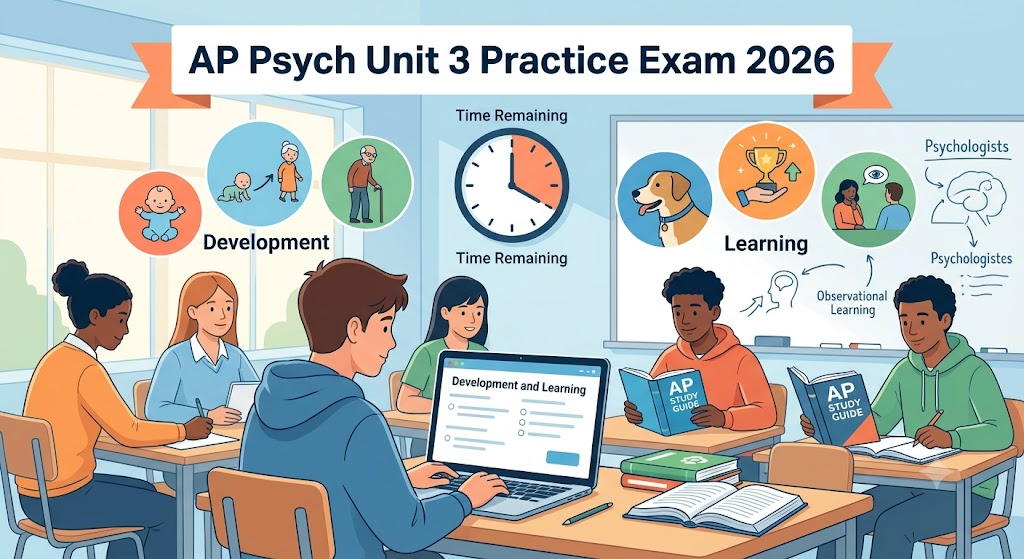
Additional Information
What the Course Entails and Exam Details
The "Development and Learning" unit covers fundamental psychological principles governing how individuals grow and adapt. It explores classical conditioning, operant conditioning, and observational learning. Key theories of lifespan development, including cognitive, physical, and socioemotional changes, are examined. Students analyze major developmental stages from infancy through adulthood, incorporating theories from psychologists like Jean Piaget, Erik Erikson, and Lev Vygotsky. The course also delves into cognitive development and moral development. It's a foundational unit for understanding human behavior and progression.
What to Expect in the Final Exam
This practice test focuses on Unit 3 topics and usually mirrors the structure of AP exam questions on those specific areas. Expect a mix of multiple-choice questions that assess conceptual knowledge, application of principles, and analysis of behavioral examples related to development and learning. The duration of this specific practice session may vary, but it often allocates roughly one minute per multiple-choice question. While this practice doesn't confer a 1-5 score like the final AP exam, aiming for high accuracy (e.g., above 80%) on this content is an excellent goal. It helps build speed and recall for the actual test. No specific physical rules apply to this practice, but simulation of exam conditions is recommended.
How to Study and Exam Centers
The most effective way to prepare is to take multiple practice tests like this one under timed conditions. Actively review missed questions and understand the underlying reasons. Use flashcards for key terms, psychologists, and developmental stages. Practice free-response questions (FRQs) even for this single unit. Draw diagrams and flowcharts of classical and operant conditioning scenarios. Regarding exam centers, the official AP Psychology exam is administered primarily in authorized schools. Students take the test at their own high school, guided by their AP teacher and school test coordinator. Online options might exist but are typically overseen by authorized educational institutions. This specific practice test is a flexible tool for independent or class-based study, not a final certified exam location.
Job Opportunities from the Course
Mastering AP Psychology provides a solid foundation for degrees in fields such as psychology, education, neuroscience, and social work. Success in this course can be the first step towards a wide range of career paths. Common career opportunities that leverage this understanding include: Licensed Psychologist (Clinical, Counseling, School), Psychiatrist, Social Worker, Human Resources Specialist, Market Research Analyst, Occupational Therapist, Child and Family Social Worker, Marriage and Family Therapist, Community Health Worker, Guidance Counselor, and University Professor. This course is an essential stepping stone towards these impactful roles, emphasizing human behavior and growth.
Frequently Asked Questions
Reviews
5.0
Based on 0 reviews
Leave a Review
No reviews yet. Be the first to review!