
AP Psychology – Social Psychology Practice Test.
$69.00
- Buy to unlock unlimited access to all Quiz questions.
- After purchase you can print a PDF of the whole quiz at any point. The PDF will contain the questions and the correct answers.
About this Exam
This AP Psychology practice test is specifically designed to assess high school students' understanding of social psychology, a crucial and engaging unit within the broader AP Psychology course.
Understanding how individuals think about, influence, and relate to others is foundational for students preparing for the official AP exam.
This practice test provides a vital self-assessment opportunity, allowing students to gauge their mastery of key concepts and identify areas for improvement before the high-stakes final exam.
It is for high school students enrolled in AP Psychology, particularly those who have completed or are currently studying the Social Psychology unit.
Ready to test your knowledge?
Buy Now to Access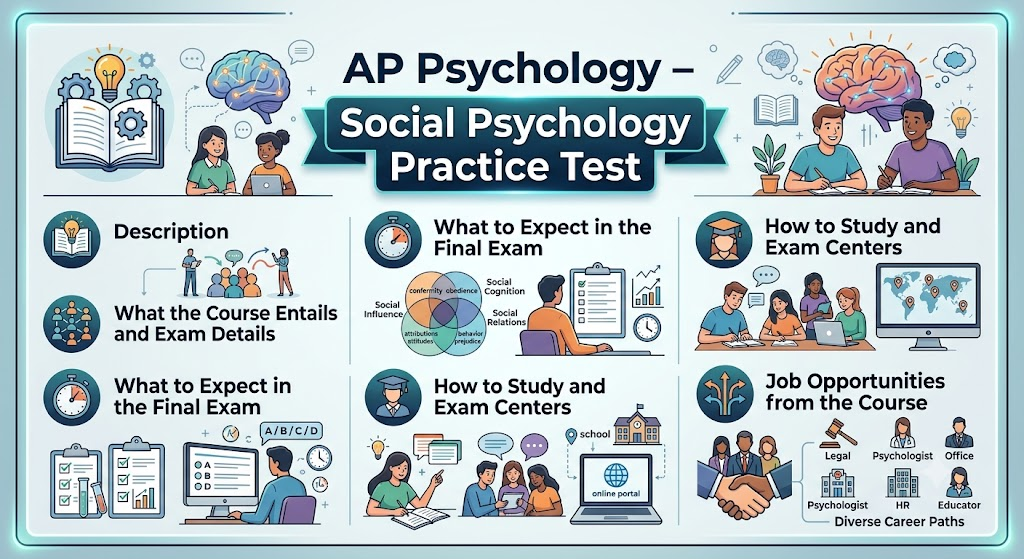
Additional Information
What the Course Entails and Exam Details
The Social Psychology unit within AP Psychology covers a range of captivating topics exploring social influence, perception, and interaction.
Specifically, it examines theoretical models and classic experiments in areas such as:
Social Influence: Conformity (Asch's studies), obedience (Milgram's research), compliance techniques, and group dynamics (social facilitation, social loafing, group polarization, groupthink).
Social Perception: Attribution theories (fundamental attribution error, self-serving bias), attitudes and attitude formation (cognitive dissonance, persuasion routes), stereotypes, prejudice, and discrimination.
Social Interaction: Aggression, altruism, and prosocial behavior, attraction (interpersonal relationships, factors), and environmental influences on social interaction.
This practice test is structured to mirror the types of multiple-choice questions students will encounter on the official AP exam, focusing entirely on this single, comprehensive unit.
What to Expect in the Final Exam
While a practice test, it aims to simulate aspects of the official AP exam environment to provide realistic preparation.
Expect a collection of multiple-choice questions covering all major themes in Social Psychology.
Each question will assess understanding of concepts, ability to apply theoretical models to real-world scenarios, and familiarity with landmark studies.
The time allowed and specific number of questions will vary by source, but typically, a unit-specific practice exam might feature 20-30 questions to be completed in 30-45 minutes.
Unlike the official AP Psychology exam, which includes both a multiple-choice section and Free Response Questions (FRQs) across all units, this practice exam likely focuses solely on assessable knowledge from the social psychology domain in multiple-choice format.
There is no official passing score for this practice test, as it serves as a study tool for the official exam, which uses a 1-5 scoring system.
The rules are flexible but adhering to realistic time constraints for practice is highly recommended.
How to Study and Exam Centers
Effective preparation for this social psychology practice test involves a multi-faceted approach.
Begin by deeply studying the relevant chapters in your AP Psychology textbook.
Employ active learning strategies:
Define all key terms and mechanisms within each major topic.
Create and review flashcards for concepts and famous experiments.
Practice explaining the studies of Asch, Milgram, Zimbardo, and others, including their findings and implications.
Apply social psychology principles to analyze everyday situations and historical events.
Form study groups to discuss concepts, test each other, and clarify challenging areas.
Crucially, take this specific practice exam under timed conditions, then thoroughly review every question you answered incorrectly, understanding the rationale behind the correct choice.
You can access additional practice tests from reliable sources like prep books, online educational platforms, or through your high school AP teacher.
Regarding centers: Official AP exams are administered at registered high schools.
However, this practice test is a flexible resource. You do not go to a formal exam center for a practice test unless your teacher arranges a specific session at school.
Typically, you will complete online practice exams from any computer with internet access, allowing for convenient study in the comfort of your own home or at school.
Job Opportunities from the Course
While this specific practice test doesn't "unlock" immediate jobs, a strong understanding of psychology is a powerful asset.
Excelling in AP Psychology and earning college credit is often the first step towards a degree in psychology, counseling, social work, or related fields.
The profound insights into social influence and human interaction gained from studying social psychology can pave the way for numerous diverse and rewarding career paths, such as:
Psychologist (after extensive graduate education and licensure)
Counselor (e.g., mental health, guidance, family)
Human Resources Specialist
Market Research Analyst
Social Worker
Public Relations Specialist
Educator
Community Outreach Coordinator
UI/UX Researcher
Frequently Asked Questions
Reviews
5.0
Based on 0 reviews
Leave a Review
No reviews yet. Be the first to review!