
AP Psychology – Sensation and Perception Practice Test
$69.00
- Buy to unlock unlimited access to all Quiz questions.
- After purchase you can print a PDF of the whole quiz at any point. The PDF will contain the questions and the correct answers.
About this Exam
Welcome to the most fascinating unit in your AP Psychology course! Sensation and Perception is where biology meets the mind, exploring how we take in the physical world and turn it into meaningful experiences.
This unit typically accounts for 6–8% of the total AP Psychology exam score. It is designed to test your understanding of the complex biological mechanisms (sensation) and psychological interpretations (perception) that allow us to interact with our environment. Mastery of these concepts is essential not only for the AP exam but also for understanding foundational principles of human behavior.
Whether you are a high school student aiming for a 5 or a self-study learner exploring psychology, this practice resource is tailored to help you evaluate your readiness and solidify your knowledge.
Ready to test your knowledge?
Buy Now to Access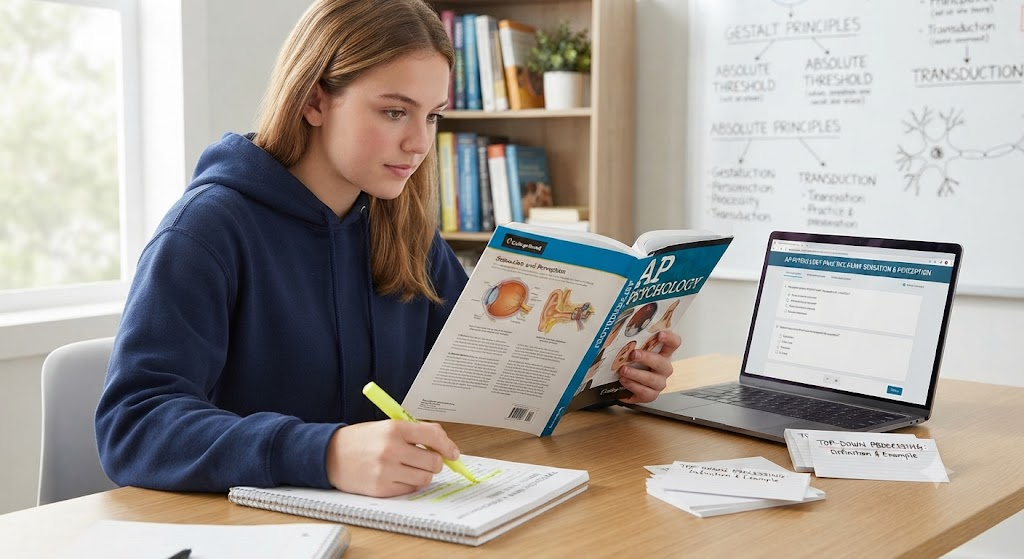
Additional Information
What the Course Entails and Exam Details
The AP Psychology Sensation and Perception unit requires students to move beyond simple definitions and apply complex concepts to real-world scenarios. The curriculum covers two distinct but interconnected processes.
Sensation (Bottom-Up Processing) This involves the biological processes by which our sensory receptors (eyes, ears, nose, skin) and nervous system receive and represent stimulus energies from our environment. Key topics include:
Thresholds: Understanding absolute thresholds, difference thresholds (Weber’s Law), and signal detection theory.
Sensory Mechanisms: Detailed study of the anatomy and function of the eye (vision) and ear (hearing), including transduction—the conversion of stimulus energy into neural signals.
The Other Senses: Understanding the chemical senses (taste and smell), the body senses (vestibular and kinesthetic), and touch/pain.
Perception (Top-Down Processing) This involves the mental processes of organizing and interpreting sensory input, enabling us to recognize meaningful objects and events. Key topics include:
Perceptual Organization: Gestalt principles of grouping (figure-ground, proximity, closure), depth perception (binocular and monocular cues), and motion perception.
Perceptual Interpretation: The critical role of perceptual set, context effects, and perceptual adaptation (such as wearing distorting glasses).
The Debate: Exploring the roles of nature vs. nurture in perception and the existence of phenomena beyond normal sensation (extrasensory perception or ESP).
What to Expect in the Final Exam
It is important to understand that there is no single, standalone "Sensation and Perception Exam" administered by the College Board. Instead, this unit is heavily integrated into the comprehensive AP Psychology Exam administered each May.
On the official AP exam, Sensation and Perception concepts will appear in:
Section I: Multiple-Choice Questions (MCQ)
You will have 1 hour and 10 minutes to answer 100 multiple-choice questions.
Approximately 6 to 8 of these questions will directly assess your understanding of Sensation and Perception.
The questions often require you to apply a concept (e.g., identifying which depth cue is used in a specific image) rather than just define a term.
Section II: Free-Response Questions (FRQ)
You will have 1 hour and 5 minutes to answer two FRQs.
One FRQ is typically a "Concept Application" question. This is a prime spot for Sensation and Perception terms to appear. You may be asked to define several terms (like rods, feature detectors, and vestibular sense) and then explain how each applies to a provided scenario (like a gymnast performing a routine).
There is no separate passing score for this unit. Your mastery is reflected in your total composite score (1–5) for the entire AP exam.
How to Study and Exam Centers
Preparing for the Sensation and Perception unit requires active learning and visualization. Rereading the textbook is rarely enough.
Actionable Study Strategies:
Create Visual Mnemonics: The eye and ear are loaded with specific vocabulary (cornea, iris, pupil, lens, retina, cochlea, basilar membrane). Draw diagrams and create mnemonic devices (e.g., "The hammer, anvil, and stirrup are the OSSicles—the Old Songs Sung").
Use Real-World Examples: For every term you study (e.g., sensory adaptation), immediately think of a personal example (e.g., getting used to the smell of a science lab after a few minutes).
Understand the "Vs.": Be very clear on the distinctions between sensation vs. perception, bottom-up vs. top-down processing, and rods vs. cones. These are favorite topics for AP examiners.
Take Practice Tests: Utilize released AP exams from the College Board, review books (like Barron’s or Princeton Review), and reputable online platforms (like Khan Academy or Albert.io). Focus specifically on quizzes categorized under "Sensation and Perception."
Official Exam Administration:
The AP Psychology Exam is not taken at a specific "exam center" like the SAT or GRE. It is administered on a designated date and time in May at authorized high schools worldwide. If your school does not offer AP courses, you must contact the College Board well in advance to locate a participating school near you that will allow you to test.
Job Opportunities from the Course
Success in AP Psychology, and specifically in understanding Sensation and Perception, is the first step toward a wide variety of dynamic and rewarding careers. While this single unit does not provide a professional qualification, it builds the foundation for advanced study in fields such as:
Audiologist: Diagnosing and treating hearing and balance problems.
Optometrist or Ophthalmologist: Examining, diagnosing, and treating the eyes and visual systems.
Neurologist: Medical doctors specializing in disorders of the brain and nervous system (which process all sensation).
Human Factors Engineer/Ergonomist: Designing products, systems, and work environments to optimize human well-being and overall system performance (e.g., designing car dashboards or cockpit controls based on how we see and hear).
Psychophysical Researcher: Conducting scientific studies on the relationship between physical stimuli and mental phenomena.
Clinical or Counseling Psychologist: Utilizing knowledge of perception and sensation in therapies, such as treating sensory processing disorders or using exposure therapy for phobias.
Frequently Asked Questions
Reviews
5.0
Based on 0 reviews
Leave a Review
No reviews yet. Be the first to review!