
AP Psychology – Biological Bases of Behavior Practice Test
$69.00
- Buy to unlock unlimited access to all Quiz questions.
- After purchase you can print a PDF of the whole quiz at any point. The PDF will contain the questions and the correct answers.
About this Exam
Welcome to your comprehensive guide for mastering one of the most critical units in your AP Psychology course: Biological Bases of Behavior. This section of the curriculum is not only fascinating but also heavily weighted on the actual AP exam, typically accounting for 8–10% of the total multiple-choice questions.
This unit bridges the gap between biology and psychology, exploring how our physical bodies—specifically the brain, nervous system, and endocrine system—influence every thought, emotion, and behavior we exhibit. This practice guide is designed for high school students currently enrolled in AP Psychology who are looking to solidify their understanding of neuroanatomy, neurotransmission, and the intricate workings of the endocrine system. Whether you are preparing for a mid-term unit test or beginning your comprehensive review for the May exam, this resource will help you gauge your readiness and identify areas needing further study.
Ready to test your knowledge?
Buy Now to Access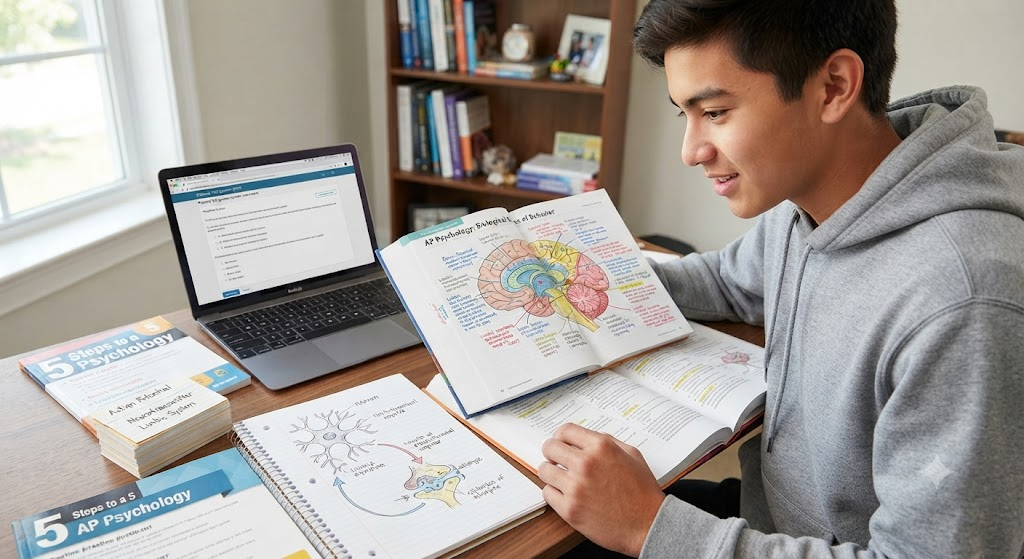
Additional Information
What the Course Entails and Exam Details
The Biological Bases of Behavior unit is foundational. To succeed, you must move beyond simple memorization and understand the function and interaction of biological systems. The College Board outlines the following core topics that you are expected to master for this section of the course:
The Nervous System and the Neuron: You must understand the structure of a neuron (dendrites, axon, myelin sheath, terminal buttons), the electrochemical process of neural firing (action potential, threshold, refractory period), and how neurons communicate across the synapse using neurotransmitters (such as acetylcholine, dopamine, serotonin, and endorphins). It is crucial to know the divisions of the nervous system (Central vs. Peripheral, and the further breakdown into Somatic, Autonomic, Sympathetic, and Parasympathetic).
The Brain: This is often the most complex sub-unit. You need to identify the structures and functions of major brain regions, organized by the "older brain" (medulla, pons, cerebellum, thalamus, reticular formation), the limbic system (amygdala, hippocampus, hypothalamus), and the four lobes of the cerebral cortex (frontal, parietal, temporal, occipital). Understanding lateralization (left vs. right hemisphere functions) and the role of the corpus callosum is also essential.
Tools for Examining the Brain: You must be familiar with the various methods psychologists use to study the brain, including lesioning, EEG, CT scans, PET scans, MRI, and fMRI.
The Endocrine System: This system works alongside the nervous system but uses hormones instead of neurotransmitters. You need to know the major glands (pituitary, adrenal, thyroid, pancreas, gonads) and their impact on metabolism, stress response, and growth.
Genetics, Evolutionary Psychology, and Behavior: This topic explores the influence of nature (genetics) versus nurture (environment). You should understand basic concepts like heredity, twin studies (identical vs. fraternal), and the principles of evolutionary psychology, including natural selection and reproductive success.
What to Expect in the Final Exam
While this guide focuses on the Biological Bases of Behavior Practice Test, it is important to understand how this content fits into the overall AP Psychology Exam. The AP Psychology exam is uniform across all test-takers and consists of two main sections:
Section I: Multiple Choice Questions (MCQs)
Number of Questions: 100
Time Allotted: 1 hour and 10 minutes
Weighting: 50% of the total exam score
Format: These questions are not simple definitions. They often require you to analyze a scenario, apply a biological concept (e.g., "Which neurotransmitter's reuptake is blocked by this medication?"), or interpret a diagram of the brain. Approximately 8–10 of these questions will specifically test your knowledge of the Biological Bases of Behavior.
Section II: Free Response Questions (FRQs)
Number of Questions: 2
Time Allotted: 50 minutes
Weighting: 50% of the total exam score
Format: One question is typically a "Concept Application" FRQ, which requires you to define psychological terms and apply them to a novel real-world scenario. The Biological Bases of Behavior unit is a very common source for these scenarios (e.g., asking how a specific brain injury or drug would affect the behaviors listed in the prompt).
Passing Score Requirements: There is no single "passing score." Colleges generally award credit or advanced placement for scores of 3, 4, or 5 on the 1-5 scale. The specific score required varies by institution.
Exam Rules:
You must bring valid photo ID and your AP Student Pack (provided by your school).
No electronic devices, smartwatches, or unauthorized aids are allowed in the testing room.
You cannot leave the testing room early.
How to Study and Exam Centers
To excel in this unit, passive reading of the textbook is insufficient. You must actively engage with the material.
Actionable Study Strategies:
Draw and Label: This is the single most effective way to learn neuroanatomy and brain structure. Do not just look at diagrams; draw them repeatedly from memory. Label the neuron, the synapse, the lobes of the brain, and the structures of the limbic system. Color-code these drawings to associate specific areas with their primary functions.
Use Mnemonics: The brain is full of complex names. Create memorable (even silly) mnemonics. For example, to remember the difference between Afferent and Efferent neurons, use "SAME": Sensory (Afferent), Motor (Efferent). For the lobes: "FPOT" (Frontal, Parietal, Occipital, Temporal).
Concept Mapping: Create large, interconnected diagrams that show the relationships between concepts. For instance, how does the Endocrine System interact with the Sympathetic Nervous System during the "fight-or-flight" response?
Utilize the "Biological Bases of Behavior Practice Test": Taking high-quality practice tests is essential. This specific practice test will expose you to the style, difficulty, and question types used by the College Board. After completing a practice test, meticulously review every question—not just the ones you got wrong. Understand why the correct answer is correct and, more importantly, why the other options are incorrect. This process clarifies common misconceptions.
Where and How to Take the Exam: You do not register for the AP exam independently. All AP exams are administered at authorized high schools, usually the same school where you are taking the AP course. Registration is typically handled by your school's AP Coordinator in the fall. If you are homeschooled or your school does not offer the course, your school's AP Coordinator can help you find a local school that is willing to administer your exam.
Job Opportunities from the Course
While the AP Psychology exam itself primarily unlocks college credit and placement, mastering the Biological Bases of Behavior is the first crucial step toward a wide array of exciting and lucrative career paths. This unit provides the foundational knowledge for professions that require a deep understanding of the connection between human biology and human behavior.
Neuropsychologist: These psychologists study the relationship between the brain and behavior, often working in clinical settings to assess patients with brain injuries or neurological disorders.
Psychiatrist (MD): Psychiatrists are medical doctors who specialize in mental health. They must have an extensive understanding of neurochemistry to diagnose disorders and prescribe medications that alter brain function.
Behavioral Neuroscientist: These researchers conduct laboratory experiments on the brain and behavior, often working in universities or pharmaceutical companies to develop new treatments for neurological and psychological conditions.
Clinical or Counseling Psychologist: While they focus more on therapy, these professionals must understand the biological factors that contribute to mental health conditions like depression, anxiety, and schizophrenia to provide effective treatment.
Cognitive Scientist: These researchers study how the mind works, drawing heavily on knowledge of brain anatomy and function to investigate processes like memory, perception, and language.
Frequently Asked Questions
Reviews
5.0
Based on 0 reviews
Leave a Review
No reviews yet. Be the first to review!