
AP Music Theory UNIT 4 Practice Test 2026
$69.00
- Buy to unlock unlimited access to all Quiz questions.
- After purchase you can print a PDF of the whole quiz at any point. The PDF will contain the questions and the correct answers.
About this Exam
The Advanced Placement (AP) Music Theory course is a challenging and rewarding program designed for motivated high school students who are passionate about understanding the inner workings of music. This course is ideal for students who aspire to deepen their musicianship, potentially earn college credit, or pursue future studies and careers in music composition, performance, education, or other related fields. Mastering the foundational elements and procedural rules of music is paramount to success. Unit 4, in particular, represents a critical step, shifting focus from individual chords to the essential principles of tonal harmony and voice leading. Understanding these core concepts is not only vital for succeeding on the overall AP Music Theory Exam but also builds the analytical and compositional skills used by musicians across centuries of musical tradition. A dedicated practice test for this specific unit allows students to solidify these critical concepts in a targeted environment, simulating real exam conditions for focused preparation.
Ready to test your knowledge?
Buy Now to Access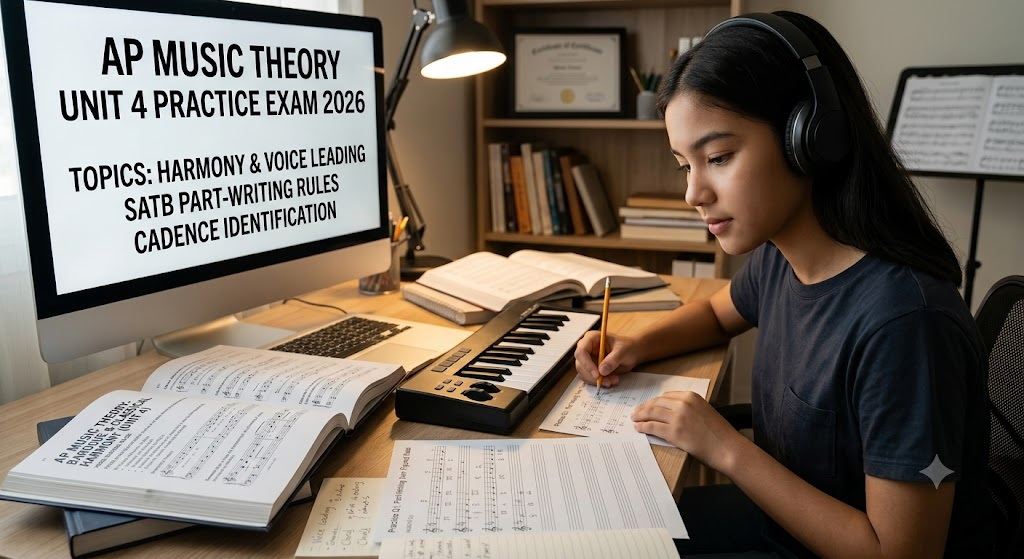
Additional Information
What the Course Entails and Exam Details
This comprehensive course spans an entire academic year, covering a wide range of topics that explore musical structure, harmony, rhythm, melody, and notation. Within this larger curriculum, Unit 4 focuses specifically on the foundational rules and procedures of 18th-century tonal harmony and voice leading. This crucial unit dives into how chords connect, what principles govern the motion of individual musical lines (voices), and how to effectively create, analyze, and understand harmonic progressions. You can expect to encounter and must master the following topics:
Principles of Voice Leading: Understanding and applying correct SATB (Soprano-Alto-Tenor-Bass) part-writing procedures, including proper doubling (preferring the root, avoiding doubling tendency tones), careful spacing between adjacent upper voices (within an octave), maintaining voice ranges, and avoiding common errors such as parallel perfect fifths and octaves, parallel unisons, direct fifths/octaves (in outer voices), and unresolved tendency tones.
Harmonic Function and Progressions: Recognizing and utilizing basic chord functions within a key: tonic (I), dominant (V), and predominant (ii, IV). Mastering common harmonic progressions and understanding the logic behind chord successions in the tonal system.
Chords in Inversion: Handling all diatonic triads and seventh chords in all their inversions correctly within progressions and part-writing.
Seventh Chords: Understanding the function, typical treatment, and resolution rules for chordal sevenths, particularly dominant seventh chords and diatonic sevenths.
Cadence Identification: Learning and recognizing the various harmonic formulas that create different degrees of closure or progression at the end of musical phrases: Perfect Authentic (PAC), Imperfect Authentic (IAC), Deceptive, Plagal, and Half cadences.
Harmonic Analysis: Analyzing given short musical excerpts (notated and/or performed) to identify chord quality, inversion, function, progressions, and cadence types, primarily within the scope of Unit 4 material.
Exam Details (Specific to a Unit 4 Practice Scenario):
While there is no standalone public "AP Music Theory Unit 4 Exam" for 2026, a comprehensive practice test for this unit will meticulously simulate the types of questions from the actual full AP exam that are relevant only to this content. A robust practice test for Unit 4 will generally include:
Multiple-Choice Questions: Targeted questions assessing your ability to visually analyze short musical examples, identify voice-leading errors, recognize correct harmonic progressions, determine chord qualities, functions, and cadences, and potentially answer foundational questions about Unit 4 concepts. These may or may not include audio stimuli in a real exam but a dedicated written practice test might focus on notated analysis.
Free-Response Questions (Written): This is where you will actively demonstrate your Unit 4 skills. Common free-response tasks simulating actual AP question types would involve:
Part-Writing from Figured Bass: Realizing a provided bass line with figured bass notation into correct four-part (SATB) vocal writing, strictly following all established voice-leading rules.
Part-Writing from Roman Numerals: Creating a four-part (SATB) harmonic progression based solely on a given sequence of Roman numerals within a specific key, again adhering to all rules of harmony and voice leading.
Harmonic Analysis: Accurately labeling the chords (Roman numerals and figured bass), identifying inversions, functions, and potentially cadences within a notated musical excerpt, focusing on the concepts from Unit 4.
What to Expect in the Final Exam
It's crucial to understand that your work in Unit 4 directly prepares you for the official AP Music Theory Exam administered in May 2026. This final, comprehensive exam covers the entire year's curriculum and significantly features Unit 4 material. The actual AP Music Theory Exam format is consistently structured into two main sections:
Section I: Multiple Choice (~1 hour 20 minutes)
This section accounts for 45% of your total score and consists of approximately 75 multiple-choice questions.
Questions will cover listening (aurally analyzing performed music) and non-listening (visually analyzing notated music) stimuli, terms, and conceptual knowledge.
A substantial number of questions, both with and without audio, will require you to analyze harmony, identify chords, functions, and progressions, and evaluate voice leading – directly drawing upon your Unit 4 mastery.
Section II: Free Response (Written & Sight-Singing)
This section accounts for 55% of your total score.
Section IIA: Written Free Response (~1 hour 10 minutes, 45% of total score): This involves seven specific questions:
2 Melodic Dictation
2 Harmonic Dictation
1 Part-Writing from Figured Bass (Directly assesses Unit 4!)
1 Part-Writing from Roman Numerals (Directly assesses Unit 4!)
1 Composition of a Bass Line/Harmonization of a Melody
Section IIB: Sight-Singing (~10 minutes, 10% of total score): This consists of two brief melodies that you will be asked to sing and record, primarily assessing melodic and rhythmic performance skills rather than direct harmonic/voice-leading rules application, though a deep sense of tonality and structure is always beneficial.
Passing Score: The AP exam is scored on a scale of 1 to 5, with scores of 3 or higher generally considered passing and often qualifying for college credit or advanced placement.
Time Limits: The total exam time is approximately 3 hours. A dedicated practice unit test will be significantly shorter, typically lasting around 45-60 minutes for a focused mock MCQ and FRQ section, designed to let you practice these specific types of questions within a controlled timeframe.
Rules: The official AP exam is administered under strict conditions at authorized testing centers. You will be provided with specific materials, no outside notes, books, electronic devices (except approved recording equipment for sight-singing), or external assistance are permitted. Practice tests should be taken under similar timed and self-sufficient conditions to best prepare you.
How to Study and Exam Centers
How to Study Effectively for AP Music Theory Unit 4:
Success in Unit 4 demands consistent, active practice and thorough understanding of the principles. Develop a focused study plan using these actionable strategies:
Active Practice is Paramount: Don't just read about the rules; do music theory. Dedicate significant time to daily part-writing exercises, realizing both figured bass and Roman numeral progressions. Feedback is essential, so have a teacher, knowledgeable peer, or reliable key check your work for errors.
Analyze, Analyze, Analyze: Routinely analyze short musical phrases from standard repertoire (hymns, classical examples) or practice excerpts. Practice labeling chords, identifying functions, and spotting potential voice-leading errors with the critical eye of an examiner.
Master the Rules systematically: Create clear, concise notes or flashcards for every voice-leading rule (doubling, spacing, parallels, tendency tones, etc.), chord function, seventh chord treatment, and cadence type. Consistently review these until they become second nature.
Utilize Dictation Practice: While harmonic dictation is a separate free-response task, practicing it alongside your Unit 4 study will enormously help you connect sound to rules and visualize harmonic progressions in your mind's ear, enhancing both your analytical and part-writing abilities. Use online dictation tools, apps, or have a friend play progressions for you.
Leverage Comprehensive Resources: Revisit your textbook chapters meticulously. Explore official College Board sample questions, scoring rubrics, and previous student responses (available on AP Central). Seek out reputable online platforms, practice sites, YouTube tutorials specific to voice leading and harmony, and consider using music notation software (like MuseScore, Sibelius, Finale) to write and check your voice leading – many have error-checking features.
Simulate Exam Conditions: Regularly incorporate timed practice sessions, especially for the FRQ types. Take a full-length practice Unit 4 test under realistic timed conditions without external aids to build stamina and confidence.
Exam Centers:
Practice Tests: You have flexibility! Practice tests can be administered within your AP class by your teacher, you can find them in review books or online, or you might choose to take them at home. The purpose here is learning and self-assessment, so take them in a quiet, dedicated environment.
Official AP Music Theory Exam: This is crucial. You cannot take the official May 2026 AP exam at home or just any public place. Registration is facilitated exclusively through your high school's AP coordinator or by contacting AP Services directly if your school doesn't offer AP exams. The actual exam will be administered at authorized physical testing locations, most commonly in designated areas within your own high school or a nearby participating school. These centers will follow standard AP testing protocols. Be sure to confirm all registration deadlines and specific testing locations with your school's AP coordinator well in advance.
Job Opportunities from the Course
A strong performance on the AP Music Theory Exam, underpinned by a comprehensive grasp of essential units like Unit 4, serves as a powerful foundation for continued music education and a gateway to diverse and fulfilling careers within the music industry. While the AP exam itself isn’t a direct job qualification, the rigorous understanding and analytical skills it demonstrates are highly valued. Here are some compelling career paths and job opportunities that this foundational knowledge, combined with further degree studies and experience, can unlock:
Music Educator: Inspire the next generation as a Band Director, Orchestra Conductor, Choir Director, General Music Teacher in elementary, middle, or high schools (requires a teaching degree/certification). Offer private music lessons in theory, composition, or an instrument.
Composer/Arranger: Create original music for film, television, video games, commercials, orchestras, bands, ensembles, or solo performers. Arrange existing pieces for different ensembles or modern contexts.
Music Director/Conductor: Lead and direct orchestras, opera companies, musical theater productions, choral groups, or other performing ensembles.
Music Professor/Theorist: Dedicate yourself to advanced music study, teaching at the college or university level (typically requires a doctoral degree). Research and publish in music theory and related fields.
Audio Engineer/Music Producer: Combine technical skills with musical understanding to record, mix, master, and produce music. Deep theory knowledge enhances communication with artists and improves production quality.
Music Therapist: Use music as a therapeutic tool to support individuals' physical, emotional, cognitive, and social needs (requires specialized training and certification/licensure). A strong theoretical foundation informs treatment.
Music Librarian/Archivist: Manage, organize, and curate vast collections of music scores, recordings, and historical documents in libraries, universities, or performance organizations (requires specific degrees/training).
Professional Performer: Excel in a performance career with a profound understanding of the music you play. This knowledge is equally valuable for songwriters who compose their own music.
Music Editor/Publisher: Work with music publishers to review, edit, transcribe, and publish sheet music, scores, and instructional materials, ensuring theoretical accuracy and clarity.
Sound Designer/Music Software Developer: Craft evocative soundscapes and effects for various media or contribute to the development of music notation, analysis, composition, or learning software, leveraging both technical and theoretical expertise.
Success in AP Music Theory proves you have the dedication, analytical ability, and foundational knowledge necessary to succeed in a demanding field and sets you apart as you embark on a fulfilling musical journey. Happy studying!
Frequently Asked Questions
Reviews
5.0
Based on 0 reviews
Leave a Review
No reviews yet. Be the first to review!