
AP Music Theory UNIT 3 Practice Test 2026
$69.00
- Buy to unlock unlimited access to all Quiz questions.
- After purchase you can print a PDF of the whole quiz at any point. The PDF will contain the questions and the correct answers.
About this Exam
Preparing for the AP Music Theory exam requires focused study, particularly on fundamental harmonic concepts. The AP Music Theory Unit 3 Practice Test 2026 is a targeted resource designed specifically for students taking the College Board's Advanced Placement Music Theory course. This practice exam is an essential diagnostic and preparation tool for those aiming for a high score on the actual test by mastering key components of harmonic analysis and part writing. It provides a realistic preview of the types of questions and difficulty level encountered in the core harmonic section of the full AP exam.
Ready to test your knowledge?
Buy Now to Access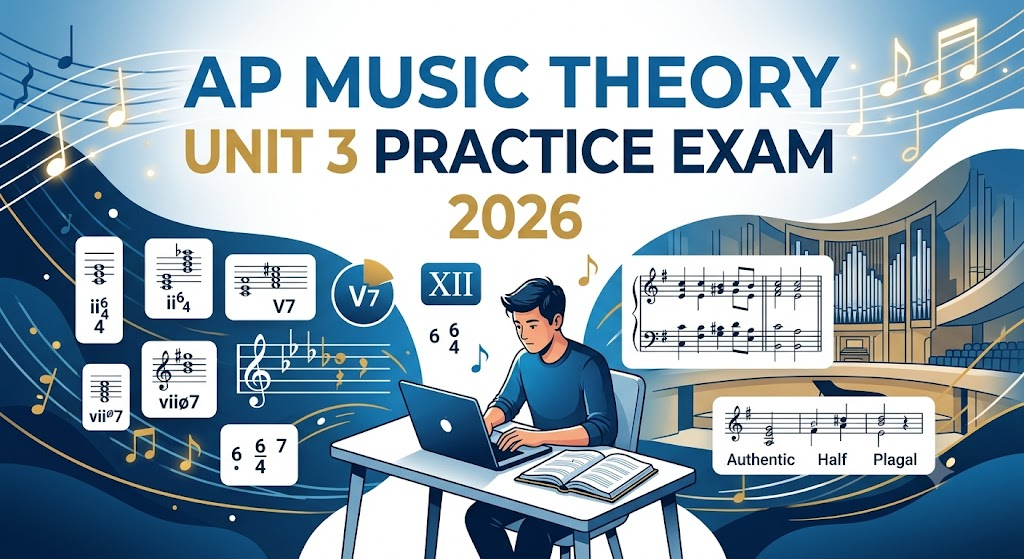
Additional Information
What the Course Entails and Exam Details
This practice exam focuses exclusively on the content covered in Unit 3 of the AP Music Theory syllabus, which builds the foundations for four-part harmony. Students can expect comprehensive coverage of:
Building Triads: Identifying, constructing, and writing major, minor, augmented, and diminished triads from any given pitch in any inversion.
Building Seventh Chords: Master the dominant seventh chord (Mm7) and other common seventh chord qualities like major-major (MM7), minor-minor (mm7), half-diminished (ø7), and fully diminished (o7).
Inversions and Figured Bass: Mastering the system of figured bass notation (e.g., 6, 6/4, 7, 6/5, 4/3, 4/2) to indicate specific chords and their positions.
Roman Numeral Analysis: Learning to label chords within a key to understand their harmonic function and relative relationships in a progression.
Identifying Cadences: Recognizing authentic, plagal, half, and deceptive cadences, which are critical for understanding musical phrases and structure.
Harmonic Function: Understanding the roles of chords within tonal progressions (e.g., tonic, dominant, subdominant).
Introduction to Voice Leading: Basic rules for smooth part writing and avoiding errors like parallel perfect fifths and octaves in initial exercises.
This specific practice test is not a comprehensive review of the entire AP course, but a targeted analysis of the crucial harmonic concepts introduced in Unit 3.
What to Expect in the Final Exam
While this is a practice test, understanding the format of the actual AP Music Theory Exam helps conceptualize its role. The full AP Music Theory exam features both Multiple-Choice and Free-Response questions, including aural dictation, part writing, and realization of figured bass.
A well-constructed practice exam for Unit 3 typically includes sections mirroring these formats to assess mastery of the specific content:
Multiple-Choice Questions: These will ask students to identify triad and seventh chord qualities, interpret figured bass, complete Roman numeral analysis of short excerpts, and recognize common chord progressions or errors in simple voice leading scenarios.
Simple Free-Response Items: A practice exam may also include shorter written exercises that require students to:
Construct a specific chord (e.g., a dominant seventh in second inversion) in a given key or from a pitch.
Provide Roman numeral analysis for a provided two-stave progression.
Fill in a bass line or melody to realize a set of figured bass symbols.
Unlike the full AP exam, where a score of 3 or higher on a scale of 1-5 is often considered "passing" for college credit, this practice exam is a learning and assessment tool. The time limit should be reasonable for the number of questions, designed to build pacing and confidence before the official testing day in May.
How to Study and Exam Centers
How to Study Effectively:
Master Fundamentals Instantly: Use flashcards for key, major/minor scales, intervals, triad types, and seventh chord types. Aim for instant identification of chord quality by both ear and eye.
Practice Chord Construction: Regularly write out triads and seventh chords in all qualities, inversions, and keys (using both accidentals and key signatures).
Become Fluent in Figured Bass and Roman Numerals: Practice realization of figured bass (writing out the implied parts) and analyzing existing examples using standard Roman numeral notation.
Listen to Harmony: Practice identifying cadences (Authentic, Half, Plagal, Deceptive) and simple progressions by listening. Tonal harmony is a crucial part of dictation skills on the full AP exam.
Utilize Past AP FRQs: Review older free-response questions focusing on figured bass and Roman numeral analysis, keeping an eye on the rules of good voice leading even at this early stage.
Where to Take the Practice Exam:
Students typically access AP Music Theory Unit 3 Practice Tests in several ways:
In-Class Assessments: Many AP Music Theory instructors administer dedicated unit practice exams to monitor student progress and adjust instruction before larger reviews.
Online Learning Platforms: Various educational websites, commercial test preparation services, and often online sections of textbooks offer interactive practice exams specifically designed for AP Music Theory.
Official College Board Resources: While the College Board releases full past exams, practice for individual units can sometimes be found in AP Classroom or materials shared by certified instructors.
(Note: The actual full AP Music Theory exam is administered officially in May at authorized schools and test centers worldwide, and in some cases, via supervised online portals as determined by the College Board.)
Job Opportunities from the Course
A strong performance on the AP Music Theory exam, supported by mastering the core principles of Unit 3, can lead to college credit and placement in advanced theory courses. For students pursuing careers in music, this course provides an indispensable foundation. AP Music Theory is a stepping stone toward several diverse career paths:
Music Educator/Teacher: High school, middle school, or private instructors. A thorough understanding of harmony is foundational for all music pedagogy.
Composer or Arranger: Creating original works or arranging existing ones for various ensembles requires a sophisticated grasp of music theory.
Audio Engineer or Producer: Understanding musical structures, harmonic function, and form is invaluable in the recording studio for effective mixing, editing, and production.
Music Director or Conductor: Directing choirs, bands, or orchestras requires profound knowledge of harmony and form to interpret music and provide meaningful direction.
Music Therapist: Theory knowledge helps design effective therapeutic interventions.
Music Theorist or Researcher: Focusing professionally on the history and structural analysis of music at a university level.
Session Musician: Deep understanding of chord changes and theory enables faster and more precise performance on varied projects.
Music Journalist or Critic: Providing insightful analysis of musical works in the public sphere.
This comprehensive study guide will help ensure you approach the AP Music Theory Unit 3 Practice Exam with confidence and clear understanding!
Frequently Asked Questions
Reviews
5.0
Based on 0 reviews
Leave a Review
No reviews yet. Be the first to review!