
AP Music Theory UNIT 1 Practice Test 2026
$69.00
- Buy to unlock unlimited access to all Quiz questions.
- After purchase you can print a PDF of the whole quiz at any point. The PDF will contain the questions and the correct answers.
About this Exam
The AP Music Theory Unit 1 Practice Test is designed to evaluate a student's foundational understanding of music fundamentals, serving as the first critical stepping stone toward success on the full Advanced Placement Music Theory Exam. This comprehensive practice assessment is tailored for high school students currently enrolled in an AP Music Theory course, as well as ambitious self-studiers aiming to validate their mastery of core concepts before advancing to more complex harmonic and melodic analysis. It focuses specifically on the elementary building blocks of music—pitch, rhythm, and meter—ensuring that learners have a robust framework in place. Taking this practice test helps students build confidence, identify specific knowledge gaps early in the year, and get acclimated to the rigor and question styles they will encounter on the official College Board exam in May.
Ready to test your knowledge?
Buy Now to Access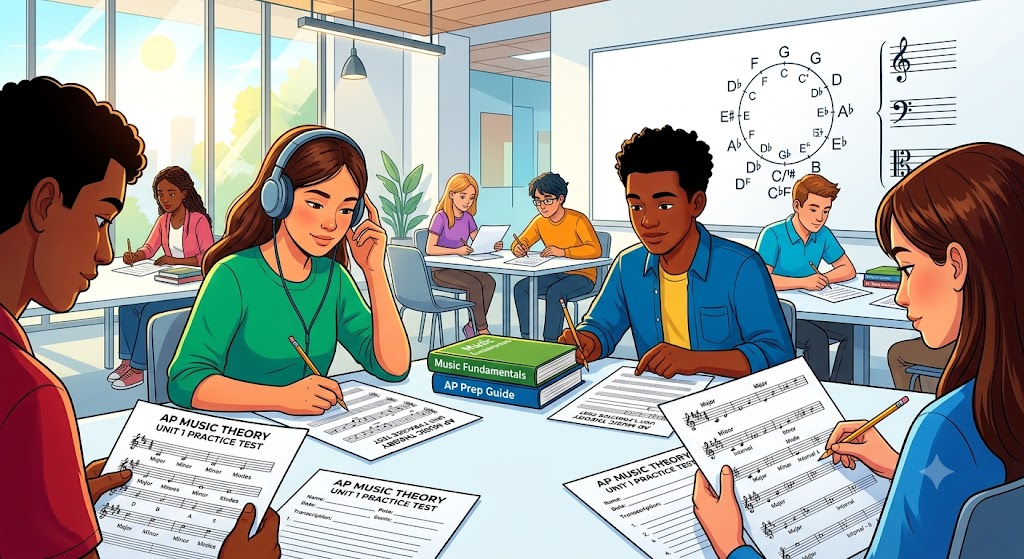
Additional Information
What the Course Entails and Exam Details
A Unit 1 practice test specifically targets the material covered in the introductory module of the AP Music Theory curriculum. The core topics tested typically include mastery of written and aural identification of pitch in treble, bass, alto, and tenor clefs; understanding simple and compound meters; and recognizing basic rhythmic patterns. Furthermore, students must demonstrate proficiency in constructing and identifying Major, minor (harmonic, melodic, and natural), and modal scales, as well as defining and recognizing various intervals (e.g., perfect, Major, minor, diminished, augmented). The practice exam itself usually mirrors a microcosm of the final AP structure, combining multiple-choice questions that test theoretical knowledge and score analysis with short free-response tasks like basic melodic or rhythmic dictation and fundamental part-writing exercises that assess the application of these foundational skills.
What to Expect in the Final Exam
It is important to understand that while this practice test focuses on Unit 1, the knowledge it assesses is fundamental to nearly every section of the complete AP Music Theory Exam. The final AP Exam, administered in May, is a rigorous assessment lasting approximately three hours and is divided into two main sections: Multiple Choice and Free Response. The Multiple Choice section (Section I) counts for 45% of the total score and tests a range of skills, including aural recognition of intervals, scales, and chords, and non-aural analysis of music theory concepts. Unit 1 content directly influences the difficulty of identifying these elements. The Free Response section (Section II) counts for 55% of the total score and requires students to demonstrate their skills in writing and analysis through aural dictation (melodic and harmonic), completing part-writing exercises based on figured bass or Roman numerals, and composing a bass line for a given melody. Mastery of Unit 1's scales, keys, and intervals is essential for success in all FRQs, as errors in fundamental pitch or rhythm notation can significantly impact scores. AP Exams are scored on a scale of 1 to 5, with 3 or higher generally considered a passing score eligible for college credit at many institutions. Specific passing requirements vary by college.
How to Study and Exam Centers
To prepare effectively for the AP Music Theory Unit 1 test, consistent and focused practice is required. Students should begin by reviewing notation fundamentals, key signatures, scales, and intervals until they are second nature, utilizing flashcards, mnemonic devices, and active recall techniques. Integrating ear training into daily study is crucial; use software, apps, or music theory websites to practice identifying intervals, scales, and simple rhythms by ear, as this skill is tested extensively in both multiple-choice and dictation questions. Regularly taking timed practice drills on specific concepts like building minor scales or identifying compound meters will build speed and accuracy. Reviewing textbook explanations and class notes on notation rules and common pitfalls is also recommended. The Unit 1 Practice Test itself is typically administered in-class by the AP Music Theory teacher as a benchmarking tool. When it comes to the official AP Music Theory Exam in May, students register and take the test at their own high school or a nearby authorized AP testing center designated by the College Board. It is not possible to take the official AP exam through private online portals or generic testing services; all registrations are handled through a student's school AP coordinator.
Job Opportunities from the Course
Success in AP Music Theory and subsequent advanced music studies opens doors to numerous diverse career paths within the music industry and related fields. Developing a profound understanding of music fundamentals through courses like AP Music Theory provides the bedrock needed for creative and analytical expertise in professional roles. Potential career paths and job titles include:
Musician (Instrumental or Vocal Performer)
Music Producer / Sound Engineer
Composer for Film, Video Games, or Theater
Music Teacher (K-12 or Private Studio)
Music Therapist
Music Critic / Journalist
Arts Administrator / Arts Management
Musicologist / Music Librarian
Conductor / Music Director
Arranger / Orchestrator
Frequently Asked Questions
Reviews
5.0
Based on 0 reviews
Leave a Review
No reviews yet. Be the first to review!