
AP Microeconomics Unit 2 Practice Test
$69.00
- Buy to unlock unlimited access to all Quiz questions.
- After purchase you can print a PDF of the whole quiz at any point. The PDF will contain the questions and the correct answers.
About this Exam
The AP Microeconomics exam is designed for high school students who wish to earn college credit by demonstrating proficiency in introductory microeconomic principles.
Unit 2, focusing specifically on Supply and Demand, is arguably the most critical foundation of the entire course.
It is tailored for students who want to build a rock-solid understanding of how markets operate and who are aiming for top scores on the final Advanced Placement test.
This practice exam will help you evaluate your knowledge and build confidence before the big day.
Ready to test your knowledge?
Buy Now to Access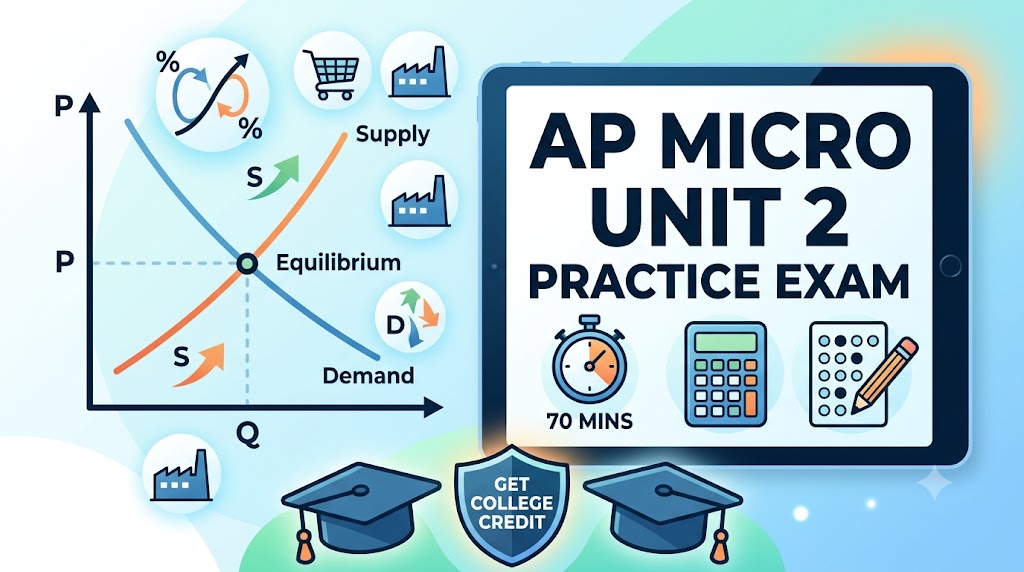
Additional Information
What the Course Entails and Exam Details
This Unit 2 curriculum delves deep into the core mechanisms that drive a market economy.
You will master the Laws of Supply and Demand and the critical difference between changes in quantity demanded/supplied versus shifts in the entire curves.
The course covers crucial concepts including equilibrium price and quantity, consumer and producer surplus, and the deadweight loss that occurs when markets are inefficient.
You will also learn to analyze market interventions like price ceilings, price floors, and the incidence of taxes.
A significant portion of the unit is dedicated to calculating and interpreting the various types of elasticity—price, income, and cross-price.
Understanding these concepts is non-negotiable for success in later units, particularly when studying different market structures.
What to Expect in the Final Exam
While this is a Unit 2 practice resource, it is designed to mimic the rigor of the actual College Board AP Microeconomics Exam.
The final AP exam is a two-part, 2-hour and 10-minute test.
Section I contains 60 multiple-choice questions that account for 66% of your total score and must be completed in 1 hour and 10 minutes.
Section II is the free-response section, which lasts 1 hour and consists of one long question and two short questions, making up 33% of your score.
A minimum score of 3 is generally required to receive college credit, though many competitive universities look for a 4 or 5.
Keep in mind that calculators are permitted for the entire exam.
How to Study and Exam Centers
The key to mastering Unit 2 is practice and application, not simply memorizing definitions.
Start by sketching graphs repeatedly. You must be able to visualize and correctly label every shift and intervention (e.g., shifts vs. movements, price controls, taxes).
Utilize official College Board resources, including past Free-Response Questions (FRQs) from their website, as they offer the best insight into the expected level of analysis.
Actively solve numerical problems involving elasticity, surplus, and tax calculations.
When you are ready, you cannot take the final AP exam online.
It is administered every May in physical authorized schools or designated testing centers.
You must register for the exam through your high school's AP coordinator. If your school does not offer AP, you must contact another local AP school to see if they can accommodate you as an "outside student."
Job Opportunities from the Course
AP Microeconomics isn't just about high school credit; it's your gateway to a vast array of business and analytical career paths.
While further college study is necessary for most professional roles, the analytical mindset you develop is prized across multiple sectors.
This knowledge base can unlock a variety of specific job titles and career paths:
Economist (including government, private sector, and research roles)
Financial Risk Analyst
Data Analyst
Financial Planner or Consultant
Accountant or Auditor
Economic Researcher
Investment Analyst
Actuary
Pricing Analyst
Business Intelligence Analyst
Policy Analyst
Supply Chain Manager
Market Research Analyst
Frequently Asked Questions
Reviews
5.0
Based on 0 reviews
Leave a Review
No reviews yet. Be the first to review!