
AP Gov – Supreme Court of the United States (SCOTUS) Cases Practice Test
$69.00
- Buy to unlock unlimited access to all Quiz questions.
- After purchase you can print a PDF of the whole quiz at any point. The PDF will contain the questions and the correct answers.
About this Exam
Mastering the required Supreme Court (SCOTUS) cases is a non-negotiable step for any student aiming for a top score on the Advanced Placement (AP) United States Government and Politics exam. This specialized practice test is meticulously designed to isolate and reinforce your understanding of the 15 landmark cases specified by the College Board. By focusing exclusively on this critical component, you will build the analytical skills needed to not only identify case facts, but to master the complex reasoning and constitutional comparisons that are the hallmark of high-scoring Free-Response Questions (FRQs). This guide is for determined high school students and independent learners seeking to turn a daunting list into a powerful academic advantage.
Ready to test your knowledge?
Buy Now to Access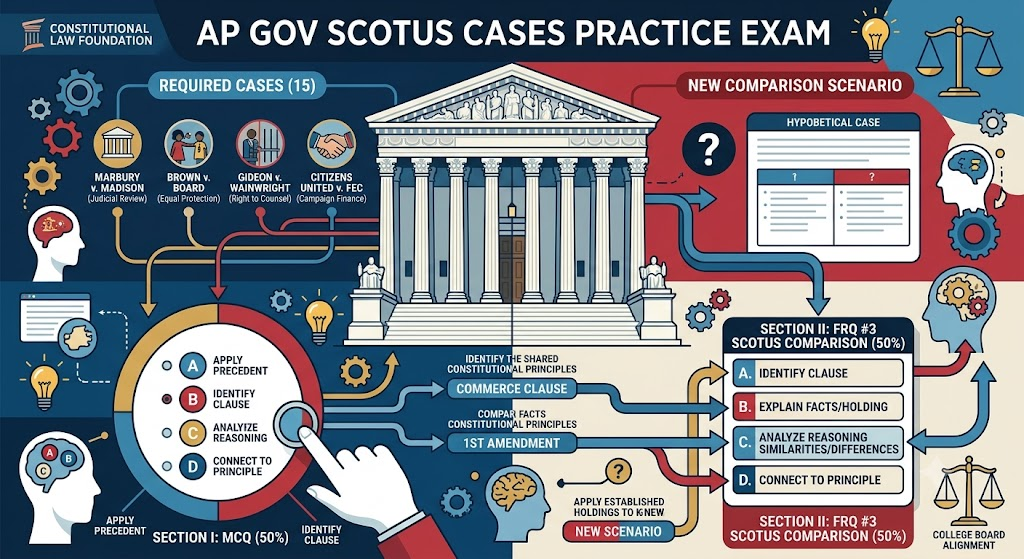
Additional Information
What the Course Entails and Exam Details
Your comprehensive study should move beyond passive recall, demanding deep understanding of four key elements for every single required case: the essential facts and background, the primary constitutional issue(s) at stake, the final holding and legal precedent established, and, most importantly, the Supreme Court's majority reasoning. Our practice materials are structured around the 15 required cases, which cover fundamental themes:
Federalism and Federal Power: McCulloch v. Maryland (1819), United States v. Lopez (1995)
Civil Liberties and the Bill of Rights: Engel v. Vitale (1962), Wisconsin v. Yoder (1972), Tinker v. Des Moines (1969), Schenck v. United States (1919), New York Times Co. v. United States (1971), McDonald v. Chicago (2010), Gideon v. Wainwright (1963), Roe v. Wade (1973)
Civil Rights and Equal Protection: Brown v. Board of Education (1954)
Redistricting and Gerrymandering: Baker v. Carr (1962), Shaw v. Reno (1993)
Judicial Power and Electoral Process: Marbury v. Madison (1803), Citizens United v. Federal Election Commission (2010)
Your final exam in the AP course, a three-hour marathon, is split evenly. The 55 multiple-choice questions (MCQs) contribute 50% of your score, assessing your ability to apply and interpret these concepts across all course content.
What to Expect in the Final Exam
While a "SCOTUS Cases Practice Test" is an invaluable tool for dedicated practice, the actual final AP U.S. Government and Politics Exam administered by the College Board is where your knowledge is ultimately tested. This final exam has two distinct sections:
Section I: Multiple-Choice Questions (MCQs)
This section contains 55 multiple-choice questions and has an 80-minute time limit. Your knowledge of SCOTUS cases will be directly tested here through scenario-based application. You might be asked to select the precedent that most closely aligns with a new, hypothetical case, or identify the core constitutional clause used in a specific landmark ruling. This section is scored entirely by computer and accounts for 50% of your total composite score.
Section II: Free-Response Questions (FRQs)
This section is where your SCOTUS mastery truly shines. Over 100 minutes, you must answer four FRQs, which also contribute 50% to your final score. The crucial connection is FRQ #3: SCOTUS Comparison. In this highly structured 4-point question, you are presented with a new, non-required Supreme Court case summary. Your task is to: (A) Identify the constitutional clause common to both the new case and one of the 15 required cases; (B) Explain how the facts in the required case led to its holding; (C) Analyze similarities and differences in how the Court's reasoning is applied to both scenarios; and (D) Connect the case to broader course themes, like interactions between branches or impact on civil rights. Passing scores are on the College Board's 1 to 5 scale, with most colleges awarding credit or placement for a 3, 4, or 5.
How to Study and Exam Centers
Effective preparation for this high-stakes section requires an active and multifaceted approach. Do not rely solely on passive reading. Create a detailed 'Case Brief Card' for all 15 cases. This card should list, with precision, the: Case Name & Year, Facts, Constitutional Question, Holding (the Court’s actual rule), and the Reasoning. Group cases by theme, comparing McCulloch vs. Lopez on federalism, or Engel vs. Yoder on religious freedom, to prepare for the FRQ comparison structure. Practice writing timed responses to past FRQ #3 prompts from the College Board website. Use our SCOTUS Cases Practice Test to simulate the high-pressure environment and identify areas for improvement.
The AP U.S. Government and Politics Exam is administered by the College Board and is typically taken at AP-authorized high schools and physical testing centers. For the specific practice tests, you can find them on our authorized online platform or through various educational resources and preparatory schools. Many students take the final AP exam in May, registered through their school's AP coordinator. Ensure you are familiar with the registration deadlines for both the course and the final exam through the College Board's official portal.
Job Opportunities from the Course
A strong understanding of constitutional law, the judicial system, and political analysis, which you develop by mastering these SCOTUS cases, provides an excellent foundation for a wide array of career paths. Success in AP Government can unlock advanced academic opportunities and, in the professional world, opens doors to positions in law, policy, advocacy, and communication, including:
Legal Field: Paralegal, Legal Assistant, Court Clerk, Compliance Officer, Conflict Resolution Specialist, Mediator. (Higher degrees, such as a J.D., lead to positions as Attorneys, Constitutional Lawyers, Judges, or Legal Analysts.)
Government and Public Policy: Legislative Analyst, Policy Advisor, Government Relations Manager, Congressional Staff Member, Political Scientist, Lobbyist, Campaign Manager.
Advocacy and Education: High School Teacher (Social Studies/Government), Political Organizer, Nonprofit Program Manager, Community Outreach Coordinator, Civil Rights Advocate.
Media and Communication: Political Journalist, Public Relations Specialist, Media Strategist, Communications Director (with an advocacy focus), Speechwriter.
By mastering these landmark Supreme Court cases, you aren’t just preparing for a test; you are gaining a lens to understand the ongoing conversation of American democracy, constitutional power, and the evolution of individual rights. Good luck!
Frequently Asked Questions
Reviews
5.0
Based on 0 reviews
Leave a Review
No reviews yet. Be the first to review!